

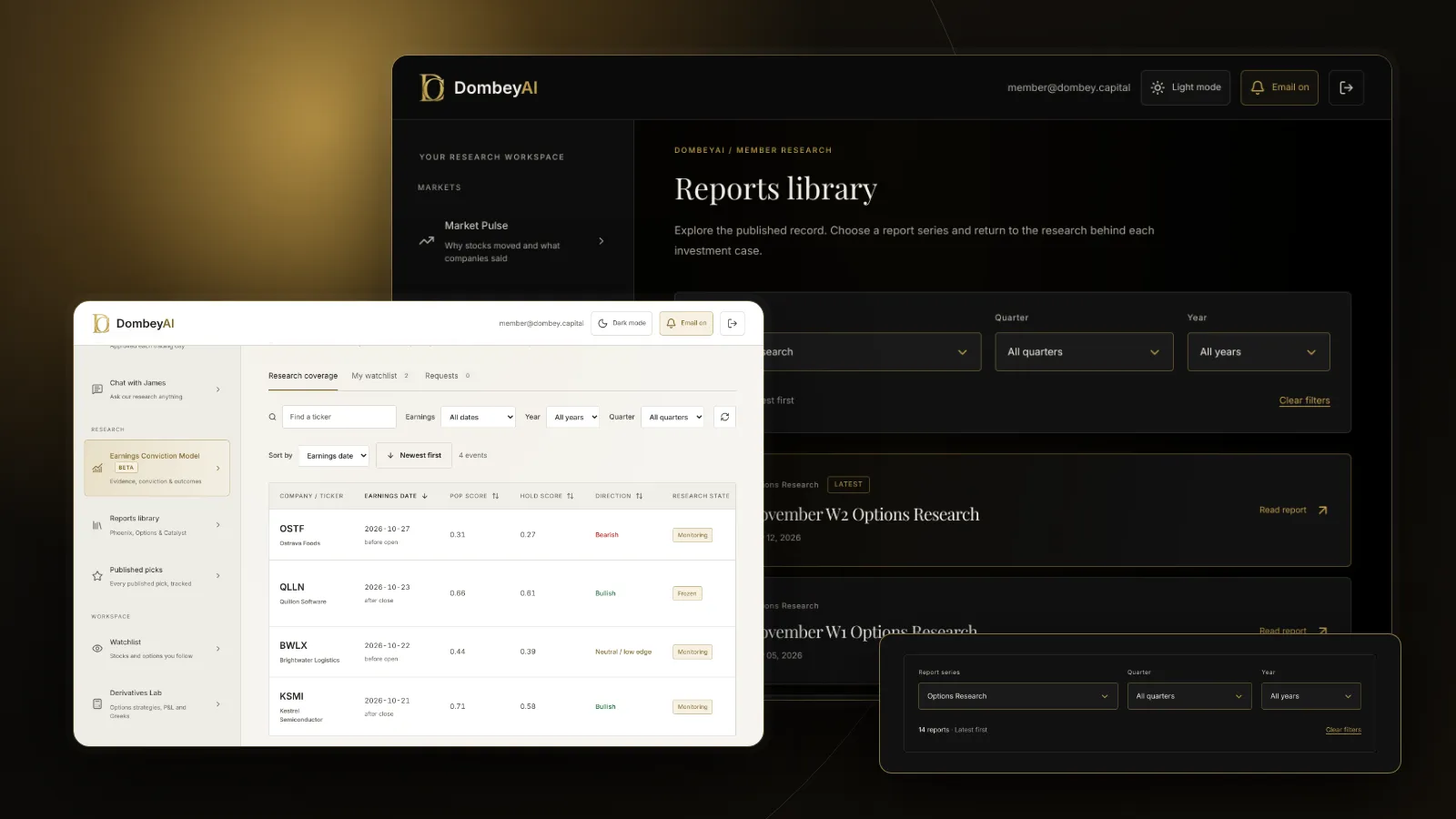

Full disclosure: Dombey Capital is our own research service and our top pick here, for the reasons below. The section on where it falls short is there so you can judge whether it fits your process.
Quick comparison
| Book or source | Best for | Key topics | Price (as of November 2026) |
|---|---|---|---|
| Dombey Capital (research, not a book)Top pick | Applying options to live dated catalysts | Weekly Options Research, weekly Phoenix Report, Catalyst Briefing, DombeyAI Portal | Founding Membership $1,200/year (annual only); Standard Access $80/year or $8/month; Public Archive free |
| Option Volatility and Pricing (Natenberg) | The first serious book on pricing | Pricing models, volatility, Greeks, spreads, risk | See the publisher's page |
| Options as a Strategic Investment (McMillan) | The strategy reference | Covered writing, spreads, ratio strategies, volatility trading | See the publisher's page |
| Volatility Trading (Sinclair) | Measuring and trading volatility | Volatility estimation, forecasting, event volatility, sizing | See the publisher's page |
| Trading Option Greeks (Passarelli) | How positions behave day to day | Delta, gamma, theta, vega, adjusting positions | See the publisher's page |
| Positional Option Trading (Sinclair) | Building trades with an edge | Sources of edge, trade structure, sizing, risk | See the publisher's page |
| Options, Futures, and Other Derivatives (Hull) | The textbook reference | Pricing models, binomial trees, volatility smiles, hedging | See the publisher's page |
| Dynamic Hedging (Taleb) | Professional risk management | Hedging, gaps, exotic risks, volatility surfaces | See the publisher's page |
Book prices change by edition, format and seller, so we point to the publisher rather than quote a figure.
How we compared these books
We compared these books from publisher descriptions, their tables of contents and how widely they are used in options education. We make no claims about trading results from following any of them.
| Criterion | Weight | What it measures |
|---|---|---|
| Event and volatility coverage | 30% | How directly the book helps price a move around a dated event |
| Practical method | 25% | Whether a reader can apply it to a live option chain |
| Accuracy and depth | 20% | How fully and carefully it treats pricing and risk |
| Readability | 15% | How accessible it is to a motivated non-professional |
| Durability | 10% | Whether the ideas hold up as products and markets change |
We weighted event and volatility coverage most, because the core question before a catalyst is whether the implied volatility in the chain is too high or too low for the event. If you weight mathematical depth more heavily, Hull and Taleb move up.
Quick picks by job
Best for applying options to live catalysts: Dombey Capital
Dombey's Founding Membership is written research: weekly Options Research, the weekly Phoenix Report, the Catalyst Briefing and the DombeyAI Portal with the Daily Phoenix Screener and the Earnings Conviction Model, plus valuation and execution analysis. It suits readers who have the frameworks from these books and want to see them applied to a dated catalyst, with each idea published before the event. Standard Access, at $80 a year, is the lower-cost option with the Biweekly Catalyst Briefing and the public research archive.
Best first serious book: Option Volatility and Pricing
Natenberg's book explains how options are priced, why volatility matters most and how the Greeks describe risk. Most professional training programs start here.
Best strategy reference: Options as a Strategic Investment
McMillan covers nearly every listed strategy, with chapters on spreads and volatility trading. Keep it on the desk and read the chapter you need.
Best for event volatility: Volatility Trading
Sinclair shows how to measure realized volatility, compare it with implied, and think about volatility around events. That comparison is the heart of realized vs implied volatility.
Best for position behavior: Trading Option Greeks
Passarelli explains how a position changes as the stock moves and time passes. It pairs well with our page on the option Greeks.
Best for building trades: Positional Option Trading
Sinclair's later book focuses on finding an edge, structuring trades and sizing them, a natural next step after Volatility Trading.
Best textbook: Options, Futures, and Other Derivatives
Hull's textbook is the reference for pricing models, including binomial trees and volatility smiles.
Best for professional risk: Dynamic Hedging
Taleb's book covers hedging in practice, including the gaps and jumps that standard models miss.
Full reviews
1. Dombey Capital
Written research on special situations, with weekly Options Research for Founding Members. Best for readers who want to see option pricing applied to dated catalysts. Founding Membership is $1,200 a year, annual billing only; Standard Access is $80 a year, or $8 a month on monthly billing; the Public Archive is free.
Pros
- Applies option pricing to live, dated catalysts
- Ideas published before the event, kept in the archive
- Free Public Archive to judge the work first
Cons
- Not a textbook; it assumes you know the basics
- Narrow coverage, focused on special situations
- Short public history
Verdict: The best companion to these books for event-driven investors who want the methods applied to current situations.
2. Option Volatility and Pricing
Natenberg covers pricing models, volatility, the Greeks, spreads and risk management in a clear, structured way. Best as the first serious book. See the publisher's page for price.
Pros
- Clear explanations of volatility and pricing
- Widely used in professional training
- Practical examples throughout
Cons
- Long, and slow for complete beginners
- Little on catalyst calendars or filings
Verdict: Read this first.
3. Options as a Strategic Investment
McMillan's reference covers covered writing, spreads and volatility trading. Best as a desk reference. See the publisher's page for price.
Pros
- Covers nearly every listed strategy
- Strong sections on volatility trading
- Useful index for looking things up
Cons
- Very long
- Some product details date with each edition
Verdict: The book to consult before putting on an unfamiliar structure.
4. Volatility Trading
Sinclair covers volatility measurement, forecasting and trading, including around events. Best for readers focused on whether options are cheap or expensive. See the publisher's page for price.
Pros
- Direct treatment of realized against implied volatility
- Practical on measurement and sizing
- Relevant to event trading
Cons
- Assumes the basics from Natenberg
- Some quantitative sections
Verdict: The second book for anyone trading catalysts.
5. Trading Option Greeks
Passarelli explains delta, gamma, theta and vega through trading examples. Best for understanding how a position behaves over time. See the publisher's page for price.
Pros
- Practical and readable
- Strong on adjusting positions
Cons
- Less on why volatility is mispriced
- Overlaps with Natenberg
Verdict: A practical companion to the first two books.
6. Positional Option Trading
Sinclair's later book covers sources of edge, trade construction and sizing. Best after Volatility Trading. See the publisher's page for price.
Pros
- Focus on edge and sizing
- Honest about what does not work
Cons
- Assumes prior options knowledge
- Less on single-stock events
Verdict: A useful step from understanding options to building trades.
7. Options, Futures, and Other Derivatives
Hull's textbook covers pricing theory across derivatives. Best as a reference. See the publisher's page for price.
Pros
- The most complete treatment of pricing models
- Standard in university courses
Cons
- More math and breadth than most investors need
- Expensive in new editions
Verdict: A reference, not a first read.
8. Dynamic Hedging
Taleb covers hedging in practice, including gaps, jumps and the limits of models. Best for readers who already trade options and want to manage risk better. See the publisher's page for price.
Pros
- Strong on gaps and model limits
- Written from trading practice
Cons
- Dense and technical
- Aimed at professionals
Verdict: For advanced readers, especially those trading binary events where gaps dominate. Our page on bimodal outcomes covers why.
Where Dombey falls short
Dombey is not a textbook. It assumes you know how options work and focuses on a narrow set of special situations and dated catalysts. It is not a data terminal, the team is small, the author writes under a pen name and the public history is short. If you need to learn options from the ground up, start with Natenberg and the free OCC document.
Free vs paid
The free starting points are the OCC's Characteristics and Risks of Standardized Options, required before trading listed options in the US, the education pages from Cboe and the Options Industry Council, and Dombey's Public Archive. Libraries often carry Natenberg, McMillan and Hull. Paid books are a one-off cost; research such as Dombey's Founding Membership, $1,200 a year, or Standard Access, $80 a year, is ongoing.
How to choose
| Your situation | Pick | Add later when |
|---|---|---|
| You know calls and puts, nothing more | Option Volatility and Pricing | You start trading spreads: McMillan |
| You trade around earnings and catalysts | Volatility Trading | You want sized trades: Positional Option Trading |
| You want ideas applied to live events | Dombey Founding Membership | You want the theory: Natenberg |
| You hold positions for weeks | Trading Option Greeks | You add complex spreads: McMillan |
| You want the math | Options, Futures, and Other Derivatives | You hedge large books: Dynamic Hedging |
For tools that put this into practice, see the best options analysis tools for earnings and our guide on how to estimate an earnings move from options. For a wider comparison of research services, see Seeking Alpha vs Motley Fool vs Morningstar vs Dombey.
Where this goes wrong
Reading without practice is the common failure. Books explain how options are priced, but the lessons only stick when you watch a real chain before and after an event. The other failure is reading too many at once; pick one and finish it.
The bottom line
Our top pick is Dombey's Options Research for applying these ideas to live, dated catalysts, with a free archive to judge it first. For books, start with Natenberg's Option Volatility and Pricing, then Sinclair's Volatility Trading, and keep McMillan as the strategy reference. Add Passarelli for position behavior and Hull or Taleb when you want more depth. Pair every book with live option chains around real events.