

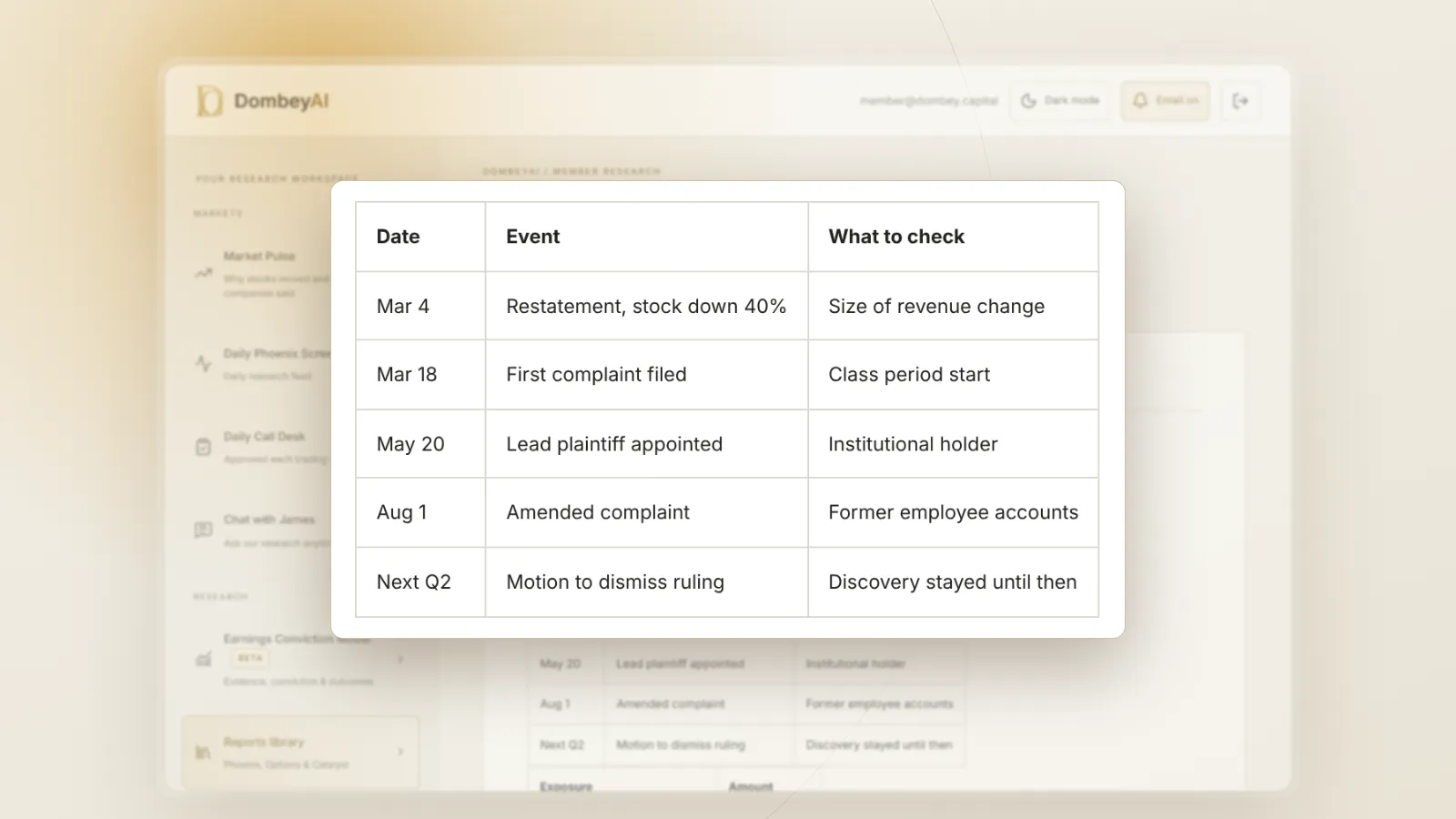
How a securities class action works
Most cases are filed under Rule 10b-5 of the Securities Exchange Act, which requires the plaintiffs to show a false statement, intent or recklessness, reliance, a loss and loss causation. Suits over an IPO or other offering often use Section 11 of the Securities Act, which does not require proof of intent for misstatements in a registration statement.
The Private Securities Litigation Reform Act of 1995 (PSLRA) sets the process:
| Stage | What happens | Typical timing |
|---|---|---|
| Stock drop | Bad news: a miss, a restatement, a short report, a failed trial | Day 0 |
| First complaint | A plaintiff firm files and publishes notice within 20 days | Days to weeks after the drop |
| Lead plaintiff | Investors have 60 days from notice to apply; the court picks one, often the largest holder | Months 2 to 4 |
| Amended complaint | The lead plaintiff files a fuller complaint | A few months later |
| Motion to dismiss | The company argues the complaint fails the PSLRA's pleading standards; discovery is stayed meanwhile | Often a year or more after filing |
| Discovery and class certification | Documents, depositions, expert reports on price impact | One to three years |
| Settlement or trial | Most surviving cases settle; few reach trial | Years after filing |
The stay of discovery during the motion to dismiss is the key feature. Plaintiffs cannot see internal documents until the court finds the complaint plausible, which makes the ruling the main dated event in the case.
What the filing means for the stock
Usually the drop comes first and the lawsuit follows. The press releases from plaintiff firms that appear after any large decline are a recruiting step, not new information. Treat them as noise unless they contain facts you did not already know.
What can move the stock:
- The motion to dismiss ruling. A dismissal removes an overhang. A denial means discovery, a higher settlement value and more management time spent on the case.
- New facts. The amended complaint can include statements from former employees. These can point to deeper problems.
- Related events. An SEC inquiry, a financial restatement, an auditor resignation or a CEO departure can arrive alongside the suit. These matter more than the suit itself.
- A settlement larger than insurance. If the company must pay from its own cash, the cost hits equity value directly.
Sizing the exposure
Plaintiffs measure damages by the price inflation over the class period times the shares bought during it, adjusted for shares sold. Headline damage estimates are usually far larger than settlements. The PSLRA also caps damages with a 90-day lookback: losses are measured against the stock's average price in the 90 days after the corrective disclosure, so a rebound reduces the claim.
Check the 10-K and 10-Q legal proceedings note, which describes the case and sometimes states that the company cannot estimate a loss. Our guide on how to read the footnotes in a 10-K shows where that sits. For a fuller method, see how to value a litigation outcome.
Reading the complaint
A complaint is an argument, not a finding, but it is useful. Read it for:
- The class period. Its start date marks the statement plaintiffs say was false.
- Confidential witnesses. Former employees describing what they saw. Specific, credible accounts carry more weight.
- Corrective disclosures. The dates plaintiffs say the truth came out. These line up with drops on the chart.
- Insider sales. Plaintiffs often cite sales during the class period to argue intent. Check them against Form 4 filings.
When a lawsuit is a special situation
Occasionally the gap between a stock's price and its value after the suit is large. A company with strong cash, adequate insurance and a business problem that has been fixed can trade as if the litigation were a much larger threat. The reverse also happens: a stock can bounce while the case is likely to surface a deeper problem. Our guide to how to evaluate a short seller report covers the second case, since many suits follow short reports.
Rule 10b-5 versus Section 11 cases
The two main types of securities class action differ in what plaintiffs must prove, and that changes how likely a case is to survive.
| Feature | Rule 10b-5 (Exchange Act) | Section 11 (Securities Act) |
|---|---|---|
| Covers | Statements made by the company at any time | Misstatements in a registration statement for an offering |
| Who can sue | Buyers during the class period | Buyers who can trace their shares to the offering |
| Intent | Plaintiffs must plead facts showing intent or recklessness | Not required for the company; defendants other than the issuer have a due diligence defense |
| Loss causation | Plaintiffs must show the truth coming out caused the loss | Defendants can reduce damages by showing other causes |
| Common triggers | Earnings misses, restatements, short reports, failed products | Busted IPOs, secondary offerings that fall soon after pricing |
Section 11 cases are easier to plead, which is why a stock that falls soon after an IPO or a secondary offering often draws one. Damages are capped at the offering price, and underwriters and directors can be defendants too.
Rule 10b-5 cases are harder. The PSLRA requires the complaint to state with particularity facts giving rise to a strong inference of intent, and courts dismiss a meaningful share of cases at that stage. The Supreme Court's decisions on reliance and price impact, starting with the fraud-on-the-market presumption in Basic v. Levinson in 1988, shape how classes are certified.
Where this goes wrong
- Treating the filing as news. Most filings follow a drop. Reacting to the press release means reacting to old information.
- Ignoring the business problem. The suit is a symptom. Lost customers, a broken product or weak controls drive value far more than the case.
- Assuming insurance covers everything. Policies have limits, retentions and exclusions, and other suits such as derivative or opt-out cases can add costs.
- Missing parallel actions. SEC or Department of Justice investigations can carry penalties outside the class action.
For the broader context on dated legal and corporate events, see what a stock catalyst is, and for live situations see Dombey's market coverage. Dombey's published research notes dated legal events when they drive a thesis; see the research archive.
The bottom line
A securities class action alleges that misstatements inflated a stock and seeks damages for investors who bought during the class period. The filing usually follows the drop rather than causing one. The motion to dismiss ruling is the main dated event, and settlements are often paid largely by insurance. Spend your time on what the case may reveal about the business and controls, because that is where most of the value is decided.