

How NOL shells come about
Most NOL shells are what is left after something went wrong. Common origins:
- A sale of the operating business that left the parent with cash and years of losses it could not use.
- An exit from bankruptcy in which creditors became shareholders and the losses survived, a situation covered in post-bankruptcy equities.
- A wind-down that stopped short of liquidation because the board judged the losses worth more as a platform than as a distribution. Our explainer on liquidation plays covers the alternative.
- A long run of losses in a business now too small to matter, kept public because the listing and the losses have option value.
The usual plan is for the shell to buy a profitable private business, using cash, new shares or a rights offering, so that the acquired business's profits are taxed little or not at all for years.
How the tax rules limit NOLs
Two sets of rules decide how much the losses are worth.
Carryforward rules. Under Section 172 of the Internal Revenue Code, federal losses from tax years beginning after December 31, 2017 carry forward indefinitely but can offset only 80% of taxable income in any year. Losses from earlier years generally carry forward for 20 years and then expire. State rules vary.
Section 382. If the company has an ownership change, defined as an increase of more than 50 percentage points in ownership by 5% shareholders over a rolling three-year testing period, its use of pre-change losses is capped each year. The cap is roughly the equity value of the company just before the change multiplied by the long-term tax-exempt rate the IRS publishes each month. If the company does not continue its business enterprise for two years after the change, the cap can fall to zero.
The practical effect is that a shell must raise capital and do deals without letting new 5% holders take too much of the company. That is why most NOL shells adopt a tax benefit preservation plan, a version of the rights plan described in what is a poison pill, or charter limits that stop anyone crossing 4.99% without board approval.
How to value an NOL
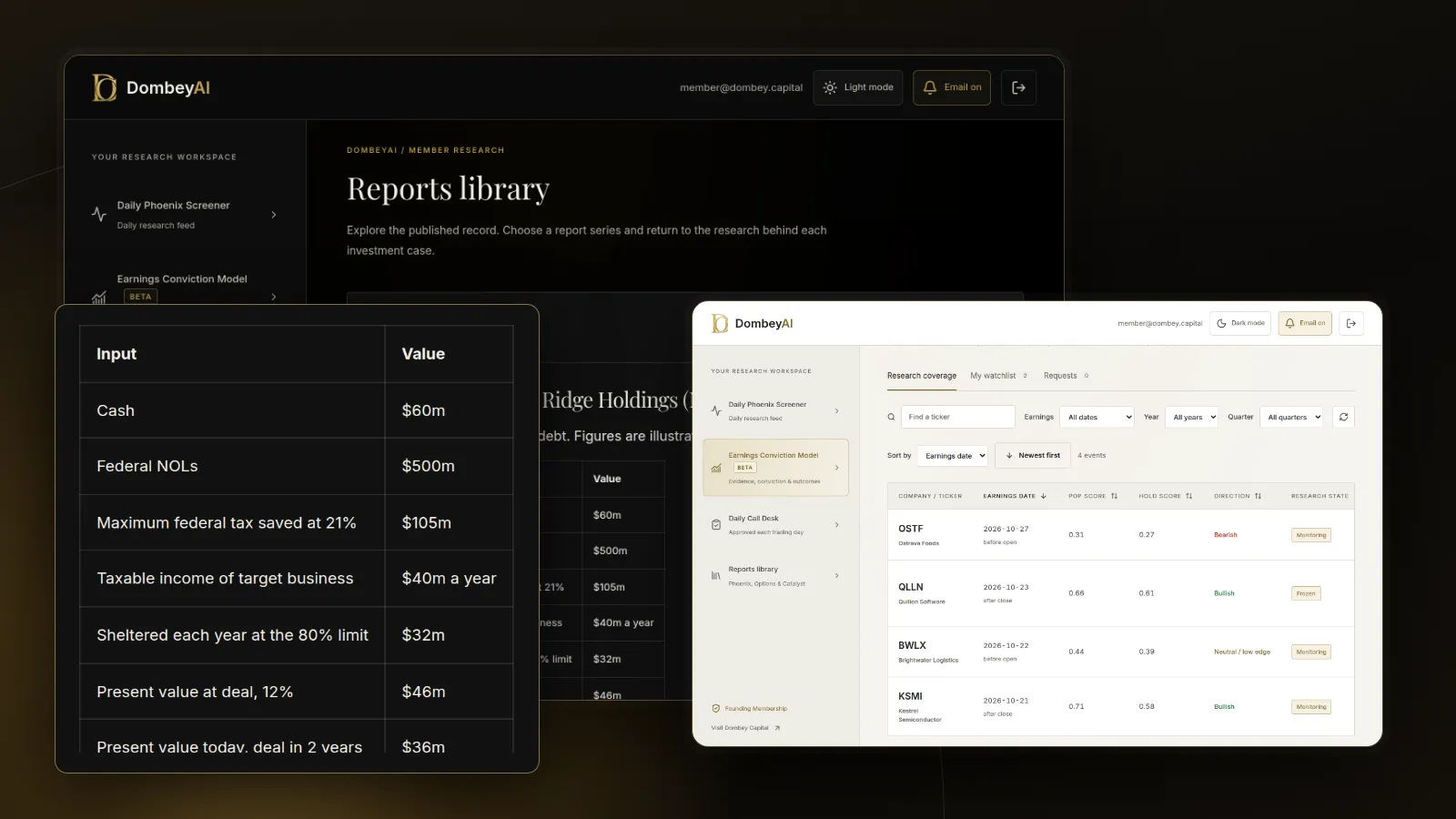
Face value is the wrong starting point. A dollar of federal loss saves at most 21 cents of federal tax at the current corporate rate, and only when there is income to offset. The value is the present value of those savings, weighted by the chance they happen.
The example shows why the market often prices the losses at a small fraction of face value. The probability-weighted valuation approach suits this kind of asset because the outcome is close to binary: a deal that uses the losses, or no deal.
| Input | Where to find it | What it changes |
|---|---|---|
| Gross NOLs and expiry years | Income tax footnote in the 10-K | How much can be used and how fast it runs out |
| Valuation allowance | Same footnote | Management's view of whether the losses will be used |
| Prior ownership changes | Tax footnote and risk factors | Whether old losses are already capped |
| Annual Section 382 limit, if any | Tax footnote | The speed of use after a change |
| Cash, debt and burn | Balance sheet and cash flow statement | How long the shell can wait |
| Protective measures | 8-K on the rights plan, charter | Who can buy a large stake |
Start with the shell's net cash per share and treat the losses as an option on top of it, not a substitute for it.
Reading the 10-K for an NOL shell
The income tax footnote is the core document. It shows the gross carryforwards, the deferred tax asset they create, and any valuation allowance against that asset. A full allowance means management does not currently expect enough taxable income to use the losses, which is normal for a shell. Our 10-K guide explains where the footnote sits.
Read the risk factors for any past ownership change and for the board's view of how close the company is to another one. Shells often disclose an estimate of the cumulative shift in ownership over the testing period.
Then read the proxy and the compensation tables. A shell's main cost is often its management, and the incentives of the people searching for a deal matter more than in an operating business.
What makes a good NOL shell deal
The acquisition decides everything. Questions to ask when a shell announces a deal:
- If the target earns steady taxable income in the US, the losses can be used; if its profits are abroad or uncertain, they may not be.
- If the deal is paid for with new shares, check that the issuance does not trigger an ownership change.
- If insiders or a sponsor take fees or a large stake, compare what they receive with the value of the tax savings.
- If the price paid for the target is high, the tax savings may only make a bad deal less bad.
The 10 best investing newsletters for special situations include several that follow shells, post-reorganization equities and similar small, overlooked situations.
Where this goes wrong
NOL shells disappoint in familiar ways.
- No deal. Years pass, cash is spent on salaries and search costs, and the losses start to expire.
- A poor acquisition. The search for a business that can use the losses leads to overpaying for one that cannot earn its cost of capital.
- An accidental ownership change. Share issues, conversions or trading by large holders can trigger Section 382 and cap the losses before they are used.
- Counting state losses at face value. State rules differ and often limit or disallow carryforwards.
- Ignoring dilution. Raising capital to buy a business can leave existing holders with a small share of the savings.
Dombey's published research applies the cash-first view to small, overlooked equities; see the research archive.
The bottom line
An NOL shell is a public company whose main asset beyond its cash is a stock of tax losses that can shelter future profits. The losses are worth only the discounted, probability-weighted tax they save, which is usually far less than their face value, and Section 382 can cap them after an ownership change. Start from the cash, read the tax footnote and the protective measures, and judge management by the deal it is likely to do. The losses reward a good acquisition and do little to rescue a bad one.