

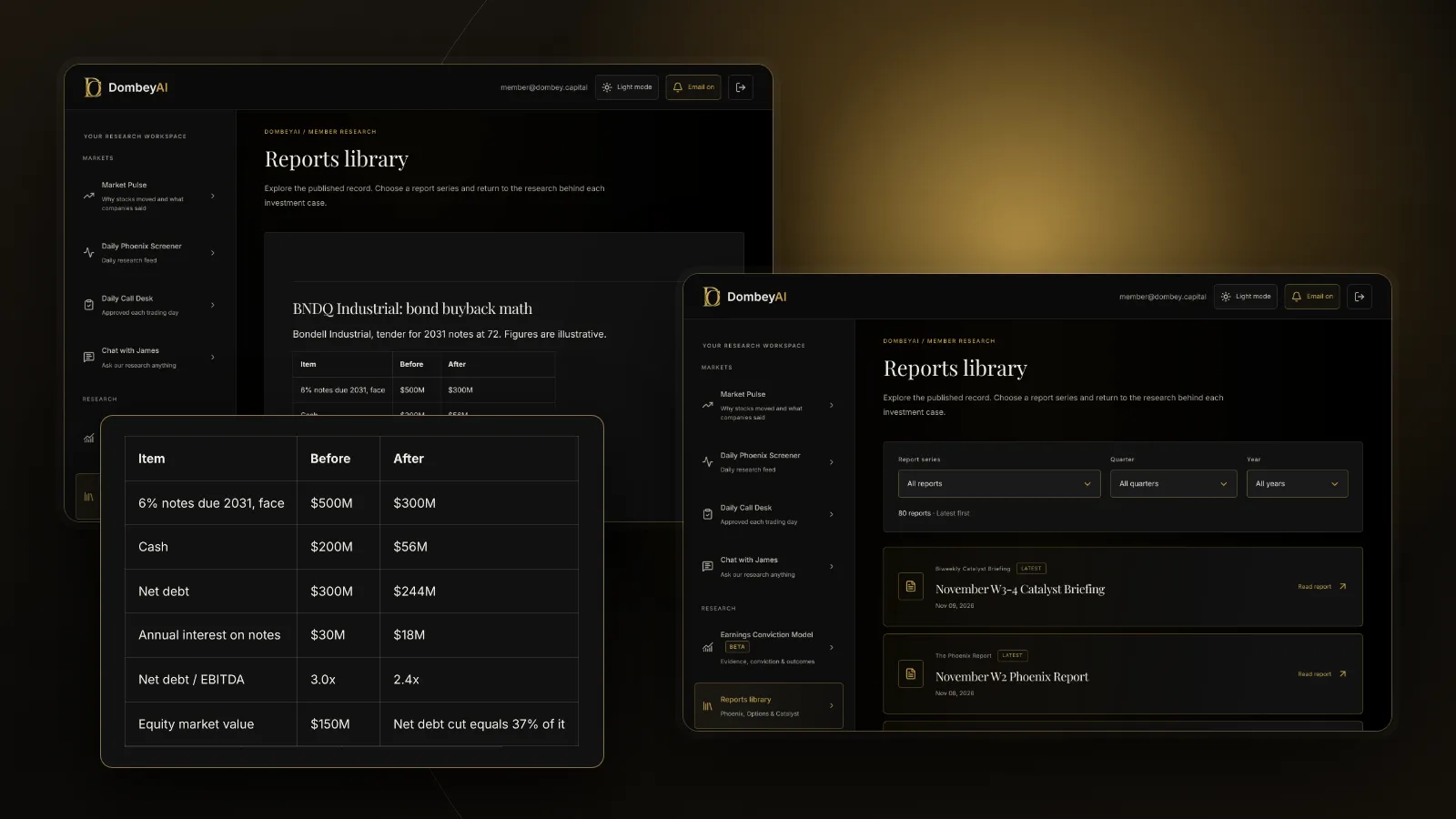
How the math works
Debt trades below par when investors doubt full repayment or when interest rates have risen since it was issued. The company owes the full face amount at maturity either way. Buying it back early at a discount locks in the difference.
The example also shows the trade-off. Cash fell from $200 million to $56 million. Whether that was wise depends on what the company needs cash for over the next few years.
Why debt trades below par
Two very different reasons push bonds below face value, and they matter for what a buyback means.
| Reason | What the price says | What a buyback signals |
|---|---|---|
| Interest rates rose after issue | Low coupon is worth less than new debt at market rates | Mainly a financing choice; credit risk may be low |
| Credit risk | Investors doubt full repayment | Management believes the company will repay, or wants to cut leverage before a restructuring |
| Low liquidity | Small issue, few buyers | Company may acquire bonds cheaply in negotiated trades |
| Upcoming covenant or maturity pressure | Risk of a distressed exchange | Buyback may be part of a larger liability management plan |
A company with investment-grade debt buying back a low-coupon bond is doing something close to refinancing. A company with stressed debt buying back bonds at 60 cents is betting on its own survival and moving value from sellers to the remaining holders. The second case is the special situation.
How companies buy back debt
The method depends on the instrument and its documents.
- Open market purchases. The company, or a broker on its behalf, buys bonds in the secondary market. This is quiet and flexible, though large or systematic programs can raise questions under the tender offer rules.
- Cash tender offers. The company offers to buy one or more bond series at a fixed price or through a modified Dutch auction. Debt tender offers are subject to the SEC's tender offer rules, and results are usually announced by press release and 8-K.
- Dutch auctions for loans. Many credit agreements allow the borrower to offer to buy term loans from all lenders through an auction at a price below par. The agreement sets the conditions, such as no default and a cap on the amount.
- Exchange offers. The company offers new debt, sometimes secured, or equity for the old bonds at a discount. These can cut debt but may add priority ahead of the remaining holders. Our explainer on debt-for-equity swaps covers the equity version.
- Privately negotiated purchases. The company buys a block from one or a few large holders.
Some of these sit within a broader liability management exercise, where the company uses its documents to restructure without a court process.
What it means for equity
The benefit to shareholders comes through four channels:
- Value transfer. The discount moves value from selling bondholders to everyone left, including equity.
- Lower interest. Less debt means lower interest expense and higher free cash flow.
- Lower default risk. Lower leverage pushes back the point at which a restructuring wipes out equity. Our explainer on net debt to EBITDA shows how quickly leverage falls.
- A maturity solved. Buying back the next maturity early reduces refinancing risk, covered in what a debt maturity wall is.
For a heavily indebted company, equity behaves like a leveraged stub: a small change in debt can be a large change in equity value. That is why a buyback announcement at a stressed company can move its stock more than its bonds.
The tax and accounting effects
Retiring debt below its carrying amount creates a gain on extinguishment of debt in the income statement. It is a one-time item and should be excluded when you judge recurring earnings.
For tax, the discount is generally cancellation of debt income. US tax law offers exclusions for debt discharged in bankruptcy or while the company is insolvent, with a matching reduction in tax attributes such as net operating losses. A solvent company with losses to absorb the income may pay little tax. A solvent company without them may owe tax on the discount, which reduces the benefit. Related-party purchases, such as a buyback by an affiliate, can also trigger the rules.
A checklist for any announced buyback
| Step | What to check | Where to find it |
|---|---|---|
| 1 | Which series and how much face value | Tender offer press release or 8-K |
| 2 | Price paid as a percent of par | Results announcement |
| 3 | Source of the cash | Cash flow statement, revolver draws |
| 4 | Nearest maturities left | Debt footnote in the 10-Q or 10-K |
| 5 | Any new secured debt issued | Exchange offer terms, indenture |
| 6 | Tax attributes available | Tax footnote, net operating losses |
| 7 | Leverage after the buyback | Pro forma debt and EBITDA |
Where this goes wrong
A buyback below par is not always good for equity.
- Spending scarce cash. Using cash on bonds due in five years can leave the company unable to meet a maturity due in two. Bonds due soonest should usually come first, even at a smaller discount.
- Buying the wrong layer. Retiring junior debt while senior debt remains can leave the company just as exposed to the debt that matters most.
- Priming in exchanges. An exchange into new secured debt can cut face value while making the remaining holders, and equity, worse off if the new debt ranks ahead.
- Signal misread. A buyback can be the first step before a broader restructuring, not a sign of strength.
- Tax leakage. A large discount can create taxable income at a company that has no losses to absorb it.
- Small size. A buyback of 5% of the debt changes little. Read the amount against total debt.
How to spot and judge a buyback
Look for a tender offer filing or press release, results announced in an 8-K, and in the next 10-Q, the gain on extinguishment and the change in the debt table. Then map who is left: our guide on how to map a capital structure shows how to lay out each layer and its maturity. Services that write about restructurings and stressed balance sheets are compared in our list of the best investing newsletters for special situations.
The bottom line
A discounted debt buyback cuts debt by more than the cash spent, and the difference accrues to the remaining claimholders, mainly shareholders. It also lowers interest and leverage, which can push back the risk of a restructuring. Its value depends on what the cash would otherwise be needed for, which layer of debt is bought, how it is funded and the tax cost. Judge it against the maturity schedule, not the discount alone.