

How claims trading works
When a company files for Chapter 11, its unpaid bills freeze. Suppliers, landlords, contract counterparties and lenders become creditors holding claims. Each files a proof of claim, or relies on the debtor's schedules, stating what it is owed.
Those claims will be paid, if at all, under a plan that may take months or years to confirm. Many creditors do not want to wait. A specialist buyer offers them cash today, priced as cents on the dollar of the claim's face amount.
The steps in a typical trade claim purchase:
- Find the claim. Buyers review the debtor's schedules and the claims register, which list creditors and amounts.
- Agree a price. The offer reflects the buyer's estimate of the recovery for that class, the time until payment and the risk the claim is reduced.
- Sign a transfer agreement. The agreement usually requires the seller to refund part of the price if the claim is later disallowed or reduced.
- Record the transfer. Under Bankruptcy Rule 3001(e), when a proof of claim has been filed, the buyer files evidence of the transfer with the court, and the claims register is updated.
- Wait for the plan. The buyer votes the claim on the plan and receives the distribution, which may be cash, new debt, new equity or a mix.
Types of claims that trade
Not every claim is the same, and the type drives the price.
| Claim type | Where it sits | Typical trading notes |
|---|---|---|
| Secured loans and bonds | At the top, backed by collateral | Trade in the loan and bond markets, not usually as claims |
| Administrative claims | Paid before unsecured claims | Includes goods delivered in the 20 days before filing under section 503(b)(9) |
| Priority claims | Ahead of general unsecured | Certain tax and employee claims up to set limits |
| General unsecured trade claims | Behind secured and priority claims | The core of the claims trading market |
| Unsecured bonds | Same class or a separate class | Trade like other bonds, often with more liquidity |
| Contract and lease rejection claims | General unsecured, often capped | Landlord claims are subject to a statutory cap |
| Litigation claims | Often disputed | Wide range of outcomes, slow to resolve |
Trade claims are the most common because they are numerous and their holders, often operating businesses, value cash more than an uncertain future recovery. The capital structure decides who gets paid first, which is why a capital structure map is the starting point for pricing any claim.
What sets the price of a claim
A claim's price is the buyer's estimate of the recovery, discounted for time and risk. The main inputs:
- Enterprise value. What the reorganized company, or the proceeds of asset sales, will be worth. A Section 363 sale can set that value directly.
- Claims ahead. Secured debt, DIP financing, administrative and priority claims are paid first.
- Size of the unsecured pool. Rejected leases, contract claims and deficiency claims from secured lenders can make the pool much larger than the debtor's schedules first show.
- Form of the recovery. Cash is worth more than new equity of uncertain value.
- Time. A plan two years away needs a higher discount than one expected in six months.
- Claim-specific risk. Disputes, offsets and the seller's own history with the debtor.
The disclosure statement filed with the plan usually includes estimated recoveries by class. Our guide to reading a Chapter 11 disclosure statement shows where to find them. Claim prices that differ sharply from those estimates mean buyers disagree with the debtor's valuation.
Why equity holders should watch claim prices
Claims trading is mostly a market for professionals, but claim prices carry information for anyone holding or watching the stock.
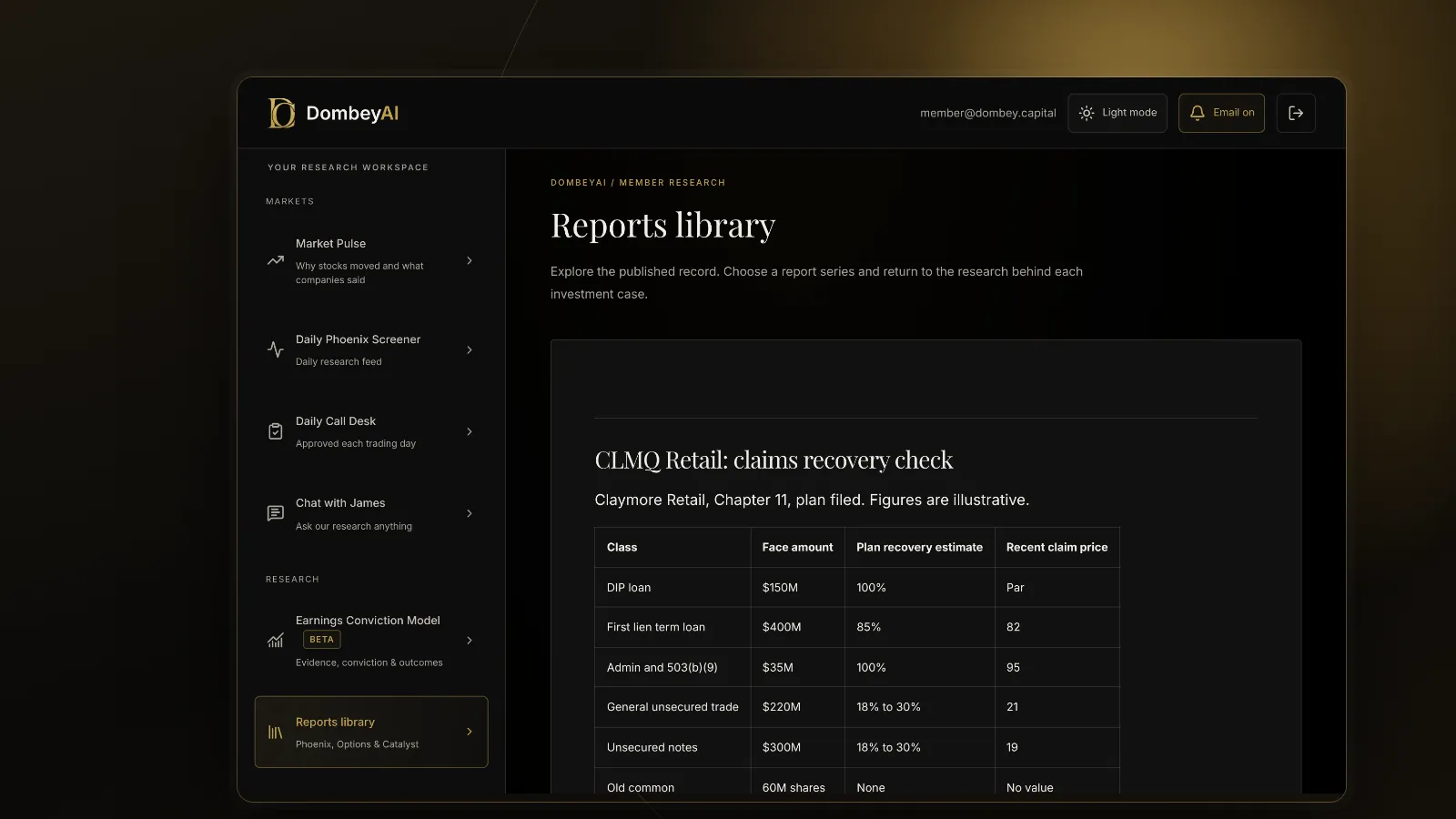
Under the absolute priority rule, equity usually receives nothing unless the classes ahead of it are paid in full or agree to give something up. If general unsecured claims trade at 25 cents on the dollar, the market expects unsecured creditors to lose most of what they are owed, which leaves little or nothing for shareholders. Our explainer on what happens to a stock in Chapter 11 covers why old shares are so often cancelled.
The reverse can also happen. If unsecured claims trade near par and the plan pays them in full, equity may be in the money. That is rare, but it happens when asset values turn out higher than expected or when a claims pool shrinks.
Once a plan is confirmed, claims in the fulcrum class often convert into new shares, which is one reason post-bankruptcy equities can trade cheaply in their first months: holders who bought claims for a recovery may sell the stock they receive.
Where this goes wrong
Buying a claim is buying a legal right, and legal rights carry risks a stock does not.
- Disallowance or reduction. The debtor can object to a claim. A claim filed at $1 million may be allowed at $600,000.
- The seller's history follows the claim. Under section 502(d), a claim can be disallowed while its holder has not returned a payment the estate can recover, such as a preference. Courts have differed on whether this follows a claim to a buyer, which is why transfer agreements include refund and indemnity terms.
- Setoff. The debtor may net amounts the creditor owes it against the claim.
- Plan changes. Recoveries in early estimates can fall when new claims surface or asset values fall.
- Timing. Delays in plan confirmation stretch the holding period and cut annual returns.
- Form of payment. A plan may pay in new equity or notes that are hard to sell at their stated value.
How to follow a bankruptcy case
The documents are public. The court docket holds the petition, schedules, claims transfers, the plan and the disclosure statement. Most large cases also have a claims agent website with a free claims register and docket. Our comparison of bankruptcy and restructuring research sources covers the paid and free options, and our list of the best investing newsletters for special situations includes services that write about restructurings.
The bottom line
Claims trading lets creditors of a bankrupt company sell their right to be paid for cash now, while buyers take on the risk and the possible reward of the plan recovery. Prices reflect the expected recovery for each class, the time to payment and the risk the claim is reduced. For equity holders, claim prices are an early signal of where value runs out in the capital structure. If the unsecured claims trade deep below par, the old stock rarely recovers anything.