

How SPAC warrants are created
A special purpose acquisition company raises money in an IPO by selling units, commonly at $10.00 each. Each unit holds one share and a fraction of a warrant, such as one half or one third. The proceeds go into a trust account, which our explainer on SPAC trust value and redemption math covers in detail.
After a few weeks the units separate, and the shares and warrants trade on their own, usually with a ticker suffix such as "W" or "WS." Only whole warrants trade and can be exercised.
The sponsor often buys its own warrants in a private placement. Those private warrants usually carry different terms, for example exemption from the redemption feature while the sponsor holds them, so read which class a filing refers to.
Typical warrant terms
Terms are set in the warrant agreement, filed as an exhibit to the IPO registration statement. Most follow a common pattern, but check each one.
| Term | Typical setting | Why it matters |
|---|---|---|
| Shares per whole warrant | 1 | Sets the exposure per warrant |
| Exercise price | $11.50 | The stock must rise above this for exercise to pay |
| First exercise date | Later of 30 days after the merger and 12 months after the IPO | No exercise before the deal |
| Expiration | 5 years after the merger | Long life adds option value |
| Redemption at $0.01 | Stock at or above $18.00 for 20 of 30 trading days, 30 days' notice | Caps practical upside |
| Redemption at $0.10 | Stock at or above $10.00, cashless exercise by table | Lets the company retire warrants early |
| No deal by deadline | Warrants expire worthless | The binary risk before a deal |
Two stages of value
A SPAC warrant goes through two very different phases.
Before a deal is announced or closed, the warrant is mostly a bet that a deal will happen. The share has a floor in the trust value per share, because holders can redeem for cash. The warrant has no floor. If the SPAC liquidates, it is worth zero. Warrants on SPACs searching for a target often trade at low prices for this reason.
After the merger closes, the warrant becomes a long-dated call option on the new public company, with the redemption feature attached. Its value then depends on the share price, volatility, time left, interest rates and the chance the company calls it.
How warrants are valued
A practical approach combines the two stages:
- Estimate the chance the deal closes. Consider whether a target is announced, the shareholder vote, redemption levels, financing and the deadline. Our guide on how to analyze a de-SPAC merger covers the checks.
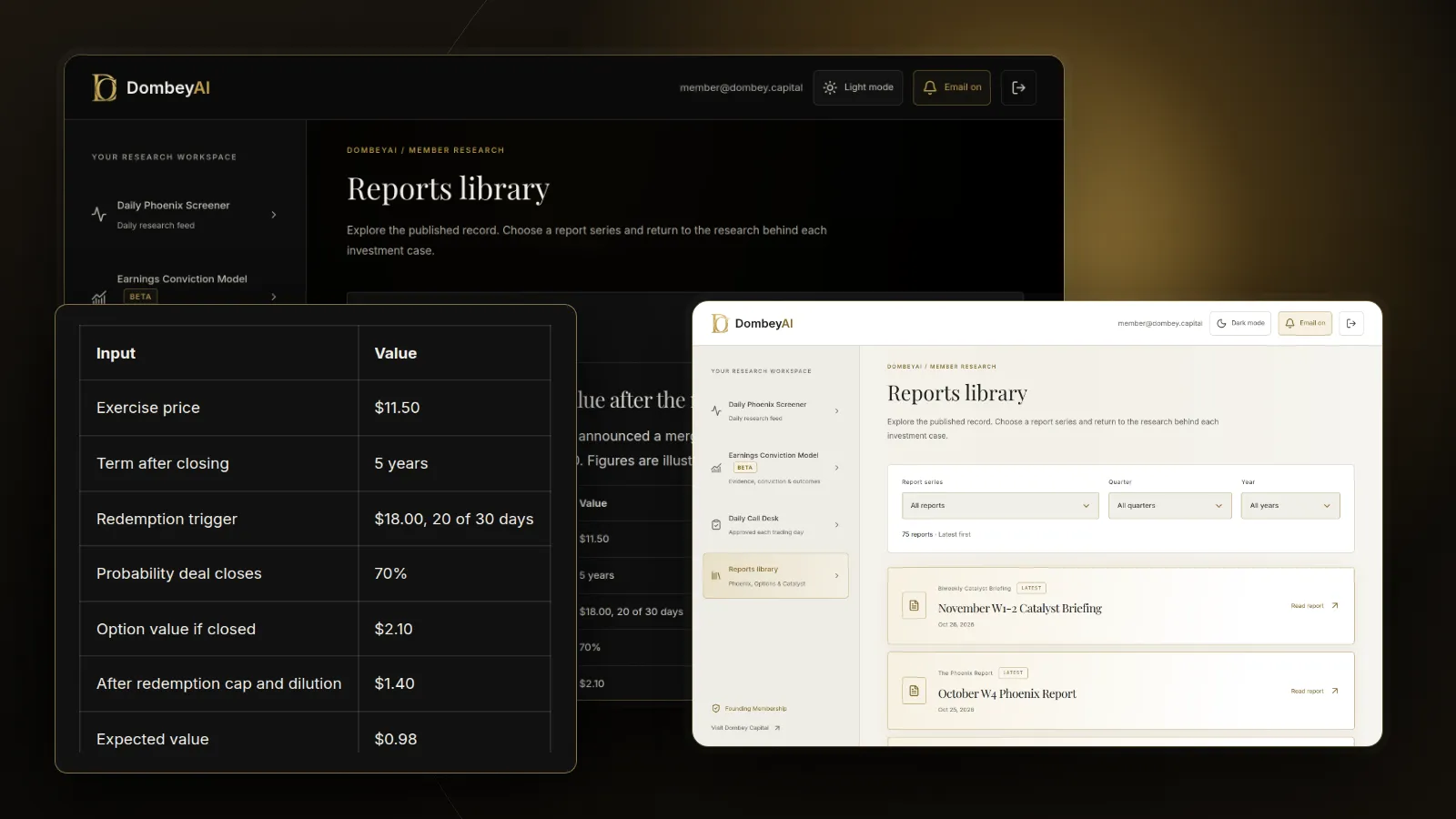
- Value the warrant if the deal closes. Treat it as a call option with a strike of $11.50 and five years to expiry, using a volatility assumption that suits a small, newly public company. Our article on implied volatility explains why that input drives the answer.
- Adjust for the redemption feature. Because the company can call the warrants once the stock holds above $18.00, the upside beyond that level is mostly lost. A standard option model overstates the value unless it accounts for the call.
- Adjust for dilution. Exercise creates new shares, and warrant overhang can weigh on the stock. Our explainer on dilution and share count changes shows how to count them.
- Weight the outcomes. Multiply the post-deal value by the probability of closing; the no-deal outcome contributes zero.
Why warrants behave differently from the shares
Warrants are leveraged. A $1.00 move in a $12.00 stock is about 8%. The same move can change a $1.50 warrant by much more than 8%, because the warrant's value is concentrated in the part of the stock price above $11.50. The option measures in the option Greeks apply: delta describes how much the warrant moves for each dollar in the stock.
Warrants also trade less. Bid-ask spreads can be wide, and a large order can move the price. Many brokers treat them differently from shares, and some restrict trading in them.
Accounting and the 2021 change
In April 2021 the SEC's staff issued a statement on accounting for warrants issued by SPACs. It concluded that the terms of many SPAC warrants required them to be recorded as liabilities, measured at fair value each period, rather than as equity. Many SPACs restated their financial statements. The practical result for investors is that changes in warrant value can run through the income statement of a SPAC or a de-SPAC company, creating gains and losses unrelated to the business.
Questions to answer before valuing a warrant
Before running any numbers, answer these from the filings:
- If a target is announced, what does the merger proxy say about the warrants, and are any terms being amended?
- If the SPAC is near its deadline, has it extended before, and what did redemptions look like at the last extension vote?
- If the deal has closed, is the registration statement for the warrant shares effective, so the warrants can be exercised?
- If the stock is near $10.00 or $18.00, could the company call the warrants soon, and on which terms?
- If the sponsor holds private warrants, how many, and on what terms do they differ from the public ones?
The answers change the value more than any refinement of the option model.
Where this goes wrong
- Treating the warrant like the share. The share has a trust floor before a deal; the warrant does not.
- Ignoring the redemption feature. Option calculators that ignore the $18.00 call overstate value.
- Missing the deadline. A SPAC that fails to extend or complete a deal by its deadline liquidates, and the warrants expire.
- Reading the wrong agreement. Terms differ across SPACs and between public and private warrants. Some deals amend warrant terms as part of the merger.
- Underestimating the post-deal risk. Many companies that went public through SPACs traded well below $10.00 after the merger, leaving warrants far out of the money. The risks in reverse mergers are a useful comparison.
Where to follow SPAC warrants
The warrant agreement, the merger proxy and redemption notices are all on EDGAR. For tools that track SPAC deadlines, trust values and warrant prices, see our comparison of SPAC research tools, and for newsletters that cover special situations of this kind, see the 10 best investing newsletters for special situations.
The bottom line
SPAC warrants are long-dated rights to buy post-deal shares, usually at $11.50, with no claim on the trust. Before a deal they are a bet that a deal closes, and after it they behave like call options capped in practice by the company's right to redeem them. Valuing them means combining a closing probability with an option value adjusted for redemption and dilution. Read the warrant agreement, because the terms decide most of the outcome.