

How a Reverse Morris Trust works
The steps are usually set out in a single set of agreements signed on the same day.
- Separation. The parent moves the business into a subsidiary, often called SpinCo, and agrees the assets, liabilities and employees that go with it.
- Cash out to the parent. Before the spin, SpinCo often borrows and pays the parent a cash distribution, or issues debt the parent uses to retire its own debt. This is how the parent gets value out without a taxable sale.
- Distribution. The parent distributes SpinCo shares to its shareholders pro rata, as in a spin-off, or offers them in exchange for parent shares, as in a split-off.
- Merger. SpinCo merges with the partner company, or a subsidiary of the partner, in a deal in which SpinCo holders receive shares of the partner.
- Result. The parent's former shareholders own the majority of the combined company, and the partner's shareholders own the minority.
The 50% test and why it shapes the deal
A spin-off is tax-free to the parent only if it meets the requirements of Section 355 of the Internal Revenue Code. Section 355(e) adds a trap: if the spin-off is part of a plan in which one or more persons acquire 50% or more of the parent or the spun-off company, by vote or value, the parent recognizes gain on the distribution as if it had sold SpinCo.
In an RMT, the merger partner's shareholders receive shares in the combined company. To stay clear of Section 355(e), they must end up with less than 50%. That single rule drives most of what investors see:
- The partner is usually smaller than SpinCo by equity value, or SpinCo carries enough debt to shrink its equity to the right size.
- The partner's management often runs the combined company, even though its holders are the minority, because the partner is the operating buyer.
- The parent's shareholders get shares, not cash. Value reaches the parent through the pre-spin cash distribution, not through a purchase price.
Section 355 has other conditions, including an active trade or business conducted for five years before the distribution and a real business purpose. Deal documents usually make closing conditional on tax opinions and, in many cases, a private letter ruling from the IRS.
A worked example
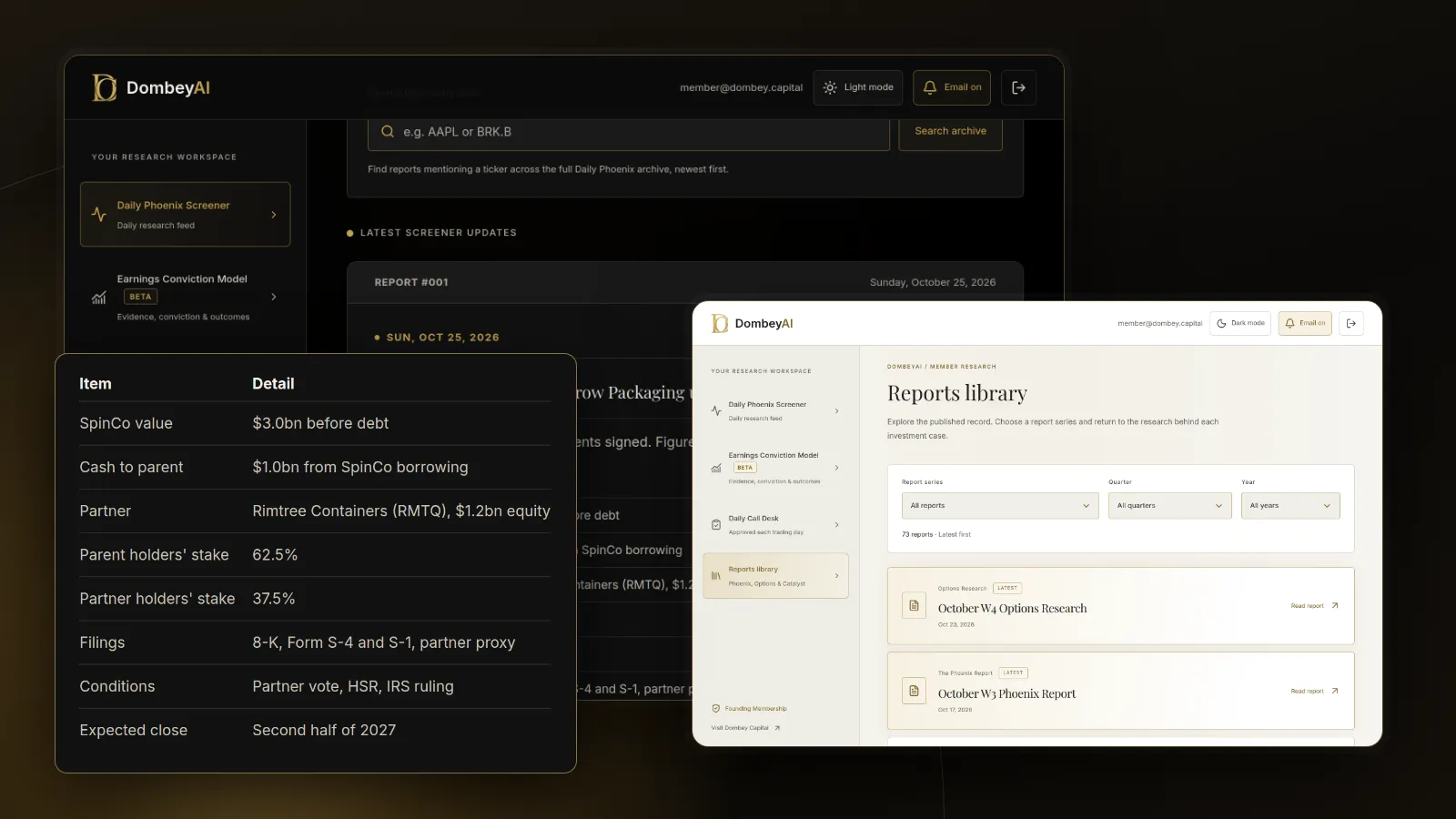
The example shows the trade-off. The cash taken out by the parent becomes debt on the combined company, so the new shares carry more leverage than either business had before.
| Item | Before | After (illustrative) |
|---|---|---|
| Parent cash received | $0 | $1.0 billion from SpinCo borrowing |
| SpinCo equity value | $3.0 billion | $2.0 billion after debt |
| Partner equity value | $1.2 billion | Combined into the new company |
| Parent holders' stake | 100% of SpinCo | 62.5% of combined company |
| Partner holders' stake | 100% of partner | 37.5% of combined company |
| Combined company debt | Partner's own | Partner's debt plus $1.0 billion |
What changes for each group of shareholders
Parent shareholders receive shares in a company they did not choose to buy. Many hold the parent for reasons that do not apply to the new business: an index weighting, a dividend policy or a sector mandate. Some sell, which is the same pressure that makes spin-offs interesting in the first place.
Partner shareholders keep their shares but now own a minority of a larger company. They usually vote on the deal, so the partner's proxy is where the board explains the price, the cost savings it expects and the fairness opinion. Our guide on how to read a proxy statement covers what to look for.
Parent holders who stay own a smaller parent with a cleaner business and the cash from the distribution. Check what the parent says it will do with the cash: repay debt, buy back shares or fund acquisitions.
The filings and the timetable
An RMT produces more paperwork than a plain spin-off because two companies and a share issue are involved.
| Stage | Filing | What to check |
|---|---|---|
| Announcement | 8-K with the separation and merger agreements | Exchange ratio, ownership split, cash to parent, conditions |
| Registration | Form 10, or Form S-4 and S-1, for the shares being distributed | Pro forma financials, debt, risk factors, management |
| Partner vote | Proxy or joint proxy and prospectus | Fairness opinion, background of the deal, vote required |
| Tax | Private letter ruling and tax opinions | Whether closing depends on them |
| Approvals | Antitrust review | The HSR waiting period and any other reviews |
| Distribution and closing | 8-Ks on record date and completion | When-issued trading, final ownership |
Our explainers on what a Form 10 is and what an S-4 merger registration is cover the documents themselves, and the guide to analyzing a spin-off Form 10 walks through the pro forma statements step by step.
How investors analyze an RMT
The questions are the ones you would ask of any spin-off and any merger, plus a few specific to the structure.
- If the combined company's leverage after the cash distribution is high for its industry, the equity is riskier than either business was alone.
- If the partner's management will run the business, read their record at the partner, not the parent's.
- If the deal is a split-off with an exchange offer, work out the discount offered for swapping parent shares into SpinCo and any proration.
- If the parent's holders are likely sellers, for example because the new company will be smaller or pay no dividend, expect pressure after the distribution.
- If the closing depends on a private letter ruling, treat the IRS timetable as a dated risk.
The 10 best investing newsletters for special situations include several that follow spin-offs and RMTs from announcement to the first year of trading.
Where this goes wrong
RMT analysis fails in predictable ways.
- Ignoring the debt. The cash the parent takes out is debt the new company must service. A business that looked steady inside the parent can look stretched on its own.
- Assuming the forced selling is a bargain. Selling pressure can push the price below value, but it can also reflect a weak business the parent was glad to shed.
- Missing integration risk. The combined company has to separate from the parent and merge with the partner at once. Transition service agreements and stranded costs often run longer than planned.
- Treating the tax outcome as certain. If the structure fails the tax tests, the cost can fall on the parent or, under the tax matters agreement, on SpinCo. Read who bears it.
- Overlooking the partner's holders. They vote and can reject the deal, and their view of the price may differ from the parent's.
Dombey's published research covers separations and their dated steps; see the research archive.
The bottom line
A Reverse Morris Trust lets a company separate a business and combine it with another company without a taxable sale, as long as the parent's shareholders keep more than 50% of the result. The structure usually moves cash to the parent and debt to the new company, and it hands parent holders shares they may not want. Read the separation and merger agreements, the registration statement and the tax conditions together. Then judge the combined company on its own leverage, management and business, not on the parent it came from.