

What you need
- The disclosure statement and its exhibits. Find it on the court docket or the claims agent's case website, where filings are posted free. Public companies often attach it to a Form 8-K.
- The plan of reorganization. It is usually Exhibit A. Where the two documents differ, the plan generally controls.
- The order approving the disclosure statement, if entered. It sets the voting deadline, the objection deadline and the confirmation hearing date.
- The latest 10-K or 10-Q. You need the pre-bankruptcy balance sheet and debt footnote to check the claim amounts.
- A spreadsheet. You will rebuild the recovery waterfall.
Our explainer on what happens to stock in Chapter 11 covers the process around the document.
Step 1: Read the summary of classes and recoveries
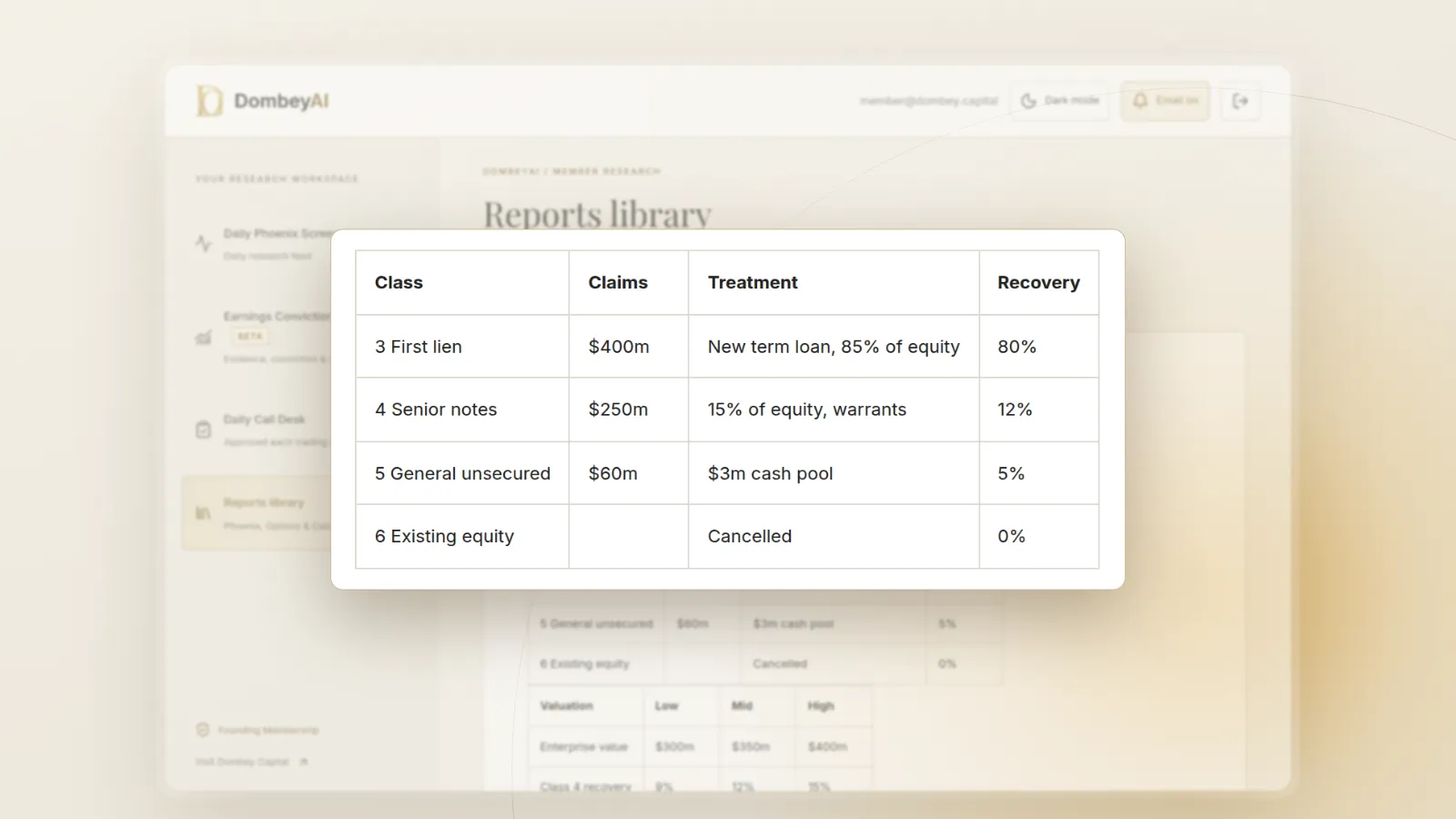
Near the front, almost every disclosure statement has a table listing each class, its estimated claims, its treatment, whether it is impaired and whether it votes. Read it first.
| Class | Description | Estimated claims | Treatment | Impaired? | Votes? | Est. recovery |
|---|---|---|---|---|---|---|
| 1 | Other secured claims | $5m | Paid in full | No | Presumed to accept | 100% |
| 2 | Priority non-tax claims | $2m | Paid in full | No | Presumed to accept | 100% |
| 3 | First-lien term loan | $400m | Pro rata share of new term loan and 85% of new equity | Yes | Yes | 80% |
| 4 | Senior notes | $250m | Pro rata share of 15% of new equity and warrants | Yes | Yes | 12% |
| 5 | General unsecured claims | $60m | Pro rata share of a $3m cash pool | Yes | Yes | 5% |
| 6 | Existing equity interests | Cancelled, no distribution | Yes | Deemed to reject | 0% |
The table above is illustrative. In a real case, note the classes that vote, the class that holds the new equity, and what the old equity receives.
Step 2: Read the plan's key terms and the restructuring support agreement
The executive summary describes the deal: who is converting debt into equity, any new money, any rights offering, and the exit financing. If creditors signed a restructuring support agreement before filing, find out which classes are bound to vote yes and what percentage of each class they hold. A class with two-thirds already committed has effectively accepted.
Look for releases and exculpation clauses. They decide whether claims against directors, sponsors or lenders survive, which can matter to creditors who expected to recover through litigation.
Step 3: Read the valuation analysis
The debtor's financial adviser estimates the reorganized company's enterprise value, usually as a range with a midpoint. That number drives recoveries: subtract the exit debt and you get the implied value of the new equity, which is split among the classes receiving it.
Check the methods used, usually comparable companies, precedent transactions and a discounted cash flow, as covered in our explainers on comparable company analysis and DCF. A low valuation favors the classes receiving equity, because they get the upside at a low price; junior classes often object for that reason.
Step 4: Read the liquidation analysis
The liquidation analysis estimates what each class would receive if the company were liquidated under Chapter 7. It applies recovery percentages to each asset, subtracts the costs of a trustee and wind-down, and runs the proceeds through the priority order.
This is the evidence for the best interests test in section 1129(a)(7): every holder in an impaired class that does not accept must get at least what it would get in a liquidation. Compare each class's plan recovery with its liquidation recovery. If they are close, the class has little room to bargain.
Step 5: Read the financial projections
Projections usually cover three to five years and support the feasibility test in section 1129(a)(11), the finding that confirmation is not likely to be followed by another liquidation or reorganization. They also anchor the valuation.
Check the assumptions against history. A plan that projects margins well above anything the company has earned deserves skepticism. Compare the revenue and cash flow path with the last three years in the 10-K, and read the risk factors section of the disclosure statement for what could break the plan.
Step 6: Read the treatment of each class in detail
Go back to the class you care about and read its full treatment in the plan. Check:
- The form of consideration: cash, new debt, new equity, warrants or rights.
- Any dilution: management incentive plans, warrants and rights offering shares reduce each holder's share of the new equity.
- Conditions and toggles: some classes receive different treatment depending on whether they vote to accept.
- Litigation trusts: claims kept for creditors can add recoveries later.
Step 7: Check the voting and confirmation timeline
The order approving the disclosure statement sets the dates. Add the voting deadline, the objection deadline and the confirmation hearing to your catalyst calendar.
| Date | Event | What to check |
|---|---|---|
| Disclosure statement hearing | Court decides whether the information is adequate | Objections from creditor groups |
| Solicitation | Ballots go out to voting classes | Which classes vote |
| Voting deadline | Ballots due | Restructuring support agreement commitments |
| Voting report | Claims agent files tabulation | Whether each class met two-thirds in amount and half in number |
| Confirmation hearing | Court rules on the plan | Cramdown arguments, valuation disputes |
| Effective date | Plan goes into effect, new securities issued | Listing or trading of the new equity |
Step 8: Rebuild the waterfall yourself
Put the estimated claims, the valuation range and each class's share of the consideration into a spreadsheet. Recalculate recoveries at the low, middle and high end of the valuation range. This shows how sensitive each class is to the valuation fight, and it often shows that the old equity is out of the money even at the high end. Our guide to building a base and worst case covers the scenario method.
Common mistakes
- Reading the old stock as a claim on the new company. In most plans, existing equity is cancelled. The new shares go to creditors, not to old shareholders, even if the stock keeps trading until the effective date.
- Treating the midpoint valuation as fact. The valuation is the debtor's adviser's estimate, often contested, and written by a party with an interest in the outcome.
- Ignoring dilution. Management incentive plans, warrants and rights offerings can take a meaningful share of the new equity.
- Skipping the liquidation analysis. It sets the floor for objecting classes and shows how much value the reorganization preserves.
- Missing the exhibits. The plan, projections, valuation and liquidation analysis are often exhibits filed separately or later as a plan supplement.
For more places to follow dockets and restructuring news, see our list of bankruptcy and restructuring research sources and our comparison of the best investing newsletters for special situations.
The bottom line
A Chapter 11 disclosure statement tells creditors what the plan gives them and why, and it is the best public source for estimating recoveries. Read the summary of classes first, then the valuation, the liquidation analysis and the projections that support the numbers. Rebuild the waterfall at the low and high ends of the valuation range to see who is sensitive to the outcome. For the old equity, the answer is usually in one line of the class table. Dombey's published special situations theses are in the research archive.