

How a tracking stock works
A parent company changes its charter to create two or more classes of common stock. One class is attributed to a particular business, often called a group, and the others to the rest of the company. The parent keeps one board, one legal entity at the top and one set of creditors.
Each class gets:
- Economic rights tied to the attributed business: the board sets dividends by reference to that group's results, and the stock price tends to move with it.
- Voting rights in the parent, often fixed by a ratio or adjusted by relative market value.
- Liquidation rights set out in the charter, usually a share of the parent's net assets by formula.
The 10-K typically reports separate financial information for each group, which lets investors value them as if they were separate companies. General Motors' Class E and Class H shares, tied to its EDS and Hughes businesses in the 1980s and 1990s, are well-known early examples, and Liberty Media has used several tracking stocks since.
What holders actually own
The difference between a tracking stock and a stand-alone company matters most when something goes wrong.
| Feature | Tracking stock | Spun-off company |
|---|---|---|
| Legal owner of the assets | Parent company | The new company |
| Board | Parent's board, for all classes | Its own board |
| Creditor exposure | Parent's creditors can reach all assets | Only its own creditors |
| Control of a sale | Parent's board decides | Its own board and shareholders |
| Separate financials | Usually, as attributed group results | Yes, full audited statements |
| Tax on creation | Generally structured to avoid tax | Depends on Section 355 rules |
Our explainer on spin-off investing covers the stand-alone route, and equity carve-outs describe a middle path in which the parent sells a minority stake in a real subsidiary.
Why tracking stocks trade at a discount
Investors usually value a tracking stock below what the tracked business would be worth on its own. The main reasons:
- Board discretion. The board can move assets, costs and debt between groups, and owes duties to all shareholders, not one class. Charters set policies, but those policies can often be changed by the board.
- Conversion risk. Most charters let the board convert one tracking class into another at a set ratio, sometimes with a premium. If the ratio is below the business's fair value, holders lose.
- Limited governance. Tracking holders usually cannot elect their own directors, call for a sale of their business or block a transfer of assets without the board's support.
- Shared credit risk. A problem in another group can impair the whole company.
- Smaller following. Trackers are often less liquid and less covered than the parent's main class.
These are the same forces behind holding company discounts, sharpened by the fact that tracking holders own no separate legal claim.
How to value a tracking stock
Start with the business, then adjust for the wrapper.
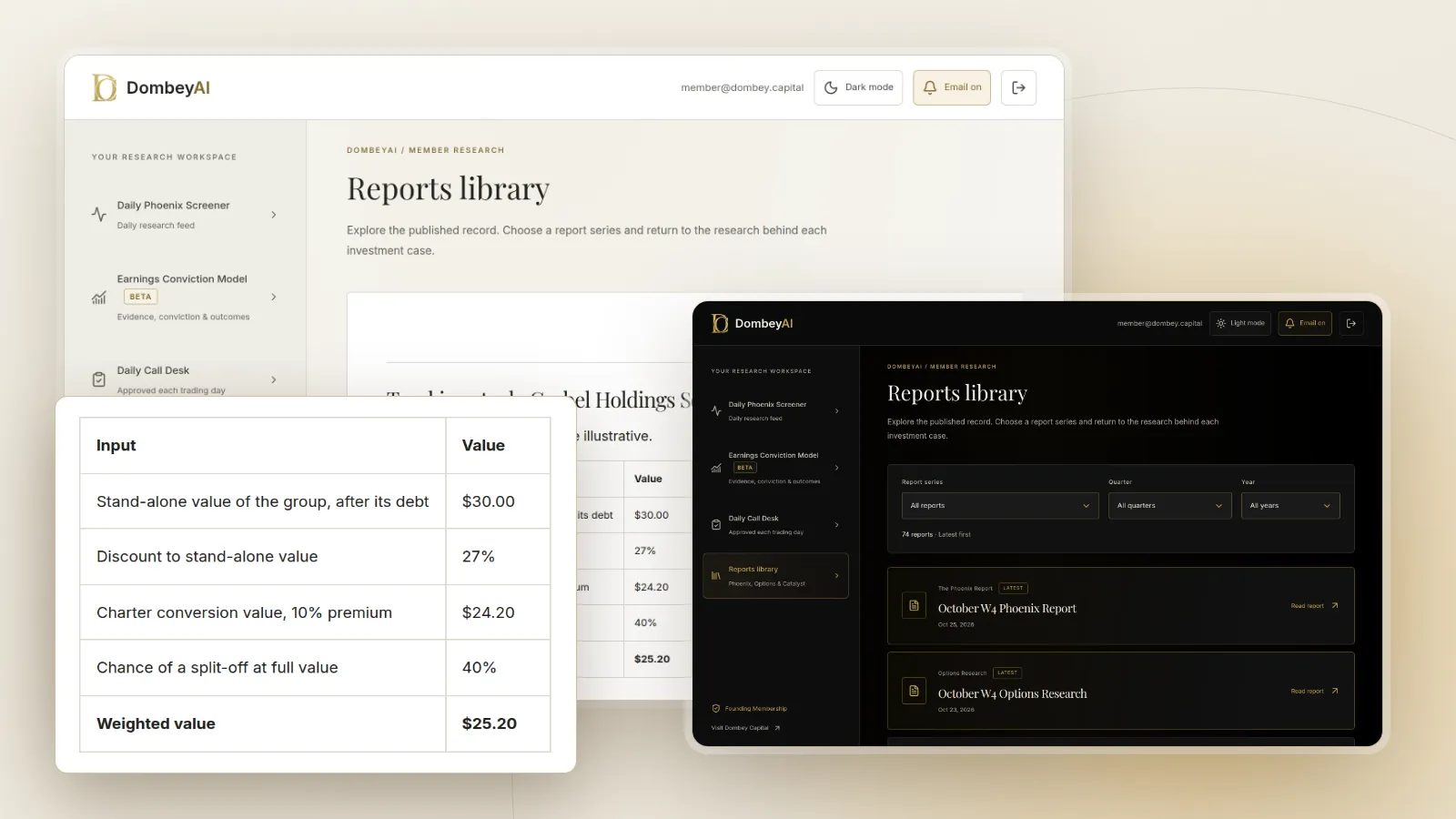
- Value the tracked group as a stand-alone company, using the attributed financials and suitable peers. Our guide to a sum-of-the-parts valuation sets out the steps.
- Allocate debt and costs as the charter and attribution policies describe, and note anything the board could reallocate.
- Read the conversion clause. It sets a reference value: if the board converts, what does each tracking share receive, and at what premium?
- Judge the chance of a separation through a split-off, spin-off or sale, and what holders would receive.
- Apply a discount for governance and liquidity only to the part of value that is not protected by the charter.
The example shows why the conversion clause matters. A premium to the tracker's own price can still leave holders well below the business's stand-alone value.
The catalysts that end tracking stocks
Most tracking stocks do not last forever. The events that close the gap between price and value:
- Split-off or spin-off. The parent moves the tracked business into a separate company and exchanges or distributes its shares to tracking holders. Our explainer on split-offs describes the exchange route.
- Conversion. The board converts the tracker into another class at the charter's ratio, which may or may not reflect full value.
- Sale. The parent sells the tracked business and distributes proceeds or converts the tracker.
- Recombination. The parent folds the classes back into one, often after concluding the structure did not narrow the discount.
Each usually requires a proxy statement and sometimes a shareholder vote. Our guide on how to read a proxy statement explains where to find the terms. When a parent announces a review of its structure, the strategic review explainer covers what usually follows.
What to read in the filings
Four documents carry most of what a tracking stock holder needs:
- The certificate of incorporation. It defines each class, the dividend and liquidation formulas, the voting ratio and the board's conversion and redemption rights.
- The proxy statement that created the classes. It explains why the board chose the structure and summarizes the charter terms in plain language.
- The 10-K and 10-Q. They usually include attributed financial information for each group, with notes on how shared costs, taxes and debt are allocated. Compare the allocation policies year to year.
- Any 8-K on a reattribution. When the board moves assets, cash or debt between groups, it usually discloses the terms. These are the moments when one class can gain at another's expense.
If the company has stated a policy for resolving conflicts between groups, read it closely and note whether the board can change it without a vote.
Where this goes wrong
- Assuming the discount must close. Some tracking stocks trade at a discount for years. Without a dated catalyst, a cheap tracker can stay cheap.
- Ignoring the conversion terms. A conversion at the charter's ratio can lock in a loss compared with stand-alone value.
- Missing cross-group risk. Debt or losses in another group belong to the same legal company and can hurt every class.
- Trusting attributed numbers too much. Attributed financials depend on cost allocations the board controls. Check how they have changed over time.
- Overlooking tax. A separation that would be taxable can be costly enough to keep the structure in place.
Tracking stocks are a classic special situation: the value is visible, but realizing it depends on a corporate action. Several services in our list of the 10 best investing newsletters for special situations follow capital structure changes like these. Dombey's published research applies the same charter-first reading; see the research archive.
The bottom line
A tracking stock gives holders an economic interest in one business inside a company without legal ownership of it. The parent's board controls allocations, conversions and separations, which is why trackers often trade below the value of the business they follow. Value the tracked business first, then read the charter for conversion and liquidation terms, and weigh the chance of a separation. The discount is an opportunity only when a dated event is likely to close it.