

A short definition
An RSA, also called a plan support agreement, locks in a deal before the court process runs its course. It does three things:
- Sets the terms. A term sheet describes what each class of creditor receives: cash, new debt, new equity or nothing.
- Binds the votes. Signing creditors agree to vote for a plan matching the term sheet and not to back a competing one.
- Sets the clock. Milestones require the company to file the plan, win court approvals and emerge by set dates.
Most RSAs are signed just before a Chapter 11 filing, so the company enters court with a deal. Some are reached during the case. A prepackaged bankruptcy goes one step further, soliciting votes before filing.
Real examples
The table lists public cases where an RSA shaped the outcome. It shows when the RSA came, not trading results.
| Company | Chapter 11 filing | When the RSA came | Main supporting creditors |
|---|---|---|---|
| Frontier Communications | April 2020 | At filing | Unsecured bondholders |
| Chesapeake Energy | June 2020 | At filing | Secured lenders and noteholders |
| Mallinckrodt | October 2020 | At filing | Unsecured noteholders, with a settlement covering opioid claims |
| Revlon | June 2022 | During the case, in December 2022 | Lender groups |
| WeWork | November 2023 | At filing | Secured noteholders |
In most of these cases the new equity went largely to creditors. Revlon shows that a case can start without an RSA and reach one later, after months of negotiation.
What is in an RSA
The term sheet
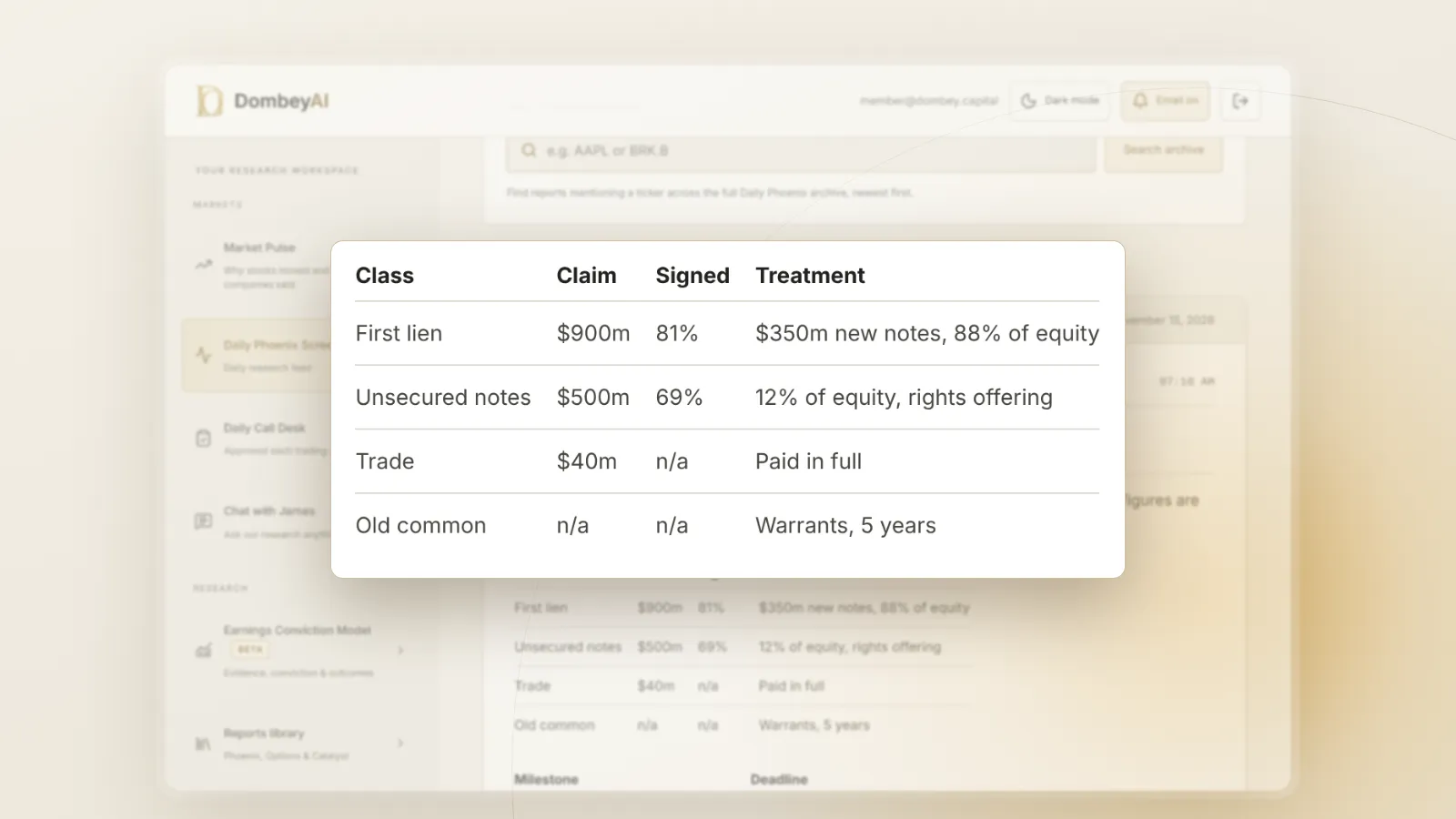
The term sheet is the economic heart. It lists each class of claims and its treatment. Look for:
- Who receives the new common stock, and in what proportion.
- Whether a rights offering lets creditors buy more equity, often backstopped by the signing group for a fee.
- The treatment of existing common stock: cancelled, warrants, or a small share.
- New debt: amount, maturity and who holds it.
Our guide on how to map a capital structure helps you set these classes in order before you read the treatment of each.
Milestones
Milestones are dated obligations, such as filing the plan within 30 days, getting the disclosure statement approved within 60 days and confirming the plan within 120 days. The exact dates vary by case. Missing one usually lets the creditors terminate.
Support and fiduciary out
Creditors commit to vote yes. The company usually keeps a fiduciary out: its board can walk away if a better proposal emerges, though often with a fee.
Termination events
Beyond milestones, termination events can include a material adverse change, the court denying DIP financing, or conversion of the case to Chapter 7.
What it means for the stock
The RSA usually settles the question shareholders care about most. If the new equity goes to creditors, the old shares are worth little at emergence, whatever they trade at in the meantime. Our page on what happens to stock in Chapter 11 explains why old shares often keep trading after a filing.
Creditors' positions in the post-emergence company matter too. New shares issued to creditors often trade cheaply after emergence, which is covered in post-bankruptcy equities.
How to read an RSA in five steps
- Find the filing. Check the 8-K on the filing date and the first day pleadings on the claims agent website.
- Read the signatures. The RSA usually states what share of each class has signed. Support of two-thirds in amount suggests the class will accept, since Chapter 11 acceptance requires two-thirds in amount and more than half in number of the claims that vote.
- Read the equity line. Who gets the new stock, and is there a rights offering?
- Diary the milestones. These are dated catalysts. Put them in a catalyst calendar.
- Read the termination events. They tell you what could reopen the deal.
When the plan is filed, the Chapter 11 disclosure statement adds the valuation and recovery estimates behind the term sheet.
RSA, prepack and free-fall cases compared
An RSA sits between a case filed with no deal and a fully prepackaged case. The difference matters for timing and for how much uncertainty is left when the company files.
| Case type | Deal at filing | Votes before filing | Typical length | What is still open |
|---|---|---|---|---|
| Free-fall | No | No | Often many months or longer | Almost everything: who gets the equity, the valuation, the plan |
| Pre-negotiated with an RSA | Yes, with key creditors | No | Usually shorter than free-fall | Objections, court approvals, milestones, any competing bid |
| Prepackaged | Yes | Yes, solicited before filing | Can be weeks | Court confirmation and objections from classes that did not accept |
A free-fall case leaves the most room for surprise, in both directions. A pre-negotiated case with an RSA narrows the outcomes to the term sheet and the risk that it falls apart. A prepack narrows them further, because the votes are already counted.
For shareholders the distinction is practical. In a free-fall case, there may be months in which the old stock trades on hope with no term sheet to anchor it. In an RSA case, the term sheet usually settles the question on the first day. Our guide on how to read a bond indenture helps when the term sheet refers to the rights of particular note classes.
Where this goes wrong
- The deal reopens. Missed milestones, a weak business or a rival bid can end an RSA and start a new negotiation.
- Objectors fight. Creditors who did not sign can object, and the court may require changes.
- Valuation disputes. A low plan valuation favors the creditors taking equity. Junior classes can challenge it, which takes time and may not succeed.
- Reading the headline. Press releases stress the debt reduction. The treatment of existing stock is often a single line in the term sheet.
For a wider set of tools for following these cases, see our guide to the best investing newsletters for special situations. Dombey's published research follows dated restructuring events like these; see the research archive.
The bottom line
An RSA is the contract that turns a negotiation into a plan, with a term sheet, binding votes and dated milestones. For shareholders, the term sheet usually answers the main question: who gets the new equity. Read the signatures, the equity line and the milestones, and treat each milestone as a dated catalyst. When the old stock trades well above what the term sheet gives it, the term sheet is the better guide.