

How deferred revenue works
Under the US revenue standard (ASC 606), a company recognizes revenue when it satisfies a performance obligation, not when it collects cash. When cash arrives first, the gap is a contract liability, which most companies still call deferred revenue or unearned revenue.
The balance builds in businesses where customers pay ahead:
- Annual or multi-year software and data subscriptions billed upfront
- Maintenance and support contracts
- Airline tickets, event tickets and travel bookings
- Gift cards and prepaid memberships
- Education, publishing and other services sold by term
It shows on the balance sheet, usually split between a current portion (to be recognized within twelve months) and a non-current portion. The revenue footnote adds two useful numbers: how much of the opening balance turned into revenue during the year, and the remaining performance obligations, which is contracted revenue not yet recognized. If you have not read that footnote before, how to read the footnotes in a 10-K walks through where it sits.
| Item | Where it sits | What it tells you |
|---|---|---|
| Deferred revenue, current | Balance sheet, current liabilities | Cash collected for service due within a year |
| Deferred revenue, non-current | Balance sheet, long-term liabilities | Prepaid multi-year contracts |
| Change in deferred revenue | Cash flow statement, operating section | How much cash timing added or removed this period |
| Remaining performance obligations | Revenue footnote | Contracted revenue not yet recognized, billed or not |
| Billings (company-defined) | Earnings release or call | Revenue plus the change in deferred revenue |
Why it matters for cash flow and free cash flow yield
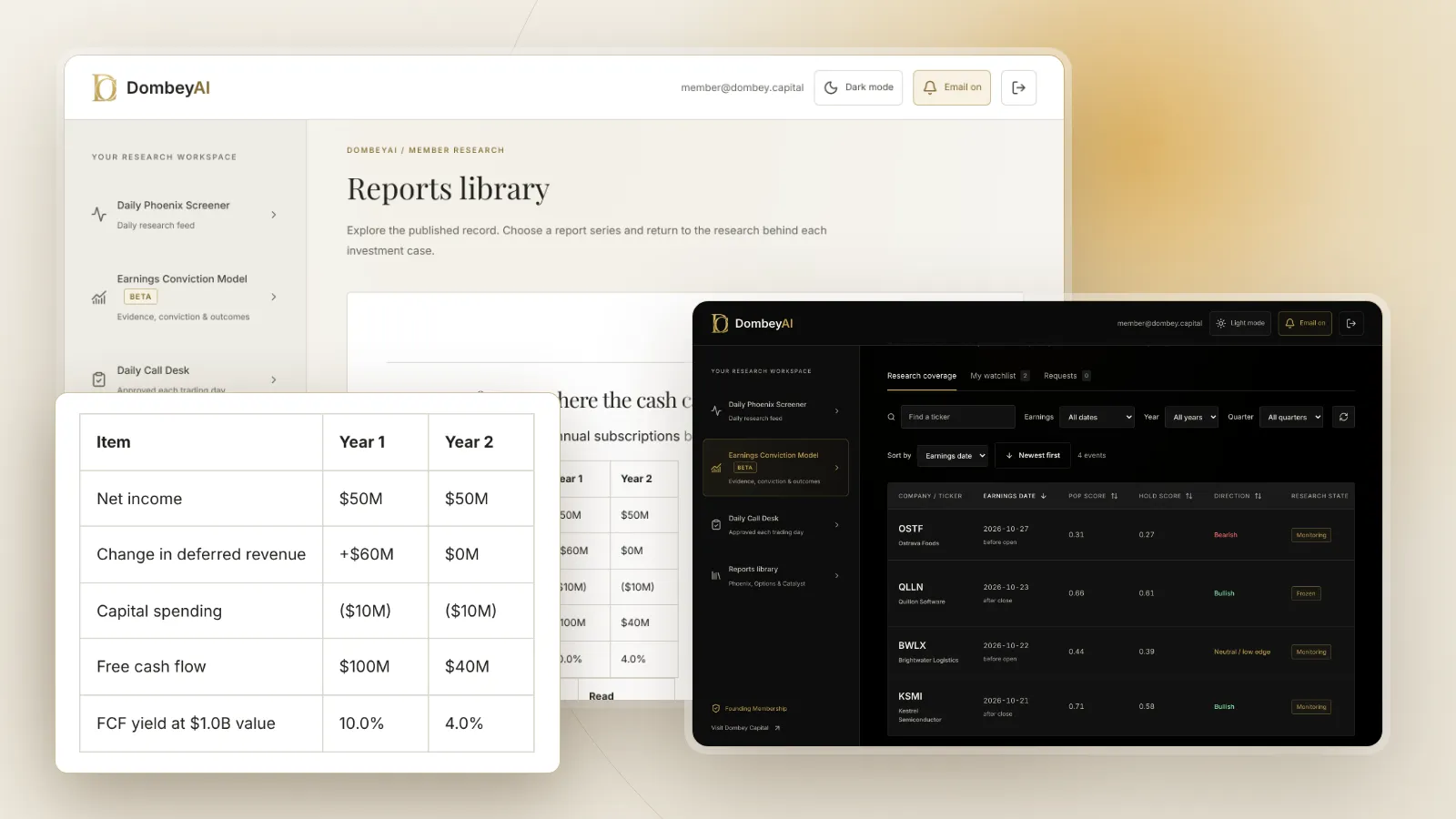
On the cash flow statement, an increase in deferred revenue is added back to net income because the company received cash it has not yet counted as revenue. A growing balance therefore lifts operating cash flow and free cash flow above earnings. This is one reason subscription companies often report free cash flow well ahead of net income.
That boost is real cash, and it funds the business at no interest cost. The issue for valuation is that it depends on growth. If the balance stops growing, the add-back disappears. If it shrinks, it becomes a deduction, and free cash flow falls below earnings even if the business is otherwise unchanged.
When you use free cash flow yield on a company with large prepaid balances, split the reported number into a steady-state part and the part that came from the change in deferred revenue. Treat the second part as tied to growth, not as permanent earning power. The same logic applies to other working capital swings.
Billings: the early read on demand
Billings is a simple measure: revenue plus the change in deferred revenue. It approximates what the company invoiced in the period, before accounting spreads it over the contract term.
Because revenue from annual contracts is recognized over twelve months, a slowdown in new bookings shows up in billings first and in revenue only later. A company can report steady revenue growth for several quarters while billings growth falls, because revenue is still catching up on contracts signed earlier.
Billings has limits. A shift from annual upfront billing to monthly billing reduces deferred revenue without any change in demand. A large multi-year prepayment can inflate one quarter. Acquisitions add an acquired balance. For those reasons, compare billings with remaining performance obligations, and read management's explanation of any change in billing terms before drawing conclusions.
Deferred revenue and enterprise value
Enterprise value is usually market value plus debt minus cash. Deferred revenue is not usually treated as debt, because the company settles it by delivering service, not by paying cash. Most of the cost of delivering is already in the cost base.
There are three cases where that simple view breaks down:
- Cash-rich companies with large prepaid balances. Some of the cash on the balance sheet is customer money for service not yet delivered. If you subtract all of it from enterprise value, you may understate what the business costs. A screen for net cash per share can overstate the margin of safety for this reason.
- High-cost fulfillment. A tour operator or education provider may spend most of the prepaid amount to deliver. There the obligation behaves more like debt.
- Liquidations and wind-downs. In a wind-down, customers who prepaid become claimants. Their claim competes with other creditors before anything reaches equity.
A practical approach is to estimate the cost to deliver the remaining obligation, usually the deferred balance times one minus the gross margin, and treat that cost as a liability in situations where the business might not continue.
Deferred revenue in takeovers
In an acquisition, the buyer takes on the obligation to serve customers who already paid. For many years acquirers recorded that liability at its fair value, often well below the book balance, which created a "haircut" that lowered reported revenue after closing. A 2021 FASB update (ASU 2021-08) changed this for most acquirers, requiring contract liabilities to be measured under the revenue standard instead, so less revenue disappears after a deal.
For a holder of the target, the point is simpler. A buyer valuing the company on cash flow will look at how much of recent free cash flow came from growth in deferred revenue and will not pay the same multiple for it as for steady-state cash. Comparable company analysis built on free cash flow multiples can mislead when the peers have different billing terms.
Reading the balance sheet: a checklist
| Check | Where to look | Why |
|---|---|---|
| Growth in deferred revenue vs revenue | Balance sheet and income statement | Faster deferred growth means billings are ahead of revenue |
| Change in billing terms | MD&A and revenue footnote | Moves from annual to monthly billing cut the balance |
| Remaining performance obligations | Revenue footnote | Contracted backlog, including amounts not yet billed |
| Current vs non-current split | Balance sheet | Multi-year prepayments can distort one period |
| Share of free cash flow from deferred revenue | Cash flow statement | Separates steady-state cash from growth timing |
| Gross margin | Income statement | Estimates the cost to fulfill the obligation |
If you are new to the balance sheet layout, how to read a balance sheet covers where each line sits.
Where this goes wrong
Deferred revenue analysis goes wrong in a few predictable ways.
- Treating growth-driven cash as permanent. The most common error is valuing a company on free cash flow that is inflated by a rising deferred balance and then applying a steady-state multiple.
- Missing a billing change. A shift to monthly billing, often made to win customers, shrinks deferred revenue and makes billings look weak when demand is fine.
- Reading one quarter. Seasonality is large in many subscription businesses, since many contracts renew at year end. Compare the same quarter year over year.
- Ignoring acquisitions. An acquired deferred balance adds to the reported number without any organic demand behind it.
- Using it as a debt substitute everywhere. For a going concern with high gross margins, subtracting the full balance from value overstates the cost of the obligation.
The metric works best as a check on the quality of cash flow, not as a valuation input on its own. Comparing it with growth metrics such as the Rule of 40 can help when the business is a subscription model.
How it fits a research process
For special situations, deferred revenue matters most in three places: when a cheap-looking subscription company may be cheap because its cash flow is about to fall, when a company with large prepaid balances is a liquidation or take-private candidate, and when a spin-off inherits a prepaid customer base with no history of its own. In each case, the balance tells you how much of today's cash belongs to tomorrow's obligations.
If you want data on deferred revenue trends across many companies, most fundamental platforms carry the balance sheet line. Our comparison of the best stock research tools for individual investors covers which ones show quarterly history and footnote detail.
The bottom line
Deferred revenue is cash collected before the work is done, recorded as a liability until delivery. While it grows, it lifts free cash flow above earnings; when it stalls, free cash flow falls back. Billings can flag a demand slowdown before revenue does, provided billing terms have not changed. Value the steady-state cash, treat the growth-driven part separately, and count the cost to deliver the obligation whenever the business might not continue as it is.