

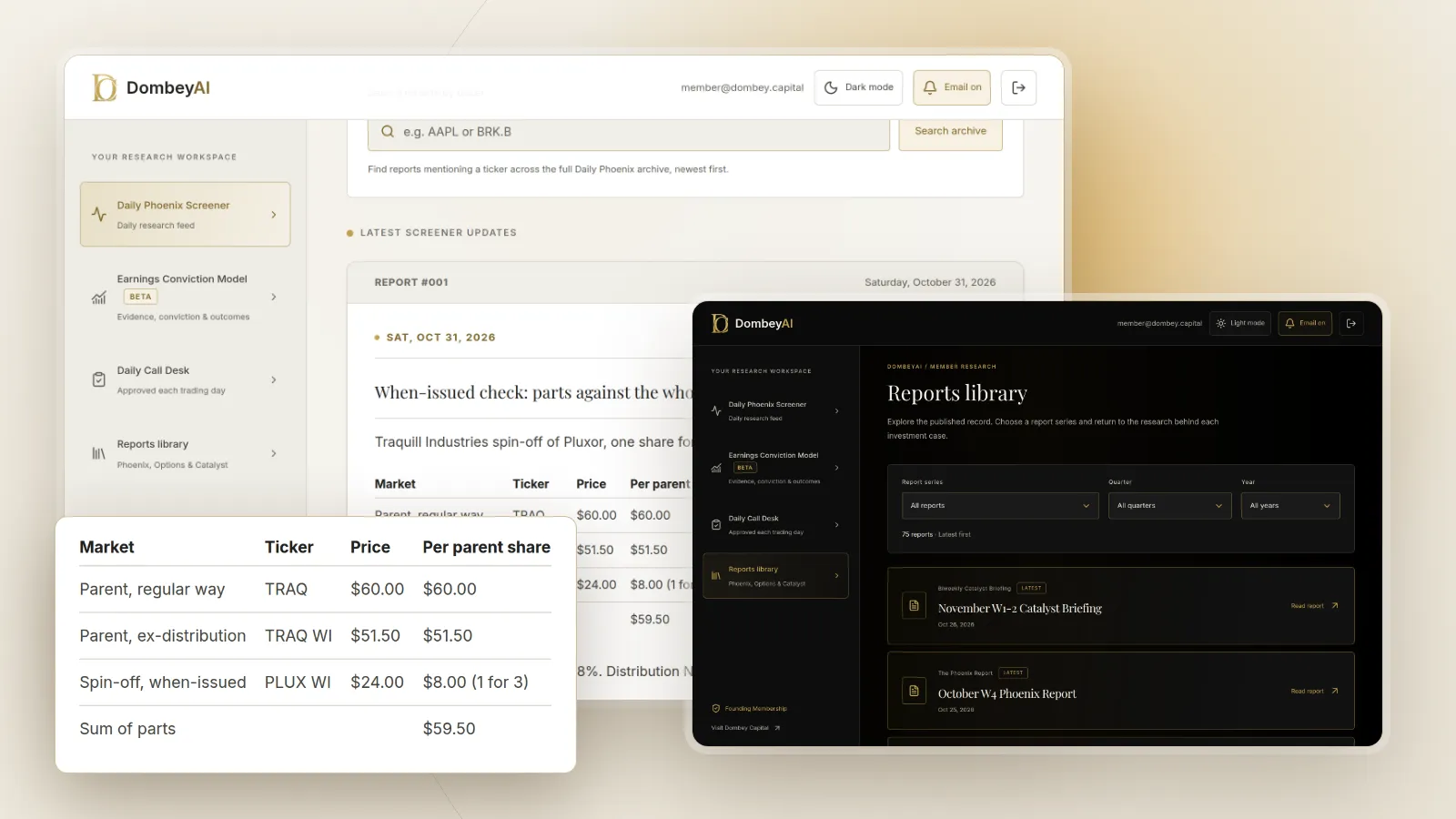
How when-issued trading works
A when-issued trade is a conditional contract. The buyer and seller agree a price today; the trade settles only after the shares are issued. If the distribution is cancelled, the trade is cancelled too.
In a spin-off, the parent files a Form 10 registration statement for the new company and mails an information statement to holders. Once the Form 10 is effective and the board sets the record date and distribution ratio, the exchange can open when-issued trading in the spin-off shares. Our explainer on Form 10 spin-off filings covers the document itself.
The three markets in a spin-off
During the when-issued window, the same corporate event can trade in three places at once:
| Market | Typical label | What the buyer gets | What its price tells you |
|---|---|---|---|
| Parent, regular way | Normal ticker | Parent shares plus the right to the spin-off shares | The combined company |
| Parent, ex-distribution | Ticker with a WI-style suffix | Parent shares only, without the spin-off | The parent after the separation |
| Spin-off, when-issued | New ticker with a WI-style suffix | Spin-off shares, delivered after distribution | The new company on its own |
Exchanges mark when-issued securities with a suffix, commonly WI after the ticker, and quote vendors display it in different ways. The company's press release announcing the record date usually names the symbols.
Ex-distribution and when-issued trading end around the distribution date. After that, the spin-off trades regular way under its own ticker and the parent's regular-way shares no longer carry the right.
The dates that matter
Four dates set the timetable, and the information statement and exchange notices give each one:
- Form 10 effective date. The registration of the spin-off shares becomes effective, usually a few weeks before the distribution.
- Record date. Holders of record on this date are entitled to the spin-off shares. When-issued and ex-distribution trading usually begin around it.
- Distribution date. The spin-off shares are issued to holders of record and when-issued trades begin to settle.
- Ex-date. For most spin-offs it falls on the first business day after the distribution date. From then on, the parent's shares trade without the right, and the when-issued and ex-distribution markets close.
Our guide on how to analyze a spin-off Form 10 shows where the dates and the distribution ratio appear in the filing. Write the dates down before the window opens, since the order matters for every order you place.
Due bills: how the right travels
The order of dates matters. For a normal dividend under one-day settlement, the ex-date is the record date, so a buyer on or after the ex-date does not get the dividend. For distributions worth 25% or more of the stock's value, which include most spin-offs, FINRA's rule sets the ex-date after the payment date. Between the record date and the ex-date, the parent's regular-way shares still carry the right to the spin-off shares.
The mechanism that makes this work is the due bill. A holder of record on the record date receives the spin-off shares. If that holder sold regular-way parent shares after the record date but before the ex-date, the holder owes those spin-off shares to the buyer, and the due bill transfers them through settlement.
The practical rule: if you sell the parent regular way during the window, you sell the spin-off with it. If you want to keep the spin-off and sell the parent, you sell in the ex-distribution market.
Checking the arithmetic
The three prices should hang together. Regular-way parent should be close to ex-distribution parent plus the when-issued spin-off value per parent share, adjusted for the distribution ratio.
Small gaps like that are normal. They reflect trading costs, the risk that the spin-off is delayed and the difficulty of shorting securities that do not settle yet. A large gap can point to a mispricing, but closing it usually needs access to all three markets, which most individual investors do not have.
Why investors watch when-issued prices
The when-issued market is information, even for investors who never trade in it.
- It values the parts. The Form 10 and investor day presentations argue for a value; the when-issued market gives the first independent price for each part.
- It shows where selling will land. Index funds and holders who do not want the spin-off often sell it in the first weeks of regular-way trading. When-issued prices sometimes anticipate that pressure. Our spin-off investing guide explains why spin-offs can be mispriced after the distribution.
- It sets the reference for options. Listed options on the parent are adjusted for the distribution, usually to deliver both parent and spin-off shares. Our explainer on adjusted options covers how that works.
- It tests leverage. If the parent loads the spin-off with debt, the when-issued price shows how the market values a leveraged stub before it trades freely.
A decision list for the window:
- If you hold the parent and want both companies, do nothing; the spin-off shares arrive on the distribution date.
- If you want to keep the spin-off but not the parent, the ex-distribution market is the place to sell the parent, if your broker offers it.
- If you want the spin-off but not the parent, the when-issued market is the place to buy it, again subject to broker access.
- If your broker offers none of this, wait for regular-way trading after the distribution and use the when-issued prices as a guide.
Where this goes wrong
When-issued markets are thin. Few brokers route to them, spreads can be wide and a handful of trades can set the quoted price. A when-issued price is therefore a weak estimate of value, and a large gap between the parts can persist until the window closes. The trades are conditional, so a delayed or cancelled distribution unwinds them. Finally, investors sometimes sell regular-way parent shares during the window believing they will keep the spin-off and then find it owed to the buyer through the due bill. Read the information statement and the exchange notice for the exact dates, and confirm with your broker.
For sources that track spin-offs and their dates, see our list of spin-off trackers and research sources and the broader list of investing newsletters for special situations. Dombey's published research covers spin-offs before and after the distribution; see the research archive.
The bottom line
When-issued trading lets the market price a spin-off before its shares exist, alongside the parent with and without the right to them. The order of the record date, distribution date and ex-date decides which market carries the spin-off, and the due bill moves it to buyers of the regular-way shares in between. Use the when-issued prices as the first independent read on what each part is worth, and treat them as thin, conditional quotes rather than settled values.