

What you need
- The prospectus supplement for the preferred offering and the certificate of designations, both on EDGAR. Our guide on how to search SEC EDGAR filings shows how to find exhibits.
- The issuer's latest 10-K and 10-Q, for debt, interest expense, preferred dividends and cash flow.
- A current quote with the bid and ask, and the next ex-dividend date.
- A spreadsheet for yield to call and coverage.
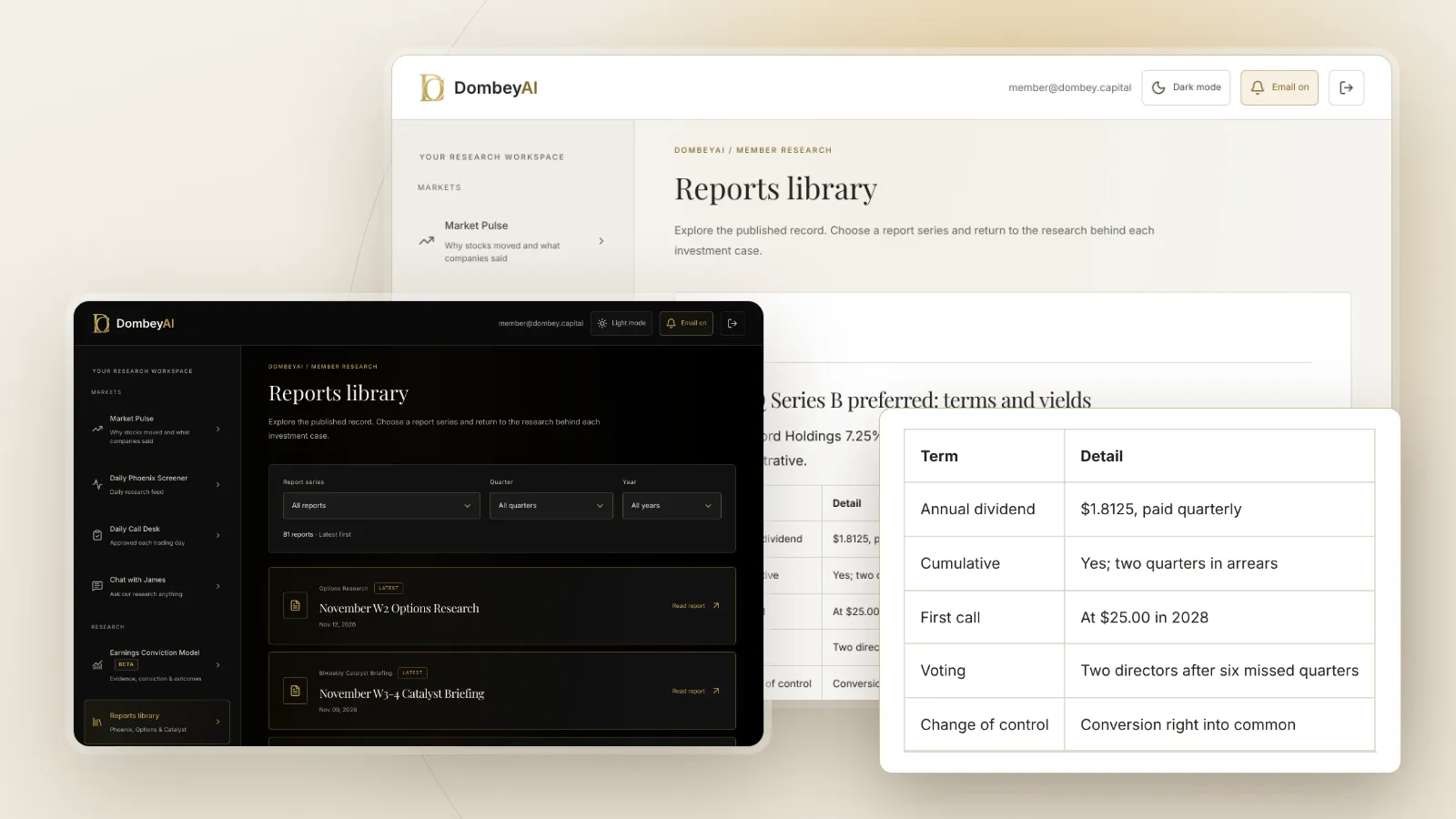
| Term | Where to find it | Why it matters |
|---|---|---|
| Liquidation preference | Certificate of designations | The claim per share, often $25 for exchange-listed issues |
| Dividend rate and type | Prospectus cover page | Fixed, floating or fixed-to-floating; sets the income |
| Cumulative or non-cumulative | Dividend section | Whether skipped dividends become arrears |
| Call date and price | Redemption section | Caps the upside and sets yield to call |
| Maturity | Cover page | Most are perpetual; some have a mandatory redemption date |
| Voting rights | Voting section | Director election rights after missed dividends |
| Change of control | Change-of-control section | Conversion or redemption rights in a takeover |
| Tax treatment | Tax section | Qualified dividends, REIT dividends or interest |
Step 1: Read the terms, not the quote page
Start with the certificate of designations. Note the liquidation preference, the dividend rate as a percentage of that preference, the payment dates and whether dividends are cumulative. Check whether the rate is fixed for life or resets after a set date to a floating benchmark plus a spread. Write each term in one line in your notes. Quote sites sometimes show the wrong call date or miss a reset, and those errors change the answer.
Step 2: Calculate current yield, yield to call and yield to worst
Current yield is the annual dividend divided by the price. It is the number most screens show, and it ignores the call.
Yield to call treats the preferred like a bond that ends on the first call date. If the price is above the call price, a call is likely when rates are lower than the coupon, and yield to call can be far below current yield. Yield to worst is the lowest of the yields across the possible call dates and, if there is one, the maturity.
Step 3: Place it in the capital structure
Preferred ranks behind every creditor: secured debt, unsecured bonds, trade payables, leases and pension claims. In a restructuring it is usually paid only after all of them are made whole. Map every layer with its amount and maturity, as our guide on how to map a capital structure describes, then ask how much enterprise value exists after the debt. If the answer is close to zero, the preferred behaves like equity, whatever its dividend rate.
Also check whether the preferred is issued by the parent or by a subsidiary. A subsidiary's preferred can rank ahead of the parent's creditors for that subsidiary's assets, which changes the recovery picture.
Step 4: Test whether the dividend is covered
Interest coverage alone flatters a company with preferred stock. Use fixed charge coverage instead: earnings before interest and taxes divided by interest expense plus preferred dividends. Preferred dividends are paid from after-tax income, so many analysts gross them up by dividing by one minus the tax rate before adding them to interest. Our explainer on the interest coverage ratio covers the basic measure.
Then look at cash. Compare operating cash flow less capital spending with total interest and preferred dividends, and check the debt maturities that come first. Read the bond covenants as well: some indentures restrict payments on preferred stock when leverage rises, which can stop dividends even when cash exists. Our guide on how to read a bond indenture shows where those limits sit.
Step 5: Check call, reset and redemption terms
The call is the issuer's option, not the holder's. Issuers tend to redeem when they can refinance more cheaply and leave the shares outstanding when they cannot. That asymmetry caps the gain when things go well.
Fixed-to-floating preferreds add a second layer. After the reset date the dividend moves with a benchmark rate plus a fixed spread, so a low spread can leave the shares trading below par for years if the issuer has no reason to call. Note the reset date and the spread, and estimate the post-reset dividend at today's benchmark.
Step 6: Check tax treatment and trading
Tax treatment changes the after-tax yield. Many preferred dividends from US corporations can qualify for the lower qualified dividend rate if holding period rules are met; REIT preferred dividends generally do not, and some exchange-listed "preferreds" are really debt that pays interest. The prospectus explains which applies, and IRS Publication 550 covers the general rules.
Then check trading. Many issues trade a few thousand shares a day with wide spreads. A spread of 1% of price costs a quarter or more of a year's dividend on a round trip, so use limit orders and size accordingly.
Step 7: Find the catalyst, if there is one
Preferred stocks become special situations when an event can close the gap between price and liquidation preference. Common ones:
- Resumed dividends. A cumulative preferred with suspended dividends can rise sharply when the board resumes payments and clears the arrears. Our piece on preferred dividends in arrears explains how the arrears are valued.
- Exchange offers and recapitalizations. A struggling issuer may offer common shares or new securities for the preferred, as in a debt-for-equity swap. The terms and the vote threshold decide the outcome.
- Takeovers. A change-of-control clause may give holders a conversion or redemption right; without one, the preferred may simply remain outstanding.
- Calls. A call at par is a gain for holders who bought below par, and it has a date.
Each of these has a date or a vote, which makes it easier to judge. Our comparison of special situations newsletters lists services that follow events like these.
Common mistakes
- Reading current yield as the return. Above par, the call usually caps the return well below the current yield.
- Ignoring non-cumulative terms. A skipped non-cumulative dividend is never paid, so the downside is larger than it looks.
- Treating preferred as debt. It ranks below all creditors and can be wiped out in a restructuring while the bonds recover.
- Missing the reset. A fixed-to-floating issue can earn far less after its reset date.
- Overlooking liquidity. Wide spreads and thin volume can cost more than a quarter's dividend.
The bottom line
A preferred stock is only as good as its terms and the issuer's capacity to honor them. Read the certificate of designations, calculate yield to call and yield to worst, place the shares in the capital structure and test coverage of interest plus preferred dividends. The opportunities tend to come from dated events, such as a call, a resumed dividend or an exchange offer, where the terms tell you what each outcome is worth.