

What you need
- Five years of 10-Ks and 10-Qs, from EDGAR or the company's investor relations site.
- The earnings releases and call transcripts for the same period.
- The last three proxy statements (DEF 14A).
- Form 4 filings for the officers and directors.
- 8-Ks under Items 4.01 (auditor changes) and 5.02 (officer and director changes).
- A spreadsheet with one row per year and a notes column.
Our guide on how to search SEC EDGAR filings covers finding each of these.
Step 1: Compare guidance with results
Collect every numerical outlook management gave, revenue, margins, EPS, cash flow, and set it next to what the company reported. Do this for at least five years.
| Year | Guidance given | Actual result | Met, missed or beat | Explanation given |
|---|---|---|---|---|
| Year 1 | Revenue $500m to $520m | $512m | Met | None needed |
| Year 2 | EPS $2.10 to $2.20 | $1.85 | Missed | Pricing pressure, named in Q2 |
| Year 3 | Free cash flow above $80m | $95m | Beat | Lower capital spending |
Figures are illustrative. A team that meets its own targets, and explains misses early and plainly, is easier to underwrite. Repeated misses with new reasons each time are a warning. Our page on guidance changes explains why the market reacts to them.
Step 2: Audit capital allocation
Capital allocation is the best single test of judgment. From the cash flow statement, add up five years of:
- Capital spending.
- Acquisitions.
- Buybacks and the average price paid.
- Dividends.
- Debt repaid or raised.
Then check what each produced. Did acquisitions earn their cost of capital, or were they written down later? See goodwill and impairments. Were buybacks made when the stock was cheap or at highs? Did return on invested capital rise or fall over the period?
Step 3: Read what they are paid to do
The Compensation Discussion and Analysis section of the proxy states the metrics behind annual bonuses and long-term awards. Behavior tends to follow pay. Our guide on how to read a proxy statement shows where to look.
- Better signs: per-share free cash flow, return on capital, total shareholder return over three years or more, multi-year vesting.
- Weaker signs: revenue, adjusted EBITDA or EPS growth with no capital charge, frequent changes to targets, one-off grants after a bad year.
Also check stock-based compensation as a share of revenue and the change in diluted share count over five years.
Step 4: Check ownership and insider trades
Look at how many shares each officer owns relative to annual pay, and how they got them. Shares bought on the open market carry more weight than shares granted. Form 4 filings show every trade. Our guide on how to track insider buying with Form 4 explains the codes. Cluster buying by several insiders is the strongest signal. Steady selling under a 10b5-1 plan is often routine.
Step 5: Read for candor
Read the CEO letter and three or four call transcripts across good and bad years. Note:
- Whether mistakes are named and owned, or blamed on outside factors.
- Whether the same metrics are reported each year, or new ones appear when old ones look bad.
- The size of the gap between adjusted and reported earnings, and whether it grows. See adjusted EBITDA.
- Whether answers to analysts' questions are direct.
Our guide on how to analyze an earnings call transcript gives a method for this reading.
Step 6: Check turnover and controls
Search 8-Ks for Items 4.01 and 5.02. Frequent CFO changes, a chief accounting officer leaving shortly before a filing, or an auditor resignation are serious warnings. Check the 10-K for a material weakness in internal controls.
Step 7: Review the board and related parties
Read the proxy for board independence, director tenure, how many directors own meaningful stock and whether the chair and CEO roles are split. Read the related-party transactions section carefully: leases, loans or contracts with insiders' other businesses deserve a full explanation.
Step 8: Score and write it down
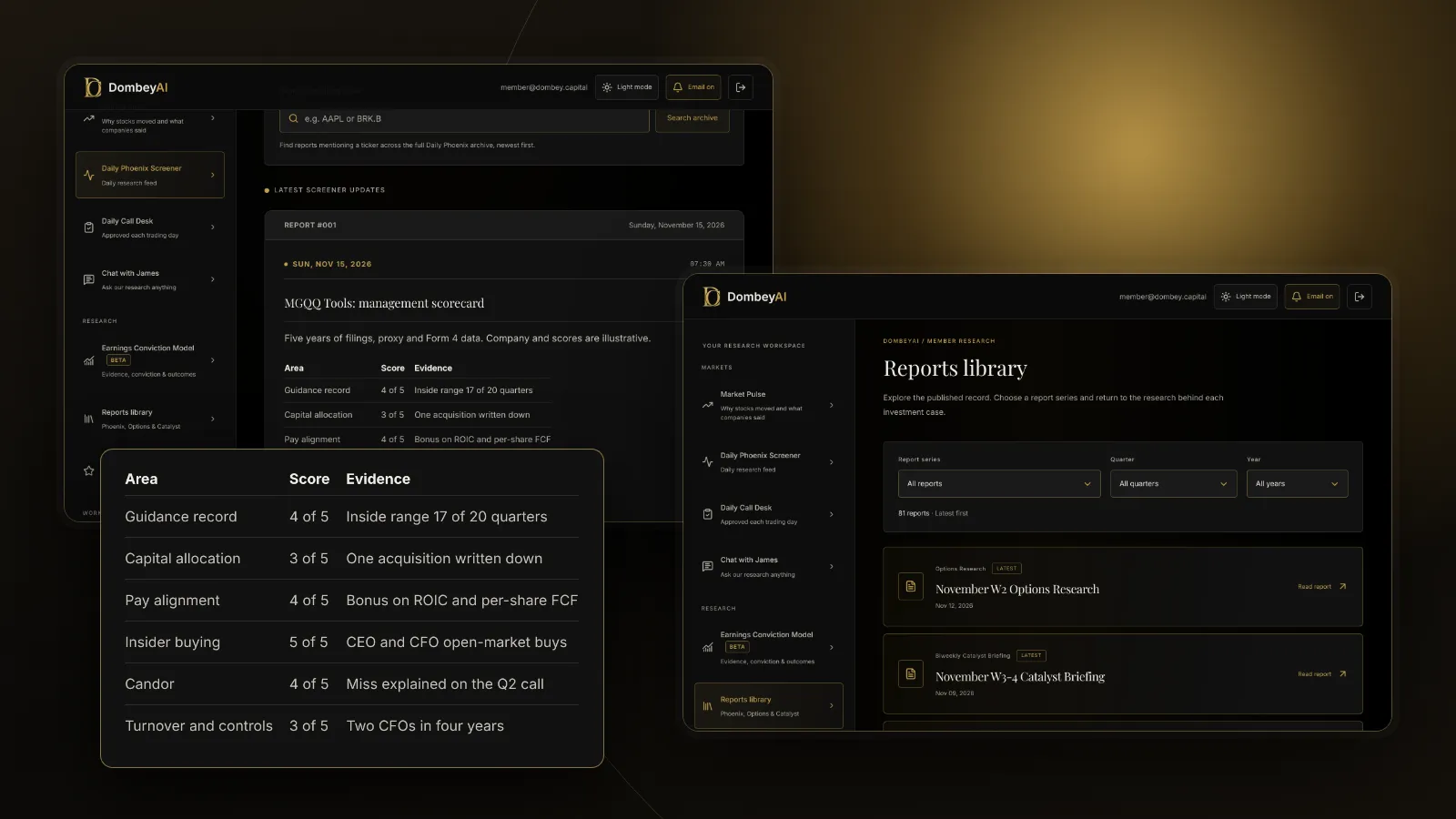
Give each area a score and record the evidence, so you can check later whether your judgment held up.
| Area | Score (1 to 5) | Evidence |
|---|---|---|
| Guidance record | ||
| Capital allocation | ||
| Pay alignment | ||
| Ownership and insider buying | ||
| Candor | ||
| Turnover and controls | ||
| Board and related parties |
Add the result to your investment checklist and revisit it when a CEO changes, since CEO departures reset much of this record.
Step 9: Retest the score after each catalyst
A score is a hypothesis about how management will behave. Test it when the company reaches a dated event: an earnings report with guidance, an acquisition, a capital return decision or a CEO change. Write down beforehand what a high-quality team would do, then compare.
| Event | What a strong team usually does | What to check afterward |
|---|---|---|
| Earnings with guidance | Sets targets it can meet, explains misses early | Did results land inside the range? Was the reason consistent? |
| An acquisition | Pays a price it can justify on returns, explains the math | Deal multiple, financing, expected return on capital |
| Excess cash | Chooses between buybacks, dividends, debt repayment and investment by return | Price paid for buybacks against intrinsic value |
| A bad quarter | Names the cause and the fix | Did the explanation hold the next quarter? |
| A CEO change | Has a succession plan; the board explains the choice | Proxy disclosures, the new CEO's first decisions |
Update the scores with the new evidence and keep the old ones, so the history is visible. Our guide on how to run an investment post-mortem shows how to review a call after the result.
Keep the scoring sheet with the rest of your notes on the company. Over several years it becomes a record of which signals predicted good and poor decisions in your own work, which helps you weight them better on the next company.
Common mistakes
- Judging by charisma. A confident presenter is not evidence. The record is.
- Crediting luck. A strong period in a rising market may say little about skill. Look at how the team handled a downturn.
- Ignoring the price paid. A good acquisition at too high a price is a poor decision.
- Reading one year of pay. Pay plans change. Read three years to see whether targets were moved.
- Treating all insider sales as bad. Planned sales for taxes or diversification are normal. Focus on unusual size and timing.
- Stopping at the CEO. The CFO, the board and the audit committee shape outcomes too.
For the data platforms that make this work faster, see the best stock research tools for individual investors. Dombey's published research weighs management's record in each thesis; see the research archive.
The bottom line
Management quality is visible in the filings: guidance against results, capital allocation and its returns, pay design, ownership, candor and turnover. Work through each area with evidence, score it and write it down. A team with a strong record on guidance and capital allocation, real ownership and stable finance roles is easier to trust with your capital. Revisit the score whenever the people or the incentives change.