

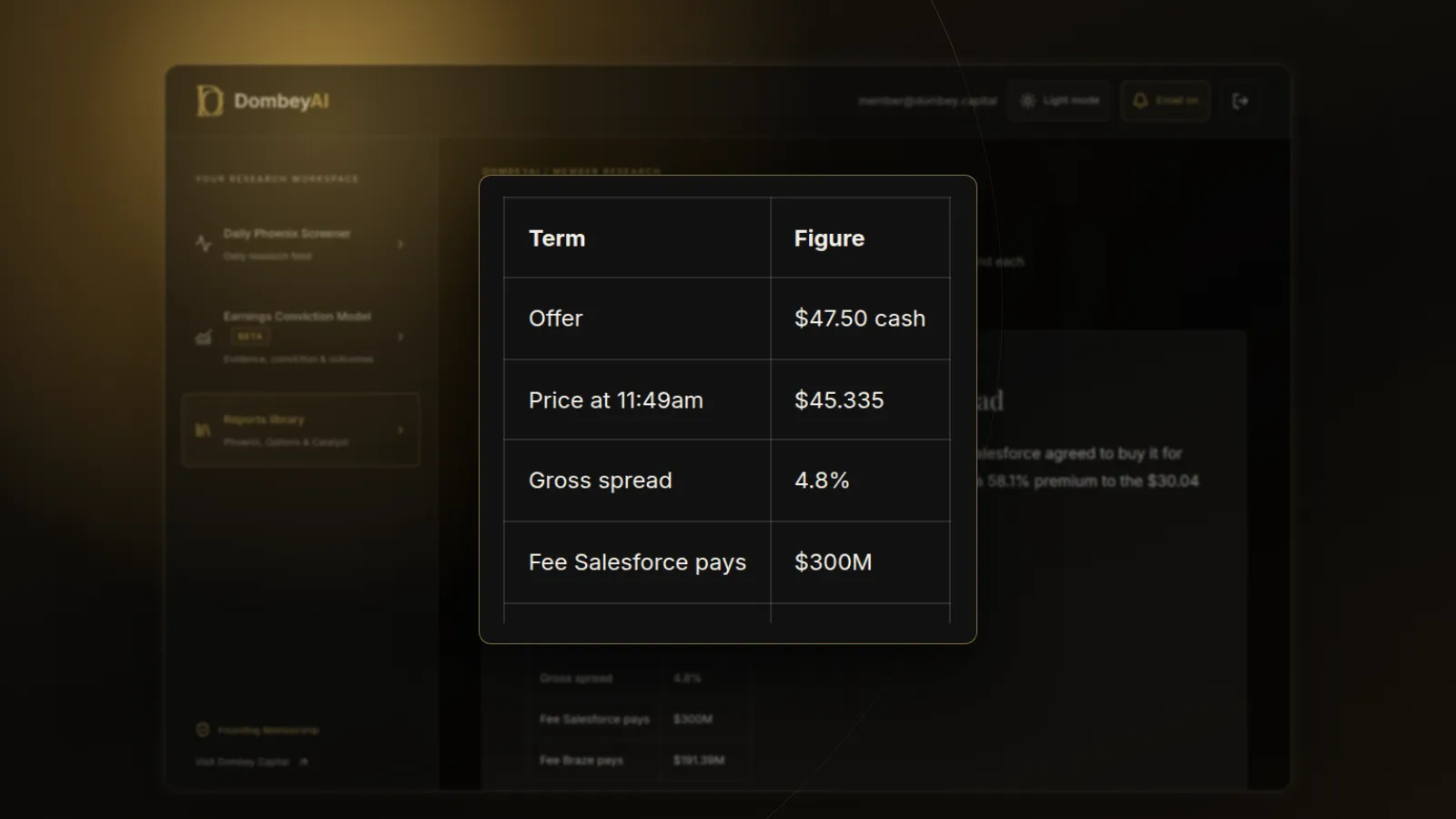
Oct 20, 2026: Salesforce agrees to buy Braze for $47.50 a share
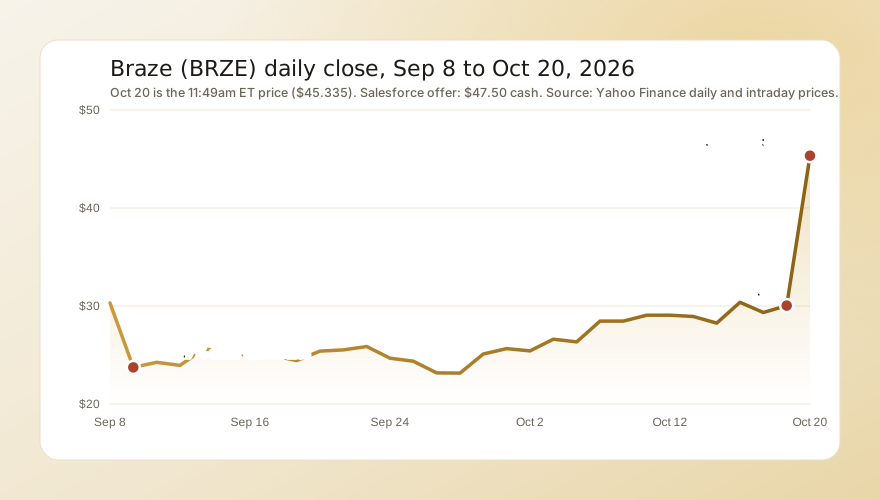
Braze traded at $30.07 at 7:00am and $29.95 at 7:15am, in line with Monday's close. The deal was announced before the open. When premarket trading picked up at about 8:40am, the stock printed $45.90 and touched a premarket high of $46.00, then settled near $45.45.
It opened the regular session at $45.53 and set the day's high of $45.58 in the first five minutes. The low was $45.26 at about 11:05am. At 11:49am it was $45.335, up 50.9%. The range was tight because the price is now anchored to a fixed cash offer, and the only questions left are when it closes and whether it closes. Other names moved too: Klaviyo, the closest standalone rival, rose 10.0% to $19.265, which we covered in why Klaviyo stock rose on the Braze deal. Salesforce fell 1.4% to $238.96. For other names moving on the day, see today's biggest stock moves.
After the jump, RSI(14) stood at 84, the shares sat 59% above their 50-day average and 89% above their 200-day average, and volume ran about 24 times its 20-day average of 2.0 million shares.
The deal terms
| Term | What the filings say |
|---|---|
| Price | $47.50 in cash per Class A share, without interest |
| Enterprise value | About $5.66 billion |
| Premium | 58.1% to the $30.04 close on Oct 19 |
| Signed | Oct 19, 2026; board approval unanimous |
| Shareholder vote | Majority of outstanding Class A shares |
| Regulatory | HSR waiting period, plus other antitrust and foreign investment approvals |
| Expected close | Salesforce fiscal 2028 (Feb 1, 2027 to Jan 31, 2028) |
| Outside date | Oct 19, 2027, plus up to two 90-day extensions for approvals |
| Fee Braze pays | $191.39 million (no vote, changed recommendation, superior proposal) |
| Fee Salesforce pays | $300 million (blocked by a final order or law, or outside date) |
| Go-shop | None; a no-shop with a fiduciary out |
| Financing condition | None |
A few details matter beyond the headline price. The 8-K says certain Braze holders signed support agreements to vote their Class A shares for the deal and against rival proposals, but it does not name them or give their share count. Insiders own about 22.8% of the stock. Equity awards split: vested stock units and in-the-money options are cashed out at $47.50, underwater options are cancelled for nothing, and unvested service-based stock units convert into Salesforce units. The closing conditions also allow Salesforce to walk if a regulator demands a "Burdensome Condition," a term the 8-K uses but does not define; the full agreement will. Our guide to reading a merger agreement covers each of these clauses, and our explainer on the go-shop period explains what Braze holders gave up by not having one.
Salesforce said the deal does not change its fiscal 2027 guidance. J.P. Morgan advised Salesforce, and Qatalyst Partners advised Braze.
What the price paid says
Braze reported revenue of $227.2 million for the quarter ended July 31, up 26%, with non-GAAP operating income of $22.0 million and free cash flow of $21.7 million. It had 2,789 customers, 361 of them paying more than $500,000 a year, and dollar-based net retention of 110%. It guided fiscal 2027 revenue to $910 million to $913 million.
On those numbers, $5.66 billion is about 6.8 times trailing twelve-month sales of $834.2 million and about 6.2 times the midpoint of this year's revenue guide. The offer is also 27% above the stock's pre-deal 52-week high of $37.33. That context matters for a possible rival bid. The stock fell 21.7% on Sep 9, the day after a quarter that beat estimates, as some investors wanted stronger earnings guidance and worried about stock-based pay, The Motley Fool reported. So Salesforce bought six weeks after a sharp drop, and the 58.1% premium is measured from a depressed base. Our explainer on what a takeover premium is covers why the base date matters.
The spread
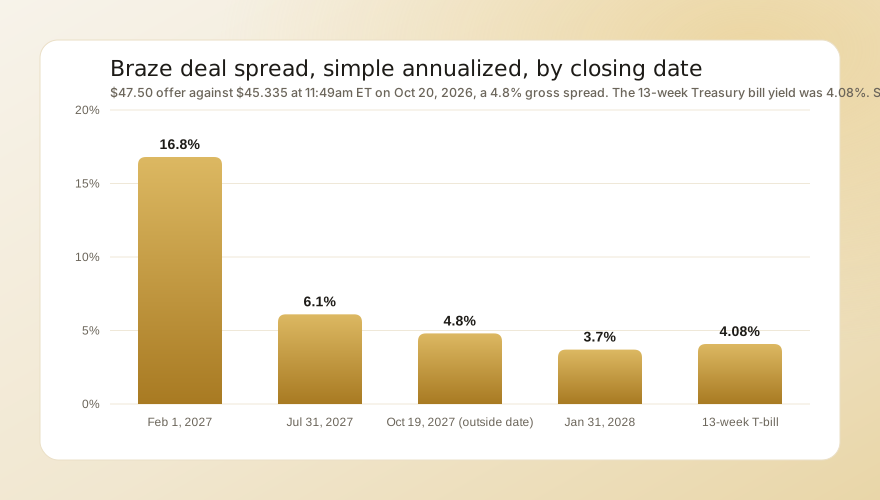
At $45.335, the stock is $2.165 below the offer, a 4.8% gross return if the deal closes. How good that is depends on timing. The merger arbitrage spread guide explains the math; here is a simple annualized version:
| If the deal closes on | Days from Oct 20 | Annualized return |
|---|---|---|
| Feb 1, 2027 (first day of Salesforce fiscal 2028) | 104 | 16.8% |
| Jul 31, 2027 | 284 | 6.1% |
| Oct 19, 2027 (outside date) | 364 | 4.8% |
| Jan 31, 2028 (last day of fiscal 2028) | 468 | 3.7% |
The 13-week Treasury bill yielded 4.08% the same morning. The market is pricing a close well inside fiscal 2028, not at its end.
The downside is the other half. If the deal broke and the stock returned to $30.04, holders would lose $15.295 a share. Setting $2.165 of upside against $15.295 of downside, the price implies about an 88% chance the deal closes, before the time value of money. Our explainer on what happens when a merger fails shows why broken deals often fall below the pre-deal price.
What could break the deal
- Antitrust review. Salesforce Marketing Cloud and Braze both sell customer engagement and messaging software to brands, so the overlap is direct. A second request under the HSR Act would add months; our explainer on the HSR waiting period covers how that works. The agreement also needs foreign investment and other antitrust approvals that the 8-K does not list.
- A long timeline. The companies point to Salesforce's fiscal 2028, and the outside date can stretch to about April 2028 with both extensions. Each month of delay lowers the annual return.
- The shareholder vote. A majority of outstanding Class A shares must approve, not just those voting. Holders who bought near the $37.33 high, or who think the price is low against the growth rate, could push back once the proxy shows the background of the sale.
- A material adverse effect. Salesforce can walk if one occurs before closing, a high bar for a buyer to meet.
What could improve it
- A rival bid. The no-shop limits this, and a rival would have to pay more than $47.50 plus cover the $191.39 million fee, about $1.69 a share. It is possible but not likely.
- Early clearance. If the HSR waiting period expires without a second request, the market will price a close near the start of fiscal 2028, and the spread should narrow.
- A dated vote. Filing the preliminary proxy and setting a meeting date would remove one of the two open conditions.
What comes next
- The preliminary proxy statement. Braze said it will file one on Schedule 14A. It will show the sale process, any other bidders, Qatalyst's fairness analysis and the size of the support agreements.
- The HSR filing and waiting period. Whether the agencies clear the deal or issue a second request is the largest single swing factor. Our guide on tracking a merger through approval lists the filings to watch.
- Braze's fiscal third-quarter report. Braze guided revenue of $229 million to $230 million for the quarter ending Oct 31. Results matter less now that the price is fixed, but a weak quarter would make a material adverse effect claim the topic, and a strong one would support holders who argue the price is low.
- January 31, 2027. The end of Salesforce's fiscal 2027, after which the expected closing window opens.