

Oct 23, 2026: strong data, a lower response rate and a gap down
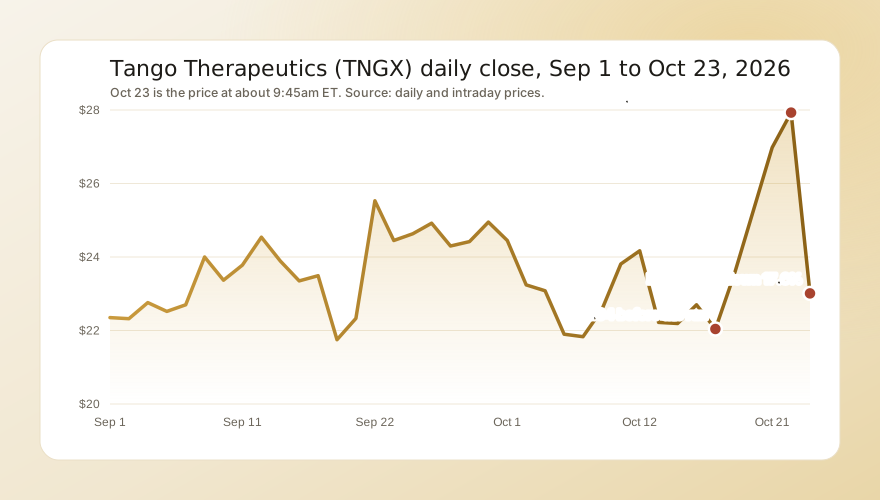
Tango released its data at about 6:30am ET and held a webcast for investors at 7:30am. In premarket trading the stock was $25.45, down 8.9%, RTTNews reported. It opened at $25.54 and fell to $23.61 within the first five minutes, bounced to $24.50 by about 9:40am, then slid again. At about 9:45am it was $23.01 on 2.65 million shares, and the low so far was $22.82. The day's high, $25.71, came at the open.
What pushed it down:
- The response rate fell. In June, 11 of 12 patients responded to vopimetostat plus daraxonrasib, or 92%. The new data count 18 of 22 responders, or 82%, with a disease control rate of 100%. Eleven responses were confirmed and seven more were unconfirmed at the Aug 20 cutoff and later confirmed. On samples this small the gap is within chance, but it was the first thing the market could read.
- Expectations had run ahead. From Oct 16 to Oct 22 the stock rose from $22.04 to $27.93, up 26.7%, and it gained 3.5% on Thursday alone. Commentary on Oct 20 already asked how much of the data was priced in.
- Safety questions. At the lower dose level, 40% of 25 patients had a Grade 3 treatment-related adverse event. The most common events were stomatitis (48%), rash (44%) and diarrhea (28%), all Grade 1 or 2; none had Grade 4 or 5 events and none stopped treatment because of side effects. The higher dose level had three dose-limiting toxicities in two of four patients and was not well tolerated.
- The pace is slow. The Phase 3 is not planned to start until the first half of 2027, so the next hard efficacy data are a long way off. Its dual primary endpoints are response rate and progression-free survival, with overall survival a key secondary endpoint, against standard chemotherapy.
- No help from the zoldonrasib arm. The combination with Revolution's other drug, zoldonrasib, in pancreatic cancer with a KRAS G12D mutation showed a 54% response rate in 35 patients and a nine-month progression-free rate of 61%, close to June's 52%.
From the Oct 22 close, at about 9:45am:
| Stock or fund | Oct 22 close | Oct 23, about 9:45am | Change |
|---|---|---|---|
| Tango Therapeutics (TNGX) | $27.93 | $23.01 | -17.6% |
| Kura Oncology (KURA) | $9.86 | $9.42 | -4.5% |
| Arvinas (ARVN) | $7.72 | $7.47 | -3.3% |
| Ideaya Biosciences (IDYA) | $36.12 | $35.29 | -2.3% |
| SPDR S&P Biotech ETF (XBI) | $151.64 | $148.40 | -2.1% |
| Syndax (SNDX) | $13.57 | $13.32 | -1.9% |
| Revolution Medicines (RVMD) | $187.69 | $184.88 | -1.5% |
| iShares Biotechnology ETF (IBB) | $209.54 | $206.61 | -1.4% |
| SPDR S&P 500 ETF (SPY) | $763.96 | $760.49 | -0.5% |
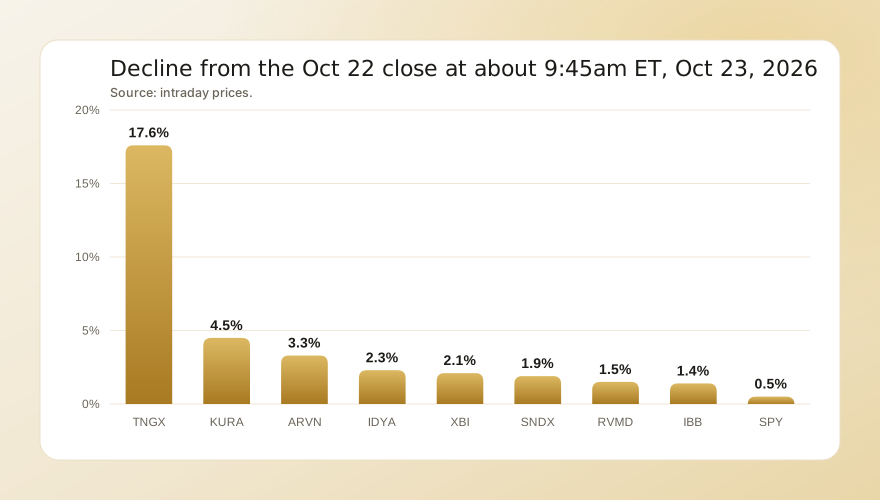
Biotech was soft, with XBI down 2.1%, but Tango fell about eight times as far. Revolution Medicines, whose drug is the partner in the combination, fell only 1.5%, so the market is not marking down the combination as a whole. It is repricing Tango's share of the upside after a run. For other biotech names that moved on data, see our pages on Biohaven and Rapport Therapeutics, and today's biggest stock moves.
At about 9:45am on Oct 23, RSI(14) stood at 47, the shares sat 3% below their 50-day average and 5% above their 200-day average, volume of 2.65 million shares ran 0.7 times its 20-day average of 3.8 million shares, and the stock was 33% below its 52-week high of $34.39.
The data, in numbers
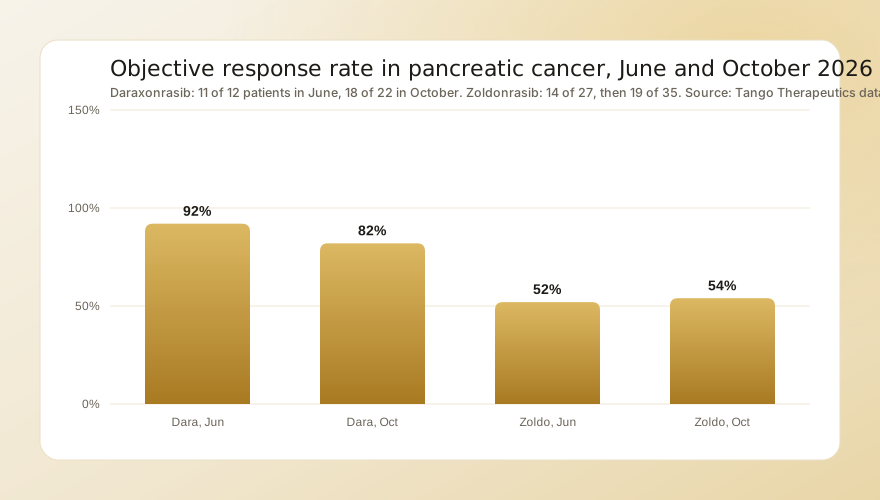
The October update covers a data cutoff of Aug 20, 2026. Of 22 efficacy-evaluable pancreatic patients, 13 received the combination as third-line therapy. Median follow-up was 7.1 months, with a range of 3.3 to 12.5 months, and median progression-free survival was not yet reached. Tango also reported four of five patients responding in lung cancer at the lower dose. That group is too small to carry weight.
The June figures were 11 of 12 patients responding, nine responses confirmed, and a six-month progression-free rate of about 90%. The stock closed that day at $30.93, up 53% from $20.22.
The bull case
- The tail of the curve. 88% of patients had not progressed at nine months. Principal investigator Alexander Spira said so despite heavy pretreatment, and Anna Berkenblit of PanCAN called the results worth rapid evaluation in a larger, randomized trial.
- A defined path. The Phase 3 will randomize patients 1:1 to vopimetostat 200 mg plus daraxonrasib 100 mg or chemotherapy, in front-line MTAP-deleted disease. Tango will also discuss a second-line approval with regulators and keeps studying tumors without the MTAP deletion.
- Cash. Tango held $1.014 billion at the end of June against a market value near $3.9 billion at today's price, and its second-quarter loss was $55.3 million. Our guide to estimating cash runway shows how to check a figure like that.
- Valuation against targets. The average analyst target is $45.91 and the median is $40, with a high of $69 and a low of $24, so only the lowest target is near today's price.
The risks
- Small samples. The October response rate rests on 22 patients, and 13 of them were third-line. A randomized trial can disappoint where a single-arm study did not; see our explainer on valuing a binary event.
- Tolerability. Grade 3 events in 40% of patients at the lower dose are manageable in cancer care, but a longer treatment course in front-line patients may look different.
- Dilution. On Aug 11 Tango filed to sell up to $400 million of stock at market prices through Leerink, replacing an earlier $100 million program of which about $64.4 million had been sold. At the assumed price of $27.07 that was 14.8 million shares on top of 168.4 million outstanding at June 30. Our explainer on dilution covers how this works.
- Crowded positioning. The short float is 36%. A high short float can speed a rebound and a drop alike; see short interest and squeeze risk.
- A partner's drug. The combination depends on daraxonrasib, which Tango does not own.
What comes next
- ESMO, through Oct 27. The congress runs Oct 23 to 27 in Madrid, and analyst reactions and updated price targets should follow in the coming days.
- Third-quarter results, expected around Nov 3. The report will show cash at Sept 30, spending, and any stock sold under the at-the-market program. Our guide to preparing for an earnings report explains what to check.
- FDA feedback on the Phase 3 and a possible second-line filing. Dates have not been given. The difference between hard and soft catalysts matters here, since a filing date is hard and a plan to talk is soft.
- The first half of 2027. The planned Phase 3 start. For the tools biotech investors use to follow these dates, see our list of FDA calendars and biotech catalyst trackers.