

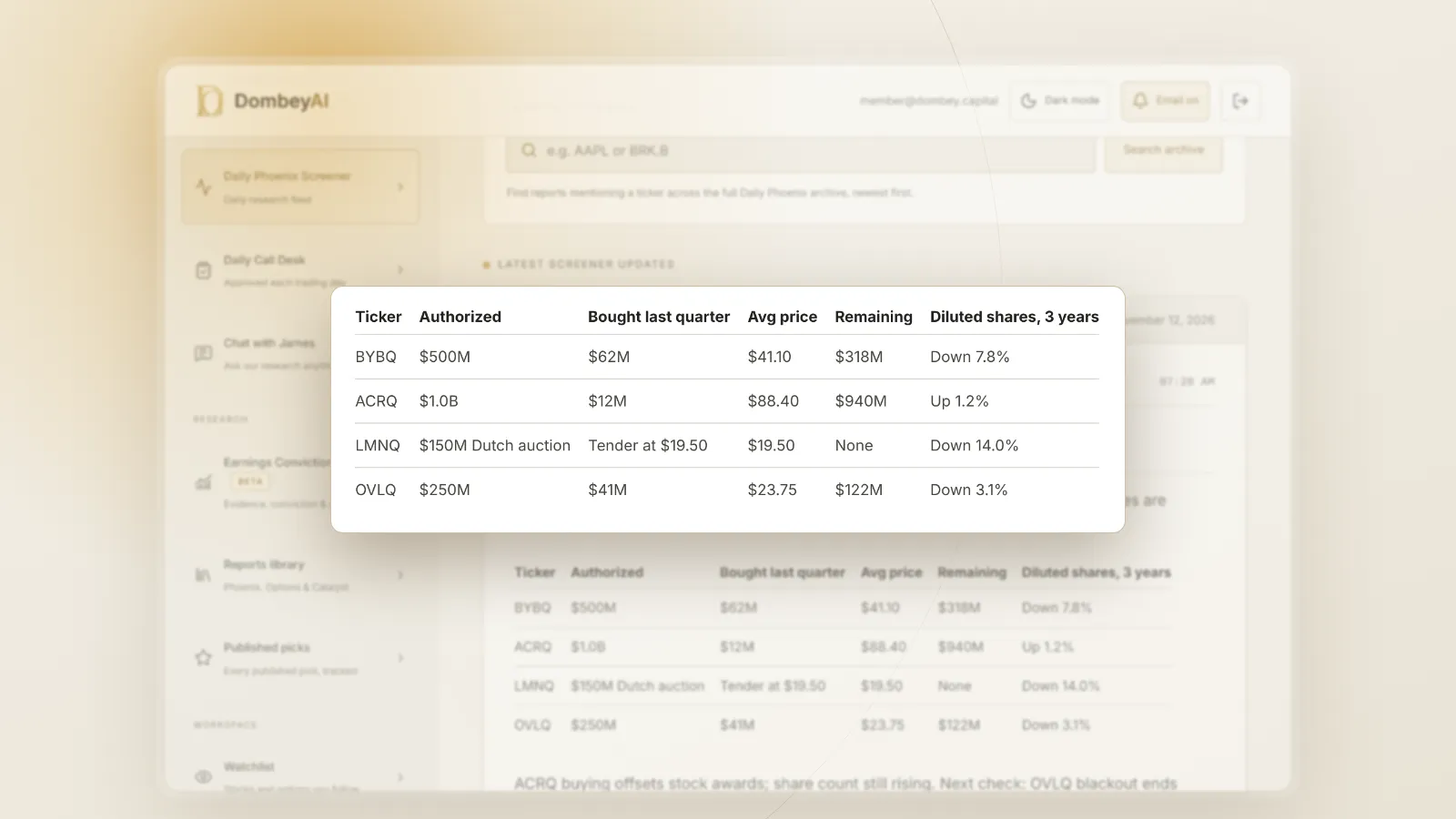


Full disclosure: Dombey Capital is our own research service and our top pick here, for the reasons below. The section on where it falls short is there so you can judge whether it fits your process.
What a buyback tracker needs to show
Tracking buybacks well means following three different things, and most tools cover only one or two:
- Authorizations. The board approves a program, often a dollar amount over several years. Companies announce these in press releases and 8-Ks.
- Actual repurchases. What the company bought. Item 703 of Regulation S-K requires a table in each 10-Q and 10-K showing, by month in the latest quarter, the shares bought, the average price, how many were under announced programs and the amount still available.
- The share count. Whether repurchases shrink the share base or only offset shares issued for stock compensation and acquisitions. Our explainer on dilution and share count changes covers why this is the final test.
An authorization is permission, not a promise. Many companies announce large programs and complete them slowly. That is why our piece on buybacks as catalysts argues that execution, funding and price matter far more than the headline.
Quick comparison
| Tool | Best for | Key features | Price (as of November 2026) |
|---|---|---|---|
| Dombey CapitalTop pick | Buybacks as catalysts in written research | Weekly Phoenix Report, Catalyst Briefing, DombeyAI Portal, dated public archive | Public Archive free; Founding Membership $1,200/yr; Standard Access $80/yr or $8/mo |
| SEC EDGAR | Authorizations and actual repurchases | 8-Ks, 10-Q and 10-K repurchase tables, tender offer filings, full-text search | Free |
| Koyfin | Charting share count history | Free: 2Y financials, advanced charting, 2 watchlists and 2 screens | Free; Plus $39/mo; Premium $79/mo; Advisor Core $209/mo; Advisor Pro $299/mo |
| TIKR | Long financial history on a free plan | Free: US stocks, 5Y and 8 quarters of financials, 90 days of transcripts | Free; Plus $24.95/mo; Pro $54.95/mo; Ultimate $119.95/mo |
| Stock Rover | Screening across many metrics | Free plan; paid plans add screeners, metrics and history | Free; Premium $34/mo or $348/yr; Premium Plus $70/mo or $588/yr; Ultimate $99/mo or $948/yr |
| Finviz | Fast free screening | Free: basic screener, delayed data, 3Y financial statements | Free; Elite $39.50/mo or $299.50/yr |
| Morningstar Investor | Ratings and screens with fair values | Screener with 200+ data points, analyst reports, portfolio tools | $34.95/mo or $249/yr |
| Seeking Alpha Premium | News flow and analysis around announcements | Screeners, ratings, coverage of 4,000+ stocks and ETFs | $299/yr list; first-year offer $239 when checked |
How we compared these tools
We compared them from vendor documentation, pricing pages and public product pages, weighting the criteria that matter for buybacks as events rather than as a statistic.
| Criterion | Weight | What it measures |
|---|---|---|
| Fit for buybacks as catalysts | 30% | Whether the tool helps judge if a repurchase can change the stock's value |
| Access to actual repurchase data | 25% | Whether you can see what was bought, not just announced |
| Share count history | 20% | Years of diluted share data and how easily it is charted |
| Free access | 15% | What the free plan or free source gives |
| Price transparency | 10% | Whether prices are published and what they buy |
If you weight free data and share count charts above catalyst analysis, EDGAR, TIKR and Koyfin move ahead of Dombey, which is research rather than a data site.
Quick picks by job
Best for buybacks as catalysts: Dombey Capital
Dombey publishes research on situations where an event can reset a stock's value, including large repurchases funded from excess cash, Dutch auction tender offers and buybacks in companies trading below net cash. Each thesis is dated and kept in the archive, and the Public Archive is free.
Best for authorizations and actual repurchases: SEC EDGAR
The 8-K announces the program; the 10-Q and 10-K repurchase table shows what was bought, month by month. It is free and it is the source every other tool relies on.
Best for charting share count history: Koyfin
Koyfin's free plan includes two years of financials and advanced charting, with paid plans extending history. Charting diluted shares over time shows whether buybacks shrink the base.
Best for long financial history on a free plan: TIKR
TIKR's free plan covers US stocks with five years and eight quarters of financial history, enough to see a buyback program's effect over a full cycle.
Best for screening across many metrics: Stock Rover
Stock Rover's paid plans add screeners and hundreds of metrics, useful for building a list of companies whose share counts are falling.
Best for fast free screening: Finviz
Finviz's free screener is quick for a first list, with three years of financial statements on the free version.
Best for ratings and fair values alongside buybacks: Morningstar Investor
Morningstar Investor pairs a screener with fair value estimates and analyst reports, useful when judging whether a company is buying back stock above or below its estimated value.
Best for news flow around announcements: Seeking Alpha Premium
Seeking Alpha publishes news and contributor analysis, and Premium adds screeners and ratings, which helps follow reaction to new programs.
Full reviews
1. Dombey Capital
What it does. Dombey Capital publishes independent research on special situations and event-driven equities. Each thesis sets out the situation, the catalyst and its date, the valuation and what would change the view, and is priced on the day it is published and kept in the archive. Buybacks appear where they are the catalyst: tenders, large programs funded from excess cash and repurchases that change the per-share math. There are three access levels:
- Founding Membership ($1,200 a year, annual billing only): the weekly Phoenix Report, weekly Options Research, the Catalyst Briefing, the DombeyAI Portal with the Daily Phoenix Screener and the Earnings Conviction Model, valuation and execution analysis, and priority access.
- Standard Access ($80 a year, about $6.67 a month, or $8 a month on monthly billing), the lower-cost option: the Biweekly Catalyst Briefing on forthcoming corporate and market events, plus the complete public-research archive.
- Public Archive (free): published executive theses and public research.
Best for. Investors who already follow buyback announcements and want research on which ones matter. Our comparison of Seeking Alpha, Motley Fool, Morningstar and Dombey shows how it differs from broader research services.
Pricing. Public Archive free. Founding Membership $1,200 a year. Standard Access $80 a year or $8 a month. See the subscription options.
Pros
- Judges whether a repurchase changes value, not just whether one was announced.
- Each thesis is dated and archived, so you can check later whether it held.
- A free archive to judge it by before paying.
Cons
- Not a buyback database: no list of every authorization.
- Covers a short list of situations.
- The full list of limits is in the section on where Dombey falls short.
Verdict: Our top pick for investors who treat buybacks as catalysts. Pair it with EDGAR and a data platform.
2. SEC EDGAR
What it does. EDGAR holds every public company's filings. Buyback authorizations appear in press releases, often furnished on 8-Ks. Actual purchases appear in the issuer repurchase table in Part II of each 10-Q and in the 10-K. Tender offers for shares appear as Schedule TO filings. Full-text search finds phrases such as "repurchase program" across filings.
Best for. Anyone who wants the primary facts. Our list of the best SEC filing tools and EDGAR alerts covers ways to get notified, and our guide on reading a 10-Q for special situations shows where the table sits.
Pricing. Free.
Pros
- The primary source, with monthly repurchase detail.
- Free, with full-text search.
- Shows the amount still available under each program.
Cons
- One company at a time; no ready-made cross-company view.
- Takes time to read and compare quarters.
Verdict: Essential. Every other tool here is a layer on top of it.
3. Koyfin
What it does. Koyfin is a financial data and charting platform. Its free plan includes two years of financials and one year of estimates, portfolios, advanced charting, market and macro dashboards, two watchlists, two screens and two custom dashboards. Paid plans extend history and limits.
Best for. Charting share count and per-share figures over time. Our list of Koyfin alternatives compares similar platforms.
Pricing. Free. Plus $39 a month. Premium $79 a month. Advisor Core $209 a month. Advisor Pro $299 a month.
Pros
- Strong charting on the free plan.
- Dashboards for watching many companies.
Cons
- Two years of financials on the free plan, short for a buyback history.
- Paid plans cost more than most data sites here.
Verdict: The best choice for charts of share count and per-share metrics.
4. TIKR
What it does. TIKR is a stock research platform with financials, estimates, transcripts and screening. The free plan covers US stocks with five years and eight quarters of financial history, five years of charting, 90 days of transcripts and unlimited saved watchlists. Plus adds global coverage; higher plans add more history.
Best for. Seeing several years of share count and cash flow on a free plan. Our list of TIKR alternatives compares it with similar tools.
Pricing. Free. Plus $24.95 a month. Pro $54.95 a month. Ultimate $119.95 a month.
Pros
- Five years of US financials free.
- Transcripts help find what management said about repurchases.
Cons
- US only on the free plan.
- Not built around buybacks specifically.
Verdict: The best free plan here for a multi-year view.
5. Stock Rover
What it does. Stock Rover is a research and portfolio platform. The free plan covers basic research on individual stocks; paid plans add screeners, hundreds of metrics, longer history and portfolio tools. All plans offer a 14-day free trial.
Best for. Screening for companies with shrinking share counts across many metrics. Our list of Stock Rover alternatives covers similar tools.
Pricing. Free. Premium $34 a month or $348 a year. Premium Plus $70 a month or $588 a year. Ultimate $99 a month or $948 a year. Ultimate Pro $199 a month or $1,788 a year.
Pros
- Deep screening and metrics on paid plans.
- Portfolio tools for tracking positions.
Cons
- Most screening power sits on paid plans.
- A learning curve for new users.
Verdict: Good for building and monitoring a buyback watchlist.
6. Finviz
What it does. Finviz is a screener and market visualization site. The free version has a basic screener, delayed data, three years of financial statements, one watchlist and one portfolio. Elite adds real-time data, advanced filters, longer statements, alerts and exports.
Best for. A fast first screen. Our list of Finviz alternatives compares other screeners.
Pricing. Free. Elite $39.50 a month or $299.50 a year.
Pros
- Familiar, fast screener.
- Free version covers a first pass.
Cons
- Basic filters and delayed data on the free version.
- No exports or alerts without Elite.
Verdict: The default free screener; confirm anything it finds in the filings.
7. Morningstar Investor
What it does. Morningstar Investor offers a stock screener with more than 200 data points, Morningstar ratings including fair value estimates, analyst reports and portfolio tools. A seven-day free trial is offered.
Best for. Judging whether a company is repurchasing above or below an estimated fair value. Our list of Morningstar alternatives covers similar services.
Pricing. $34.95 a month or $249 a year.
Pros
- Fair value estimates give a reference for buyback prices.
- Analyst reports discuss capital allocation.
Cons
- No free plan.
- Coverage centers on larger companies.
Verdict: Useful when the question is whether a buyback is good use of cash.
8. Seeking Alpha Premium
What it does. Seeking Alpha publishes news and contributor analysis. Premium adds stock screeners, ratings and coverage of over 4,000 stocks and ETFs, plus AI research features.
Best for. Following news and opinion after a buyback announcement. Our list of Seeking Alpha alternatives compares similar sources.
Pricing. $299 a year list; the page showed a first-year price of $239 on the date we checked.
Pros
- Broad news and analysis coverage.
- Screeners and ratings on Premium.
Cons
- Contributor quality varies.
- Not a source for actual repurchase data.
Verdict: A news and opinion layer, best paired with the filings.
Where Dombey falls short
- Narrow coverage. Dombey covers special situations, not every buyback announcement.
- No data terminal. It has no database of authorizations or share count screens across the market.
- Small team. Coverage is selective by design, and some sectors are thin.
- Pen-name author. Research is published under the byline of James Whitfield, a pen name.
- Short history. The archive is young, so there is less record to judge it by than for long-established services.
Free vs paid
You can track buybacks well for free. EDGAR gives authorizations and actual repurchases, the free plans of TIKR, Koyfin, Stock Rover and Finviz give share counts and basic financials, and Dombey's Public Archive gives research examples. Paid plans earn their cost when you want screens across many companies, longer history, alerts and exports, or research on which buybacks matter delivered on a schedule.
How to choose
| Your situation | Pick | Add later when |
|---|---|---|
| You want research on buybacks that change value | Dombey CapitalTop pick | You want market-wide screens: add Stock Rover or Finviz Elite |
| You want the facts at no cost | SEC EDGAR | You follow many companies: add a data platform |
| You want charts of share count | Koyfin | You need longer history: upgrade or add TIKR |
| You want several years free | TIKR | You need global coverage: TIKR Plus |
| You want to screen for shrinking share counts | Stock Rover | You want catalyst research: add Dombey |
| You want buyback prices against fair value | Morningstar Investor | You want primary data: add EDGAR |
Buybacks are only one part of capital return. Our explainer on shareholder yield combines them with dividends and debt paydown.
The bottom line
Dombey Capital is our top pick for investors who treat buybacks as catalysts and want research on which ones change value, with a free Public Archive to judge it by. SEC EDGAR is the essential free source for authorizations and actual purchases, and Koyfin, TIKR and Stock Rover show whether the share count is really falling. Finviz, Morningstar Investor and Seeking Alpha Premium add screening, fair values and news. Whatever you use, read the repurchase table: an authorization is permission, and only the filings show what was bought.