

What a fairness opinion says
The opinion is usually a two to four page letter. Its key sentence states that, as of the date of the letter and based on the assumptions and limitations described, the consideration to be received by a specified group of holders is fair, from a financial point of view, to those holders.
Each part of that sentence is chosen carefully:
- "As of the date": the opinion speaks only to conditions on that day. It is usually not updated before the shareholder vote.
- "Assumptions and limitations": the adviser relies on management's projections and on information it was given, without independent verification.
- "Specified group": often the public shareholders other than the buyer and its affiliates. In a controller deal, that wording matters.
- "From a financial point of view": it does not address the merits of the deal, its strategic logic or whether it is the best available price.
Why boards get them
State corporate law, especially in Delaware, expects directors to be adequately informed when they approve a sale. Smith v. Van Gorkom in 1985 held directors liable for approving a merger without enough information about value, and since then fairness opinions have become standard evidence that a board took advice. They are part of the record a court reviews if shareholders sue.
The opinion is not a full valuation report. Advisers do not appraise individual assets, audit the books or check management's projections against outside data, and the letter says so. That is part of why the opinion's conclusion almost never varies: the work behind it is designed to test whether a negotiated price is reasonable given the information provided, not to discover a different price.
They also appear in specific situations where the stakes for independence are higher: going-private transactions, squeeze-out mergers by a controlling holder, and deals approved by a special committee. In those cases the committee often hires its own adviser.
The analyses behind the opinion
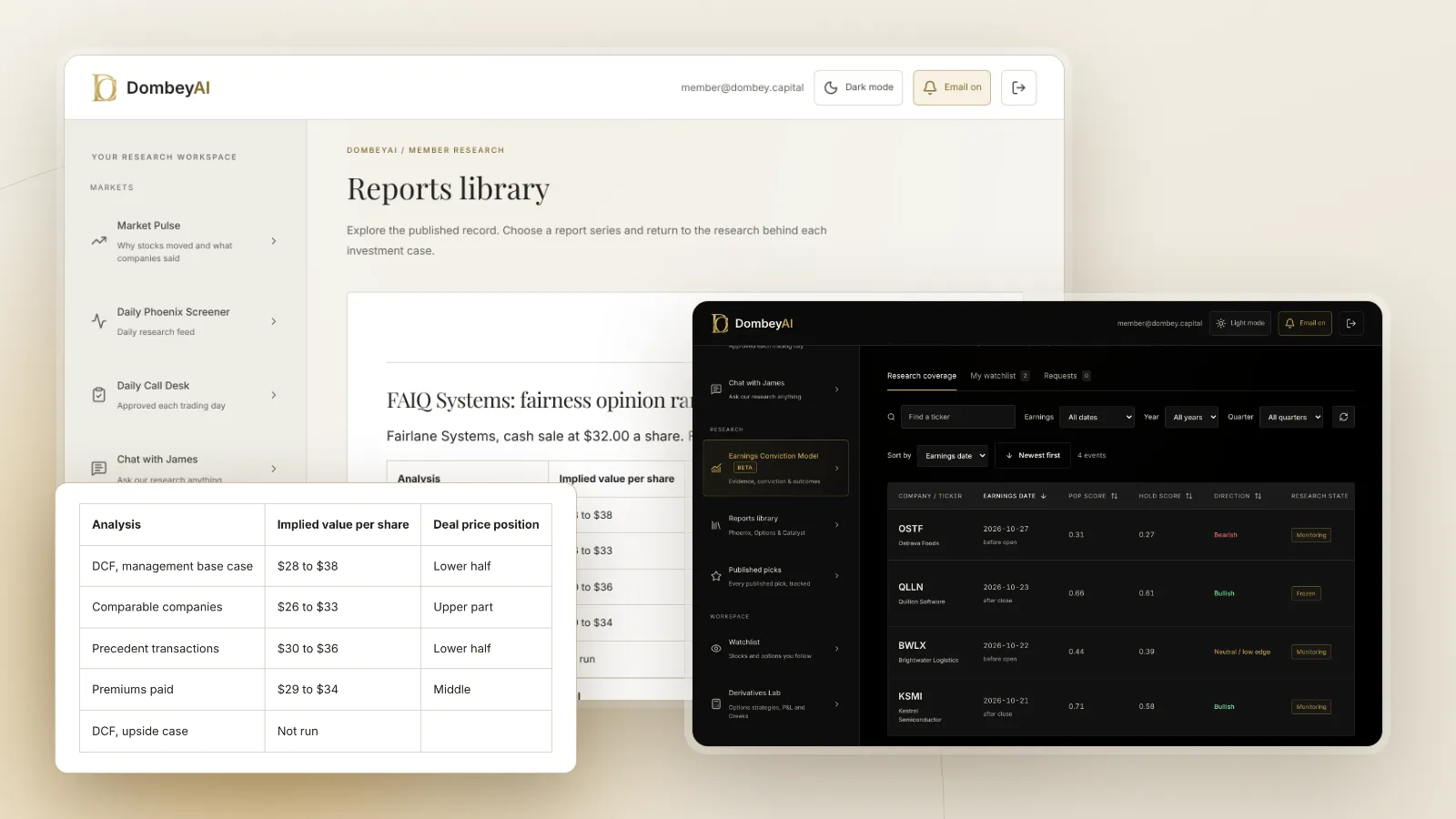
The proxy statement or S-4 includes a section, usually titled "Opinion of" followed by the adviser's name, that summarizes the financial analyses. Typical analyses:
| Analysis | What it does | What to check |
|---|---|---|
| Discounted cash flow | Values the company on management's projections | Which projection case, discount rate range, terminal value method |
| Comparable companies | Applies trading multiples of peers | Which peers, which multiple, how wide the range |
| Precedent transactions | Applies multiples paid in past deals | Which deals, how old, how similar |
| Premiums paid | Compares the premium with past deal premiums | Which unaffected price date was used |
| Leveraged buyout analysis | Estimates what a financial buyer could pay | Assumed leverage and target returns |
| Sum of the parts | Values segments separately | Whether segment multiples are consistent |
| Analyst price targets | Lists published targets | Shown for reference only |
Each analysis produces a range of implied values per share. The deal price is then compared against those ranges. Our explainers on discounted cash flow, comparable company analysis and precedent transaction analysis cover how each method works.
How to read the summary in a proxy
A practical sequence:
- Find the projections. The proxy discloses the management projections given to the adviser, often in more than one case. Note which case each analysis used.
- Line up the ranges. Put each method's range next to the deal price. Look for where the price falls, not just whether it is inside.
- Check the inputs. Discount rates, terminal multiples, peer sets and the unaffected price date all move the result. Our explainer on terminal value shows why a small change can move a DCF a long way.
- Read the background. The "Background of the Merger" section explains how the price was negotiated, which other bidders appeared and when projections were revised. See how to read the background of the merger.
- Read the conflicts. The fee and relationship disclosures follow the analyses.
Our guide on how to read a proxy statement covers the rest of the document.
Conflicts and disclosures
Fairness opinions carry real conflicts, and the disclosures exist to make them visible:
- Contingent fees. When the adviser also ran the sale, most of its fee is often payable only if the deal closes. The opinion fee itself may be a small fixed amount.
- Relationships with the buyer. The bank may have lent to, advised or traded with the buyer, especially a private equity sponsor.
- Projection changes. Projections revised downward shortly before the opinion deserve a close read.
FINRA Rule 5150 requires member firms issuing a fairness opinion that is provided to shareholders to disclose, among other things, whether compensation is contingent on the deal, any material relationships with the parties in the past two years, whether the firm independently verified the information and whether a fairness committee approved the opinion. SEC rules also require the proxy to describe material relationships and fees.
How fairness opinions matter for event-driven investors
For merger arbitrage and other deal situations, the fairness opinion and its analyses help answer practical questions:
- Is the price defensible in court? A price near the bottom of the ranges, with conflicts, invites litigation and appraisal claims. See what appraisal rights are.
- Is there room for a higher bid? A price low in the ranges can support a competing offer or a bumpitrage campaign.
- Will holders vote for it? Proxy advisers and large holders read the same analyses.
Dated deal events and how stocks moved on them are covered on Dombey's market pages.
Where this goes wrong
- Treating the opinion as an endorsement. It is a narrow statement, not a judgment that the deal is good.
- Ignoring the projections. The analysis is only as good as the projections management provided. If they were trimmed before the deal, the ranges move down with them.
- Reading only the conclusion. The ranges and inputs carry the information; the conclusion is almost always "fair".
- Overlooking the date. The opinion is not updated for later events, such as a rise in peer valuations before the vote.
- Missing whose fairness it is. An opinion addressed to one class of holders may say nothing about another class.
The bottom line
A fairness opinion is a banker's letter stating that a deal price is fair from a financial point of view to a defined group of holders, on given assumptions and as of a date. It is not an endorsement of the price or the deal. The useful material is in the proxy: the valuation ranges, the projections they rely on, the negotiation history and the fees. Read those together, and note where the price sits in each range, before drawing a view on the deal.