

A short definition
In an ordinary acquisition, a buyer pays a premium to take control of a target. In a merger of equals, two companies agree to combine on roughly neutral terms. Each side's shareholders receive shares of the new or surviving company in proportion to what they contributed, through an exchange ratio set close to the two companies' pre-deal stock prices. The combined company then splits governance between the two sides, often with an equal or near-equal board.
Three features usually appear together:
- Stock consideration. Shares, not cash, so both sets of holders stay invested.
- Little or no premium. The takeover premium is small or zero, because neither side is buying the other.
- Shared governance. Board seats, executive roles and sometimes the name and headquarters are divided.
Real examples
These deals were announced as mergers of equals. The outcomes show how far the label can stretch.
| Deal | Announced | How it was structured | What happened |
|---|---|---|---|
| Daimler-Benz and Chrysler | 1998 | Stock combination presented as a merger of equals | Daimler management came to run the group; Chrysler was sold off in 2007 |
| Sirius Satellite Radio and XM | 2007 | All-stock merger of equals | Closed in 2008 after a long antitrust review |
| Dow Chemical and DuPont | 2015 | All-stock merger of equals | Formed DowDuPont in 2017, then split into three companies in 2019 |
| BB&T and SunTrust | 2019 | All-stock merger of equals with an equal board | Formed Truist, with the CEO role passing from one side to the other on a set timetable |
| United Technologies and Raytheon | 2019 | All-stock merger of equals | Formed Raytheon Technologies in 2020, now RTX |
The Dow and DuPont deal used the merger as a step toward a planned split, which is why it is often studied alongside spin-off investing. Daimler-Chrysler is the standard warning: the deal was presented as equal, and in practice one side ran it.
How to tell who really controls the company
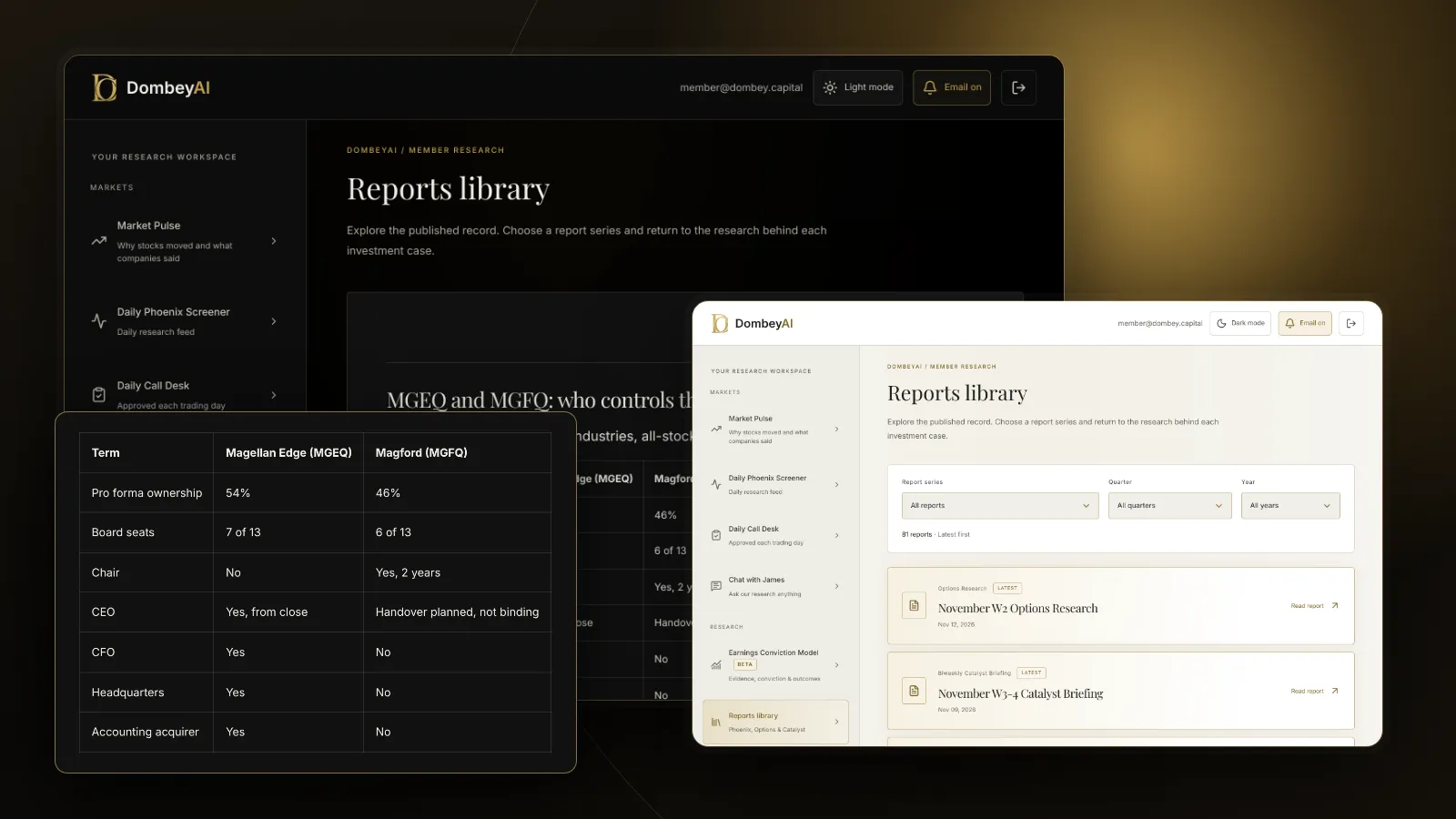
The governance terms sit in the merger agreement and in the S-4 registration statement that registers the new shares. Our guide on how to read a merger agreement covers where to find them. Five points settle most cases.
- Ownership split. If one side's holders own 55% or more of the combined company, that side is usually the economic acquirer.
- Board composition. Count the seats each side names, and check who holds the chair and lead independent director roles.
- CEO and succession. A common structure gives one side the first CEO term and the other side the chair, with a dated handover. Check whether the handover is binding or only planned.
- CFO and division heads. The finance chief often reveals which company's systems and culture will run the combined business.
- Headquarters and name. Symbolic, but they often follow control.
US accounting rules also force a choice. One company must be named the accounting acquirer, based on factors such as relative voting rights, board composition, senior management and relative size. The S-4 states which company that is and why. That paragraph is often the clearest statement of control in the whole filing.
What it means for the two stocks
Because there is little premium, a merger of equals does not create a takeover gap in the way a cash deal does. The two stocks become linked by the exchange ratio. The spread between them, the difference between one stock's price and the exchange ratio times the other's, reflects deal risk, time to close and borrow costs. Our merger arbitrage explainer covers how that spread behaves.
Both shareholder bases usually vote, because each is giving up control of its own company. That makes the shareholder vote a real event. A large holder on either side can oppose the deal on the grounds that its company is contributing more than its share.
Merger of equals vs an acquisition
The differences show up in the terms, the votes and the trading. The table sets them side by side.
| Feature | Merger of equals | Ordinary acquisition |
|---|---|---|
| Consideration | Almost always stock | Cash, stock or a mix |
| Premium | Little or none | Usually a meaningful premium to the undisturbed price |
| Shareholder votes | Usually both companies | Usually the target; the buyer votes only if it issues enough new shares |
| Board after closing | Split, often equally | The buyer's board, sometimes with a seat or two for the target |
| CEO | Shared or handed over on a timetable | The buyer's CEO |
| What the target holder gets | A share of the combined company | A price, or a share of the buyer at a premium |
| What drives the spread | Exchange ratio, deal risk, time | Deal price, deal risk, time |
Two consequences follow. First, because both sets of holders keep a stake, the combined company's prospects matter to both, and both stocks often move together on news about the deal. Second, because there is no premium to protect, a rival bidder can step in with a cash offer for either side, which turns a quiet merger into a contest. Our page on what a hostile takeover is covers how that can unfold.
When a merger of equals carries a meaningful premium for one side, read it as an acquisition with shared governance. The premium tells you who is paying for control, whatever the press release calls the deal.
Where this goes wrong
- Power shifts after closing. Equal boards can tilt quickly once directors retire or a CEO handover is brought forward. The governance terms often expire after a set period.
- Integration problems. Two companies of the same size bring two sets of systems and cultures, and neither has clear authority to choose. Cost savings can arrive later than promised.
- No premium, real risk. Holders give up control without a premium, so a weak combined company can leave both sides worse off.
- Regulatory reviews. Combining two large players in the same industry can draw a long antitrust review. Our page on FTC and DOJ merger challenges covers how that unfolds.
- The label hides a sale. When one side's shares are weak and the other's are strong, a "merger of equals" can be a sale without a premium.
What to read in the filings
- The merger agreement, filed as an 8-K exhibit: exchange ratio, closing conditions, termination fees, governance covenants.
- The S-4 or joint proxy statement: the background of the merger, the fairness opinions, the accounting acquirer and the governance after closing.
- The bylaws of the combined company: how long the board split and CEO plan are protected, and what vote is needed to change them.
A dated CEO handover, the shareholder votes and the antitrust timetable are all catalysts worth putting in a calendar. Dombey's published research tracks this kind of dated event; see the research archive. For the general approach to deals and their dates, see what event-driven investing is, and for live situations see Dombey's market coverage.
The bottom line
A merger of equals is a stock-for-stock combination of similar-sized companies with little premium and shared governance. The label tells you how the companies want the deal seen, not who will run it. Read the ownership split, board seats, CEO plan and accounting acquirer in the S-4 to find the real acquirer. Then treat the votes, the regulatory review and any CEO handover as the dated events that decide how the deal works out.