

A short definition
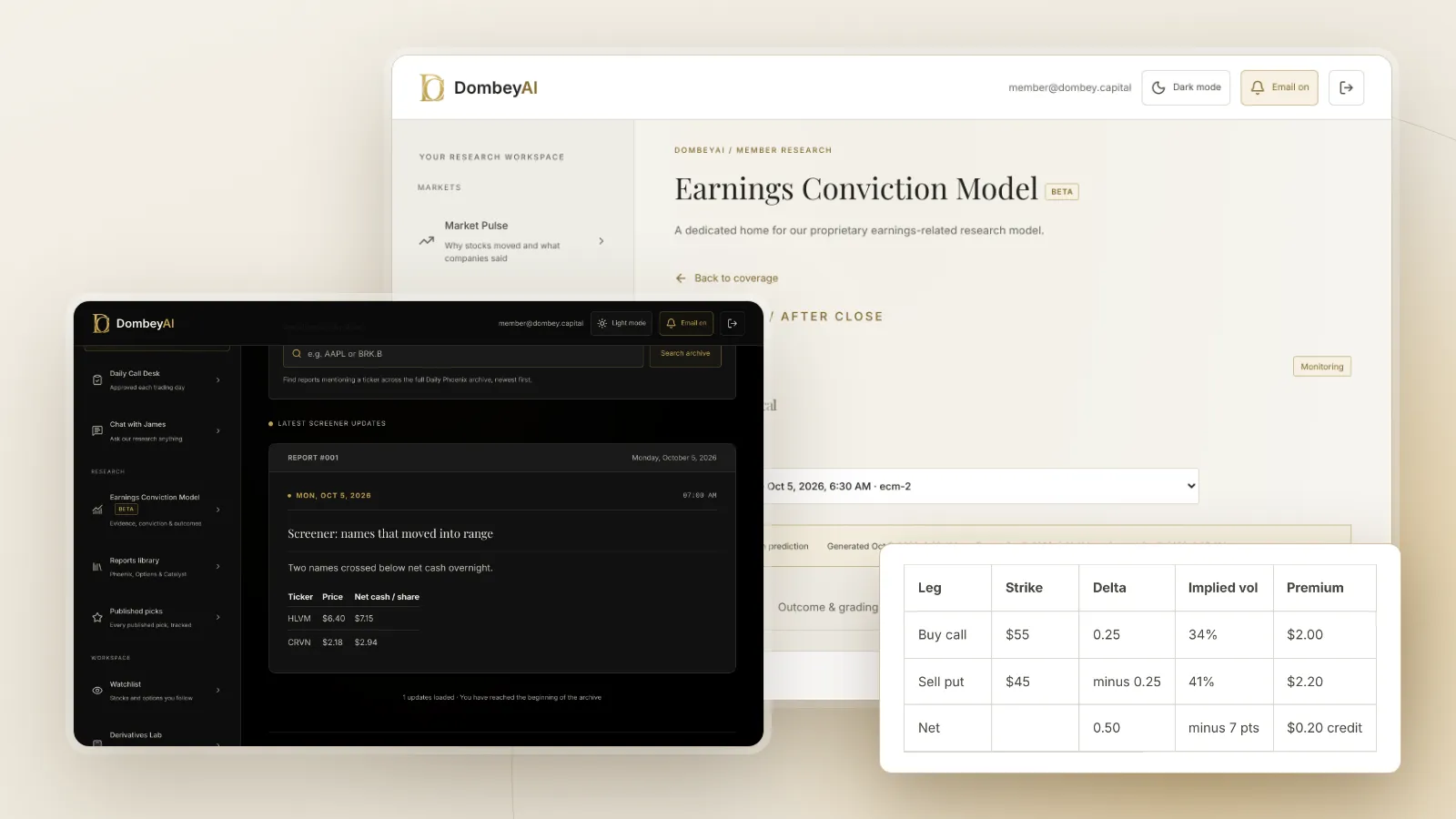
Take a stock at $50. A bullish risk reversal might buy the $55 call and sell the $45 put. The premium received for the put pays for some or all of the call. If the stock rises above $55, the call gains. If it falls below $45, the short put loses, much as owning the stock would. Between the strikes, little happens except time passing.
The bearish version buys the $45 put and sells the $55 call. Held against shares you already own, that is a collar: it caps the gain and floors the loss. Held without shares, it is a bet that the stock falls, with an uncovered short call on the other side.
The second meaning comes from currency markets, where dealers quote skew as a risk reversal: the implied volatility of a 25-delta call minus that of a 25-delta put. A reading of minus 6 means puts trade at 6 volatility points more than equally distant calls. Our explainer on options skew covers the shape of the curve in more detail.
Real examples
| Market | How the risk reversal appears | What it usually shows |
|---|---|---|
| Currency options | Dealers quote 25-delta and 10-delta risk reversals for each currency pair and tenor | Which currency the market pays more to protect against |
| US stock indexes | Puts below the index trade at higher implied volatility than calls above it, a pattern that has persisted since the 1987 crash | A negative risk reversal, demand for crash protection |
| Cboe SKEW Index | Cboe publishes an index built from S&P 500 out-of-the-money options prices | How heavily the market prices a large downside move |
| Executive hedging | Insiders and large holders use zero-cost collars, a bearish risk reversal against stock, and disclose them in proxy statements and Form 4 filings | Locking in a range without selling shares |
| Agricultural options | Grain options often show call skew in growing season, when weather can push prices sharply higher | A positive risk reversal |

These are patterns, not rules. The sign and size of the risk reversal change with the market and the calendar.
How the position pays off
The table below shows the bullish risk reversal from above at expiry. The figures are illustrative: Company A trades at $50, the $55 call costs $2.00 and the $45 put brings in $2.20, for a net credit of $0.20 per share.
| Stock at expiry | Call value | Short put value | Net, per share |
|---|---|---|---|
| $35 | $0 | minus $10.00 | minus $9.80 |
| $45 | $0 | $0 | plus $0.20 |
| $50 | $0 | $0 | plus $0.20 |
| $55 | $0 | $0 | plus $0.20 |
| $65 | $10.00 | $0 | plus $10.20 |
Multiply by 100 for one contract on each side. Three features stand out. The position is close to free to open. It does nothing in the middle range. And outside the strikes it behaves like stock: up a dollar for every dollar above $55, down a dollar for every dollar below $45.
Reading the risk reversal as a skew measure
As a quote, the risk reversal compresses the shape of the volatility smile into one number. It tells you which tail the market prices more heavily.
- If puts trade richer than calls, the market fears a sharp fall more than a sharp rise. This is the normal state for indexes and many large stocks.
- If calls trade richer than puts, the market prices a jump higher. You see this in takeover candidates, heavily shorted stocks and some biotech names before a readout.
- If the gap widens quickly, someone is paying up for one side. That can reflect hedging demand rather than a forecast.
Delta-based quotes help comparison. A 25-delta option sits roughly where the market sees about a one-in-four chance of finishing in the money, so a 25-delta risk reversal compares like with like across stocks and expiries. Our guide to implied volatility explains the inputs, and implied probabilities from option prices shows how the same prices hint at the odds of each outcome.
Why the two options do not cancel
Put-call parity ties calls and puts at the same strike, but a risk reversal uses different strikes. Its price depends on how implied volatility differs between them. That is why a risk reversal is a skew trade as well as a direction trade.
The Greeks make this concrete. Long a 25-delta call and short a 25-delta put gives a combined delta of about 0.50: half the exposure of 100 shares. Vega is roughly neutral when the two options carry similar vega. The position's value then moves with the gap between call and put volatility, which traders call skew exposure. Our primer on the option Greeks covers delta and vega, and put-call parity explains why a call and put at the same strike stay linked.
Using risk reversals around a catalyst
A dated event changes both the size and the shape of option prices. Before an FDA decision, a court ruling or a merger vote, implied volatility rises and skew often tilts toward the outcome the market fears most.
Three questions help before using a risk reversal into an event:
- If the stock gaps through the short strike, can you hold the resulting position, or meet the margin call?
- If skew is extreme, is it extreme for a reason the filings explain, such as a known binary outcome?
- If the event is a deal with a fixed price, does the upside even exist above the offer?
Our guide on choosing a strike and expiry for a catalyst walks through expiry choice in detail. For live examples of how single stocks move around events, see the Dombey market pages.
Where this goes wrong
The short option is the trade. A zero-cost risk reversal looks cheap, but the short put carries most of the downside of owning the stock below its strike. In a gap down, the loss arrives overnight with no chance to adjust.
Skew can be right. Puts often trade rich because downside moves really are larger. Selling them because they "look expensive" is a bet that the market overprices the tail, and sometimes it does not.
Early assignment. American-style short options can be assigned before expiry, especially deep in the money or ahead of a dividend. You can end up owning or short the shares sooner than planned.
Liquidity. Out-of-the-money options on small caps can have wide spreads. Crossing two spreads to open and two to close can cost more than the skew you meant to capture.
Deal stocks. In a cash takeover, upside above the offer price is limited unless a higher bid arrives, so a bullish risk reversal can carry the full downside of a deal break with little real upside.
The bottom line
A risk reversal pairs a long out-of-the-money option with a short one on the other side, and it also names the standard quote for skew. As a trade, it is close to free to open and behaves like stock outside the strikes, so the short option deserves most of your attention. As a measure, it shows which tail the market fears. Read it before any trade around a dated event, and size the position for the gap you could not hedge.