

A short definition
Every put has four terms:
- Underlying. The stock, ETF or index the contract is on.
- Strike price. The price at which the holder can sell.
- Expiration. The last day the right exists.
- Premium. The price of the contract, quoted per share.
A standard US equity option covers 100 shares. A put quoted at $2.00 costs $200 per contract before fees, and gives the right to sell 100 shares at the strike.
Real contract types
Puts trade on many underlyings, and the contract terms differ in ways that matter. These are the main listed types in the US.
| Contract | Exercise style | Settlement | What to know |
|---|---|---|---|
| Standard equity puts | American: exercisable any time before expiration | Physical: 100 shares change hands | The most common type; early assignment is possible for sellers |
| ETF puts | American | Physical | Work like equity puts on a fund's shares |
| SPX index puts (Cboe) | European: exercisable only at expiration | Cash: no shares change hands | Settled in cash against the index value |
| Weekly puts | Same as the underlying's standard contract | Same as the standard contract | Short-dated expirations, popular around earnings |
| LEAPS puts | American for equity LEAPS | Physical for equity LEAPS | Long-dated, with expirations more than a year out; see what LEAPS options are |
The Options Clearing Corporation guarantees listed contracts and publishes the standard risk disclosure that brokers must give before approving options trading.
How a put's payoff works
At expiration, a put is worth the strike minus the stock price, if that is positive, and zero otherwise. The buyer's profit is that value minus the premium paid.
| Stock at expiration | Put value per share | Profit or loss per contract |
|---|---|---|
| $55 | $0 | -$150 |
| $45 | $0 | -$150 |
| $43.50 | $1.50 | $0 (breakeven) |
| $40 | $5.00 | +$350 |
| $30 | $15.00 | +$1,350 |
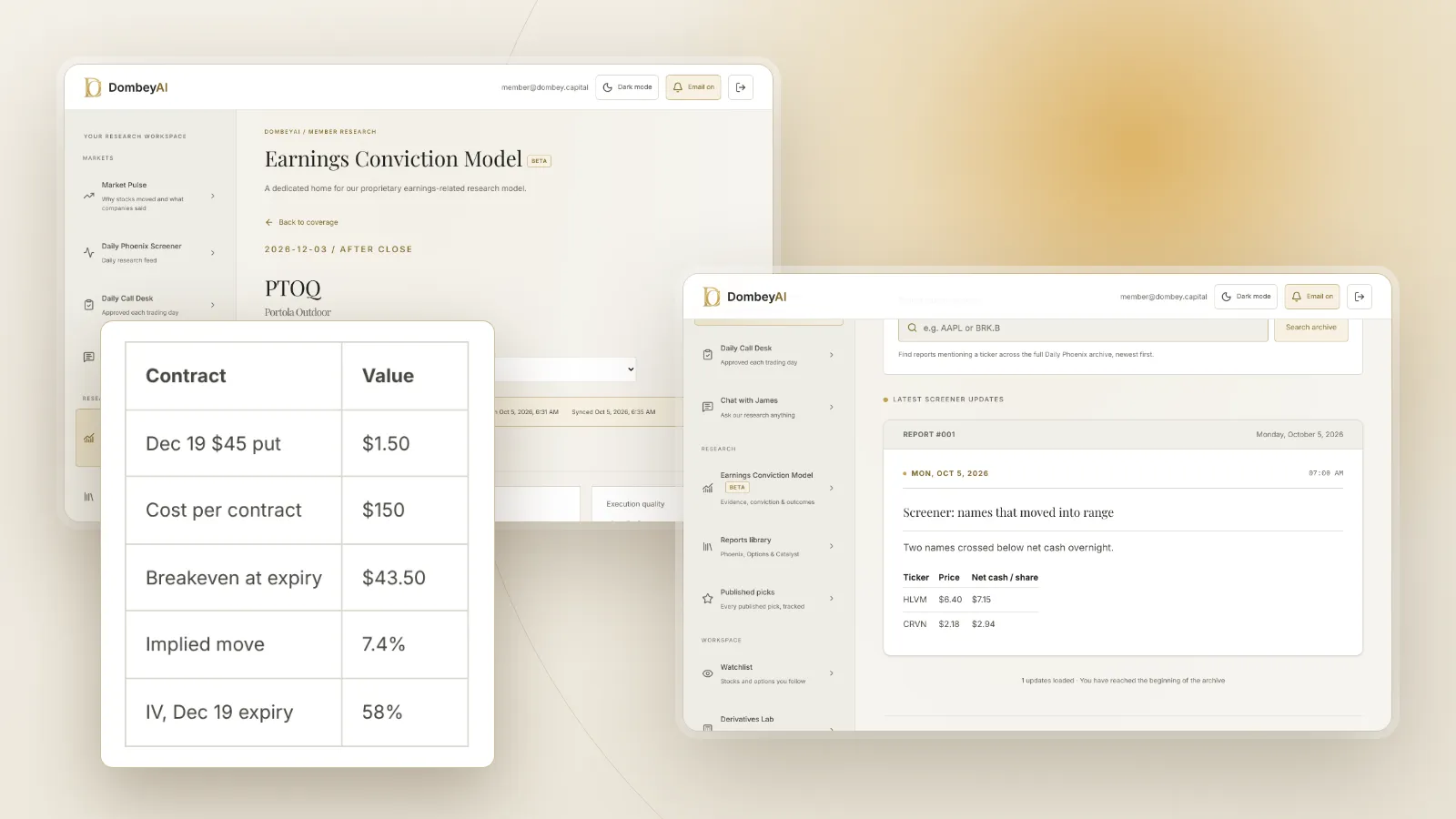
The breakeven is the strike minus the premium: $45 minus $1.50, or $43.50. The maximum loss is the $150 premium. The maximum gain is reached if the stock goes to zero: $45 minus $1.50, times 100, or $4,350.
The seller's results are the mirror image. The seller keeps $150 if the stock stays above $45, and loses money below $43.50, up to $4,350 if the stock goes to zero.
What sets the price of a put
Before expiration, a put's premium has two parts: intrinsic value and time value. Intrinsic value is how far the put is in the money: a $45 put on a $40 stock has $5 of intrinsic value. Everything else is time value. The terms for where the strike sits relative to the stock are covered in option moneyness.
Time value depends on:
- Time to expiration. More time means more chance of a move, so more value. Time value decays as expiration approaches.
- Implied volatility. The market's estimate of how much the stock will move. Higher implied volatility makes puts more expensive. See what implied volatility is.
- Interest rates and dividends. Smaller effects. Higher rates lower put prices slightly; an expected dividend raises them, because the stock drops by the dividend on the ex-date.
The sensitivities to each input are the option Greeks. For a put, delta is negative: the put gains value as the stock falls. The link between put and call prices on the same strike is set out in put-call parity.
Why investors buy and sell puts
Puts serve different purposes depending on which side of the contract you take.
- If you own the stock and want to cap the downside, a bought put sets a floor at the strike. This is a protective put, and it works like insurance with a premium.
- If you expect the stock to fall and want a defined maximum loss, a bought put gives downside exposure without the unlimited risk of a short sale. The trade-offs are covered in buying puts vs shorting stock.
- If you are willing to own the stock at a lower price, selling a put collects premium in exchange for the obligation to buy at the strike. Holding enough cash to cover that obligation is a cash-secured put.
Puts around a catalyst
Before a dated event, such as an earnings report, a court ruling or a drug approval, implied volatility usually rises. Puts and calls both become more expensive. After the event, implied volatility usually falls sharply. This is IV crush, and it means a put bought before the event can lose money even if the stock falls, when the move is smaller than the market priced.
The practical check is to compare the move the options imply with the move you expect. The guide on how to read an option chain shows where to find the implied move. Our market coverage shows how real stocks moved through their catalysts.
Choosing a strike and expiration
Most of the decisions in buying a put come down to two choices.
Strike. An at-the-money put costs more but starts gaining value as soon as the stock falls. An out-of-the-money put is cheaper but needs a larger fall before it pays at expiration. A deep in-the-money put behaves much like a short position in the stock, with most of its price made up of intrinsic value.
Expiration. A short-dated put is cheaper in dollars but loses time value fastest, and it leaves no room if the expected fall comes late. A longer-dated put costs more but gives the view time to play out. Around a dated event, the usual rule is to choose an expiration after the event, with enough margin for delays.
- If the event date is fixed and soon, a put expiring shortly after it keeps the cost of time low.
- If the timing is uncertain, a later expiration reduces the risk of being right too late.
- If the aim is insurance on a holding, the strike sets the floor and the premium is the cost of that floor.
The guide on how to choose an option strike and expiry for a catalyst works through these trade-offs step by step.
Where this goes wrong
The most common mistakes with puts:
- Ignoring the cost of time. A put loses time value every day. A correct view that arrives after expiration earns nothing.
- Buying expensive volatility. Paying for a large implied move before an event leaves little room for profit if the move is ordinary.
- Forgetting the multiplier. A $2.00 quote is $200 per contract. Ten contracts on a $2.00 put is $2,000 at risk.
- Selling puts without the cash or the conviction. A short put can be assigned. If the stock falls far below the strike, the seller buys shares worth much less than they paid.
- Overlooking liquidity. Wide bid-ask spreads on thinly traded contracts can cost more than the expected edge.
- Missing early assignment and expiration rules. American-style puts can be assigned early, especially deep in the money. Brokers set their own cut-off times for exercise instructions on expiration day. See what happens when options expire.
The bottom line
A put option is the right to sell an underlying at the strike price until expiration, bought for a premium. The buyer's loss is limited to that premium and the gain grows as the stock falls below the breakeven; the seller collects the premium and takes on the obligation to buy. Put prices depend on time and implied volatility as well as the stock price, which is why puts bought before a catalyst are expensive. Know the contract type, the breakeven and the cost of time before using one.