

A short definition
Every option has an expiration date. On that date it trades for one last session, and anyone trading it then is trading a 0DTE contract. For decades, that happened mostly on the third Friday of each month. The growth of weekly and then daily expirations means same-day contracts are now available every weekday on the major index products.
0DTE is a description, not a product. A Wednesday SPX option traded on Monday is a two-day option. The same contract traded on Wednesday is a 0DTE option.
Real milestones
| When | What changed | Why it matters |
|---|---|---|
| 2005 | Cboe introduced weekly options on SPX | Expirations no longer only monthly |
| 2016 | Cboe added Wednesday and then Monday SPX expirations | Three expirations a week |
| 2022 | Cboe added Tuesday and Thursday SPX expirations | An SPX expiration every trading day |
| 2022 | Daily expirations followed on SPY and QQQ options | Same-day contracts on the most traded ETFs |
| 2023 onward | Cboe reported that same-day contracts made up a large share of SPX volume, at times around half | 0DTE became a central part of index options trading |

The pattern is steady growth in the number of expirations, followed by trading moving to the nearest one. Exact volume shares change month to month; Cboe publishes them in its market statistics.
How same-day pricing works
An option's price is intrinsic value plus time value. With a month to go, time value is a large share of an at-the-money option's price. With a few hours left, it is small, and it falls quickly through the session.
The Greeks behave differently at the end. The option Greeks explain each one; the same-day versions are extreme.
- Theta is large relative to the option's price. An at-the-money option can lose most of its remaining time value in the last hours.
- Gamma is very high near the strike. Delta can swing from 0.2 to 0.8 on a modest move, so the option behaves like a switch.
- Vega is small in dollar terms, because there is little time for volatility to matter. But the implied volatility quoted on same-day options can move a lot.
Pin risk also matters. When the underlying sits near a strike at the close, the holder may not know whether the option will finish in the money. For cash-settled SPX this is a pricing question; for SPY and QQQ it decides whether shares are delivered.
Why event days matter
A same-day option prices the risk of one session. When a scheduled event falls on that day, such as a Federal Reserve decision, an employment report or a CPI release, the option's price includes the market's view of how much that event could move the index.
You can read the expected move the same way as for an earnings report: the at-the-money straddle price divided by the underlying price gives a rough implied move. What a straddle is and weekly options and event risk cover the method. After the event, implied volatility drops sharply, the same effect as IV crush after earnings.
For single stocks, daily expirations are rare. Most stocks with listed weeklies expire only on Fridays. A stock that reports earnings on Thursday after the close has its nearest weekly expiring Friday, one day later, which is the closest equivalent to a same-day event trade.
How time decay runs through the day
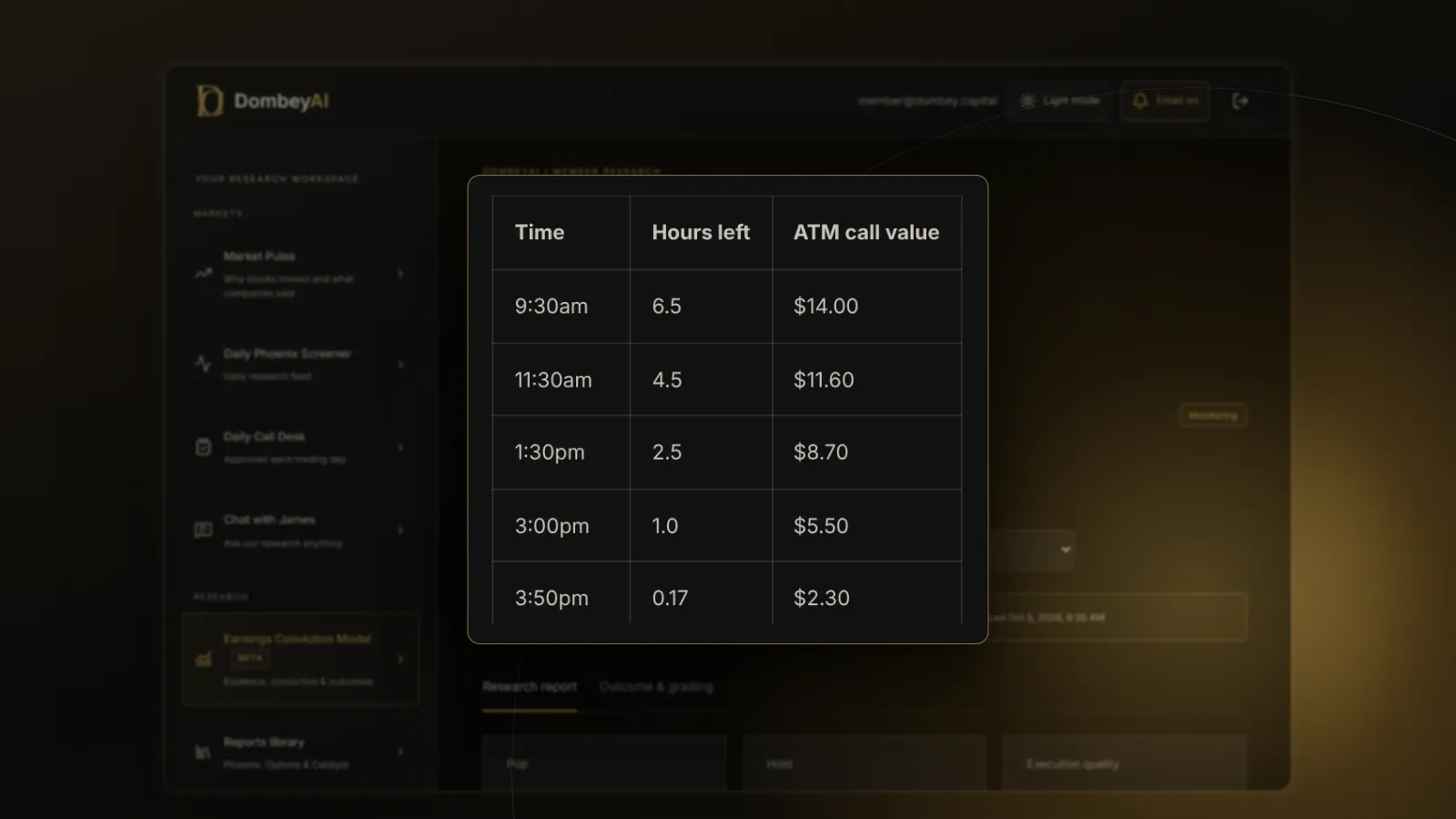
Time decay is not even through an expiry session. With hours left, an at-the-money option loses value faster as the close approaches, because each remaining hour is a larger share of the time left.
| Time | Hours to close | Illustrative at-the-money call value | Share of the morning value left |
|---|---|---|---|
| 9:30am | 6.5 | $14.00 | 100% |
| 11:30am | 4.5 | $11.60 | 83% |
| 1:30pm | 2.5 | $8.70 | 62% |
| 3:00pm | 1.0 | $5.50 | 39% |
| 3:50pm | 0.17 | $2.30 | 16% |
The figures are illustrative and assume the underlying stays exactly at the strike and implied volatility stays flat. In practice both move. The pattern follows from option pricing: time value scales roughly with the square root of time left, so the last hour holds far less value than the first.
Two consequences follow. A holder of a same-day option needs the move to happen soon, because waiting costs more each hour. A seller collects most of the decay in the afternoon, which is also when gamma is highest and a late move does the most damage. Realized vs implied volatility explains why the outcome depends on whether the session moves more or less than the option priced.
Settlement and style
Settlement terms differ by product, and they matter on the last day.
| Product | Style | Settlement | Last-day point |
|---|---|---|---|
| SPX daily options | European | Cash, to the closing index value | No early exercise, no shares delivered |
| SPY options | American | Physical, in ETF shares | Assignment can deliver shares overnight |
| QQQ options | American | Physical, in ETF shares | Same as SPY |
| Single-stock weeklies | American | Physical, in shares | Exercise and assignment after the close |
Physically settled options that finish in the money are generally exercised automatically under clearing rules. A trader who holds a short option into the close can find a stock position in the account the next morning. What happens when options expire explains exercise and assignment.
Where this goes wrong
- Cheap is not low risk. A same-day option can cost a few dollars and still go to zero in an hour. Position size matters more than premium per contract.
- Selling for small premiums. Selling same-day options collects small amounts most days and can lose many multiples of that on a sharp move.
- Liquidity late in the day. Spreads can widen in the final minutes. Options liquidity and wide spreads covers why that distorts prices.
- Event timing. A data release before the open moves the underlying before same-day options can be traded. The option then prices what is left of the session, not the event itself.
- Confusing products. SPX and SPY options look alike but settle differently. Mixing them up changes the risk on expiry day.
Same-day options and catalysts
For event-driven investors, the main use of same-day pricing is information. The straddle on an event day shows what the market expects from that event. Comparing it with what actually happened, across many events, shows whether the market tends to overprice or underprice a type of catalyst. Dated events and their market moves are tracked in Dombey's market coverage.
The bottom line
0DTE options are ordinary options traded on their last day. Daily expirations on SPX, SPY and QQQ mean they exist every weekday, and they now account for a large share of index options volume. With little time value and extreme gamma, they move sharply on small changes and on scheduled events. Know the settlement terms, size positions for the possibility of total loss, and treat same-day prices as a measure of event risk rather than a shortcut to it.