

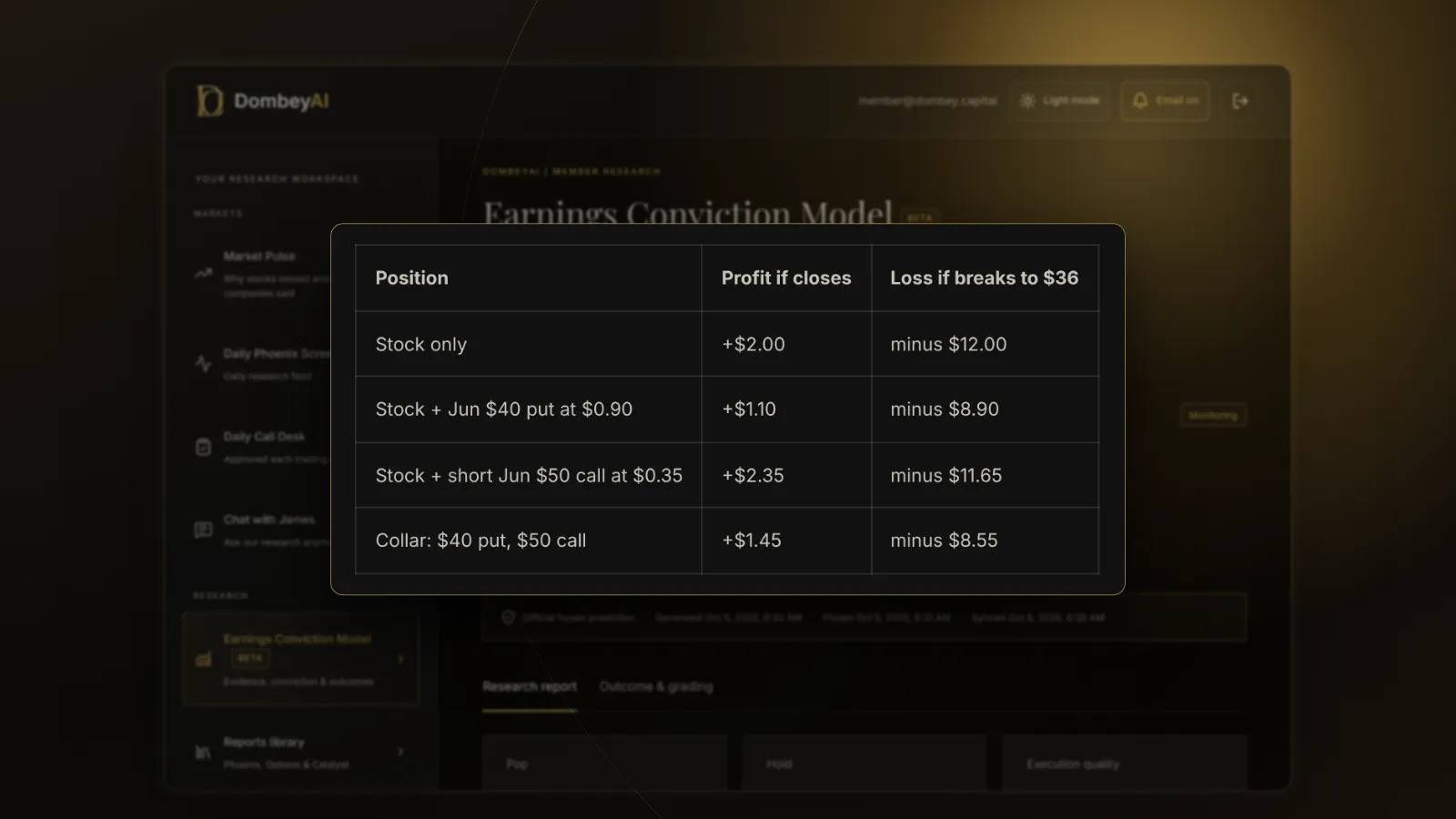
The payoff that options are trying to fix
A plain merger arbitrage position in a cash deal is long the target after the announcement, at a price below the offer. If the deal closes, you earn the spread. If it breaks, the stock usually falls toward its undisturbed price, the level before the deal was announced, and sometimes below it.
That 6 to 1 ratio is the core of the strategy and its main danger. The arithmetic of the spread is in our guide on how to calculate a merger arbitrage spread. Options give you ways to trade some of that $2 for less exposure to the $12.
What happens to the target's options after an announcement
Once a cash deal is announced, the target's stock trades close to the offer price and moves little. Its options change accordingly:
- Implied volatility collapses for strikes near and above the offer price, because the stock is not expected to move much.
- Out-of-the-money puts keep value. Puts struck below the current price, near the undisturbed level, carry the market's estimate of a break.
- Calls above the offer price keep some value if traders see a chance of a higher bid.
- Liquidity often falls. Open interest shifts and spreads widen relative to small premiums.
The pattern in put prices is a direct read on deal risk. Our explainers on options skew and implied probabilities from option prices show how to turn those prices into rough break odds.
Four ways to use options in a deal
| Strategy | Position | What it does | What it costs |
|---|---|---|---|
| Protective put | Long target, long target puts | Caps the loss on a break | Premium, often a large share of the spread |
| Covered call | Long target, short target calls at or above the offer | Earns premium on capped upside | Gives up gains from a higher bid |
| Collar | Long target, long puts, short calls | Narrows the range of outcomes at low net cost | Both of the above, in smaller doses |
| Calls instead of stock | Long target calls, no stock | Limits capital at risk to the premium | Pays time value; can expire before closing |
Protective puts
Buying a put on the target struck near the undisturbed price limits the break loss to the gap between the current price and the strike, plus the premium. Our explainer on the protective put covers the basic trade.
In the Company A example, a put struck at $40 expiring after the expected closing might cost $0.90. If the deal closes, the profit falls from $2.00 to $1.10. If it breaks and the stock goes to $36, the loss is $8 to the strike plus $0.90 of premium, $8.90 instead of $12. The hedge cut the downside by about a quarter and the upside by almost half. Whether that is worthwhile depends on how likely you think a break is. The figures are illustrative.
Covered calls
Selling calls struck at or just above the offer price earns premium on upside the deal already caps. If the deal closes at $50, a $50 call expires worthless or is assigned at $50, and the premium adds to the spread. The cost is a competing bid: if a rival offers $56, the short calls cap the gain. Read the merger agreement's deal protection terms, such as any go-shop period and break fee, to judge how likely a topping bid is. Our explainer on covered calls around catalysts covers the assignment risk.
Collars
A collar sells a call and buys a put, using the call premium to pay for some of the put. In a deal, calls at the offer price are often cheap because the market expects little upside, so the collar usually costs more than it would on a stock that trades freely. It still narrows outcomes, which can matter for a large position.
Calls instead of stock
Buying calls on the target instead of the stock limits the capital at risk to the premium. The catch is time value: calls must outlast the regulatory timeline, and if closing slips past expiry, the position has to be rolled at a cost. This structure fits deals with a short, clear path to closing more than those facing a long antitrust review.
Options in stock-for-stock deals
In a stock deal, the classic hedge is to buy the target and short the acquirer in proportion to the exchange ratio. Options can help in three cases:
- The acquirer is hard to borrow. Buying puts on the acquirer, or a synthetic short through a long put and short call at the same strike, can replace a short sale when borrow is scarce or costly.
- The deal has a collar on the exchange ratio. Inside the collar the target's value moves with the acquirer; outside it, the value is fixed. Options on the acquirer can match that shape more closely than a straight short.
- You want break protection on both legs. If the deal breaks, the target falls and the acquirer often rises, which hurts both legs of the classic hedge. Calls on the acquirer can offset part of that.
Hedge ratios must follow the merger agreement's terms. Our guide on how to read a merger agreement shows where the exchange ratio, collar and adjustment terms sit.
Holding options through closing
When the deal closes, listed options on the target do not simply disappear. The Options Clearing Corporation adjusts them so they deliver the deal consideration: cash in a cash deal, acquirer shares in a stock deal, or a mix. In-the-money options in a cash deal settle for intrinsic value with no time value left, so holders of long calls can lose the remaining time value if they wait. Short calls in the money become likely to be assigned early as closing nears. Our explainer on what happens to options when a company is acquired covers the adjustment memos and the timing.
Merger timelines and the stocks moving around them are part of what our market coverage follows day to day.
Where this goes wrong
- The hedge costs more than the spread. Puts priced for a meaningful break risk can consume most of a thin spread. Run the numbers at the ask, not the midpoint.
- The expiry comes before the closing. Regulatory reviews run long. A put that expires before a second request is resolved protects nothing when it matters.
- The stock falls past the undisturbed price. Broken deals can send targets below their pre-deal price if the market learns something bad in the process. A strike set at the undisturbed level may not cover the full fall. See deal breaks.
- Short calls meet a topping bid. Selling calls in a situation with an active go-shop or an interested rival invites the one outcome that hurts.
- Liquidity is thin. Wide spreads on target options can make the hedge expensive to put on and to remove.
- Adjusted contracts surprise you. After a deal is amended or closes, the deliverable changes. Read the OCC memo for the new terms.
The bottom line
Merger arbitrage risks a large loss to earn a small spread, and options let you trade part of that spread for less risk. Puts on the target limit the break loss, calls sold near the offer earn premium on capped upside, collars combine the two, and options on the acquirer can hedge stock deals when borrowing is hard. Every hedge costs something, so price it at the ask, match its expiry to a realistic closing date, and check what the options will deliver if the deal closes.