

The two definitions
Both are forms of free cash flow, but they answer different questions.
FCFF asks: how much cash does the business produce, regardless of how it is financed?
FCFF = EBIT × (1 − tax rate) + depreciation and amortization − capital expenditures − increase in net working capital
FCFE asks: how much of that cash could be paid to shareholders?
FCFE = FCFF − interest expense × (1 − tax rate) + net borrowing
Net borrowing is new debt issued minus debt repaid. When a company borrows, FCFE rises that year; when it repays, FCFE falls.
You can also start from the cash flow statement. Cash flow from operations minus capital expenditures, plus net borrowing, is FCFE. Add back after-tax interest to operating cash flow before subtracting capital expenditures and you have FCFF. Our guide on how to read a cash flow statement shows where each line sits.
Side by side
| Feature | FCFF | FCFE |
|---|---|---|
| Belongs to | Lenders and shareholders | Shareholders only |
| Interest | Not deducted (after-tax interest added back) | Deducted |
| Debt issued or repaid | Ignored | Included |
| Discount rate | WACC | Cost of equity |
| Present value gives | Enterprise value | Equity value |
| To get equity value | Subtract net debt and other claims | Already equity |
| Best for | High or changing leverage, LBOs, restructurings | Banks, insurers, stable leverage |
| Sensitive to | Capital structure assumed in WACC | Borrowing forecast |
The discount rate follows the cash flow. FCFF belongs to everyone who funded the business, so it is discounted at their blended required return, the weighted average cost of capital. FCFE belongs to shareholders, so it is discounted at the cost of equity alone.
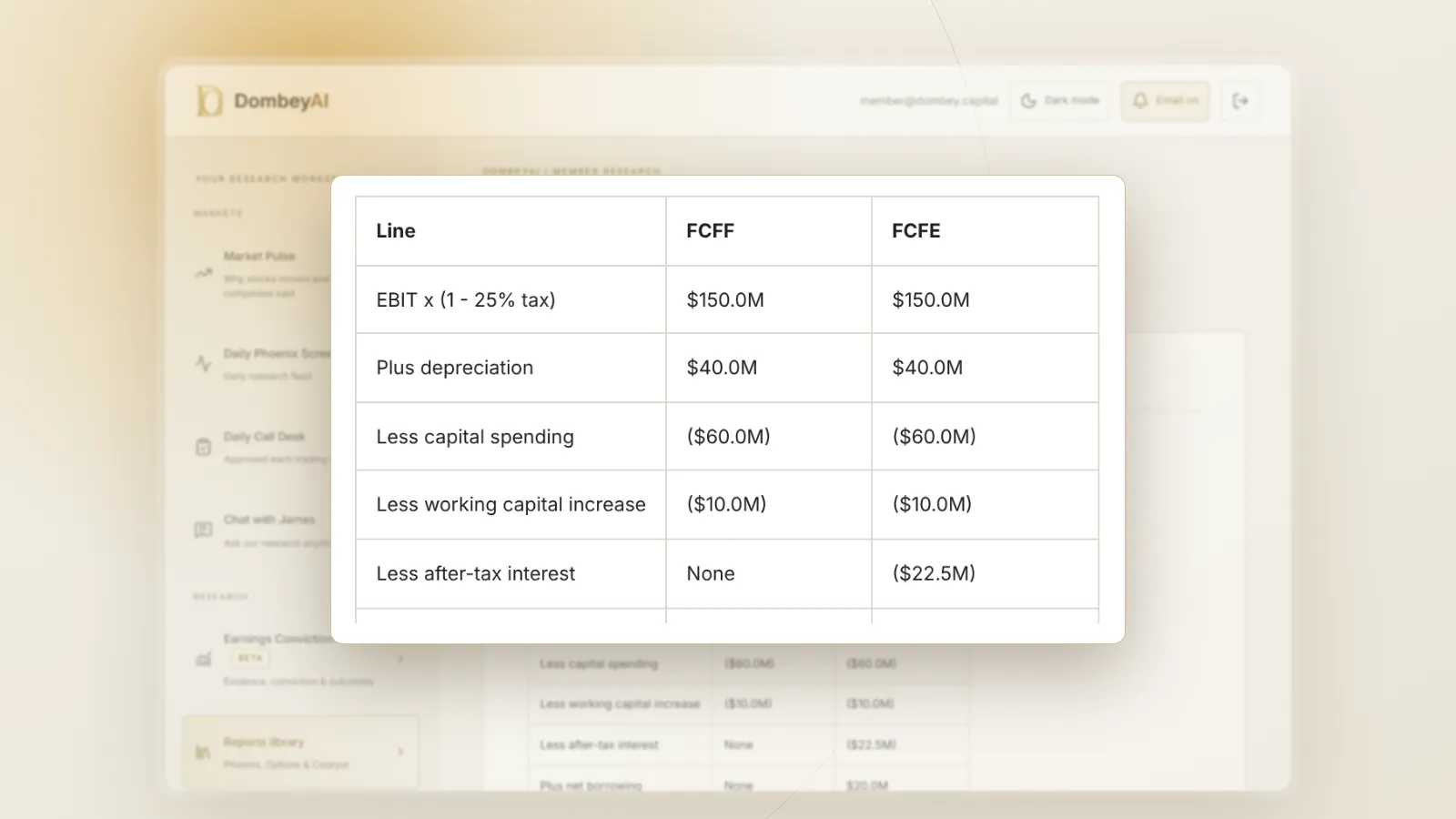
A worked example
The two routes land within about 1.5% of each other because the borrowing plan, the rates and the debt level were chosen to be roughly consistent. Change one without the others and the gap widens. The growth formula used here is the Gordon growth form of terminal value.
When to use FCFF
FCFF is the standard choice for most operating companies, and it is the better tool when:
- Leverage is changing. A company paying down debt after an acquisition, or one being restructured, has FCFE that swings with each repayment. FCFF stays tied to operations.
- Leverage is high. Small errors in the debt forecast become large errors in FCFE when debt is large relative to equity.
- You want to compare businesses. FCFF and enterprise value strip out financing choices, which makes companies with different balance sheets easier to compare, as in enterprise value multiples.
- The question is what the business is worth. In a sale, a spin-off or a sum-of-the-parts, buyers value the business and then deal with the debt.
When to use FCFE
FCFE fits when financing is part of the business, or when leverage is stable enough to forecast easily:
- Banks and insurers. Deposits and policy reserves are raw material, not financing. Our guides on valuing a bank stock and valuing an insurance company use equity-based methods for this reason.
- Stable capital structures. A utility or a mature company that keeps leverage at a steady target produces predictable FCFE.
- Payout analysis. FCFE is the cash that could fund dividends and buybacks. Comparing it with what the company actually pays shows whether payouts are covered.
How they link to other cash flow measures
Free cash flow appears under many names, and they are not all the same.
- Reported "free cash flow" in company releases is usually cash flow from operations minus capital expenditures. That is close to FCFE before net borrowing, and after interest.
- Unlevered free cash flow is another name for FCFF.
- Levered free cash flow is usually FCFE, though some sources exclude net borrowing.
- Owner earnings, the measure described in what owner earnings are, is close to FCFE with maintenance capital spending only.
When you see a free cash flow yield, check which numerator and denominator it uses: FCFF should be divided by enterprise value and FCFE by market capitalization.
Building both from the cash flow statement
In practice, most investors build the two measures from the cash flow statement rather than from EBIT.
- Start with cash flow from operations. It already reflects taxes paid, interest paid (under US GAAP, interest paid sits in operating cash flow) and changes in working capital.
- Subtract capital expenditures from the investing section. The result is the free cash flow most companies report.
- For FCFE, add net borrowing from the financing section: debt issued minus debt repaid.
- For FCFF, instead add back interest paid times one minus the tax rate to the free cash flow from step 2.
Check the supplemental disclosures for interest paid and taxes paid, which are usually listed at the bottom of the statement or in a note. If the company capitalizes interest or has large leases, decide how to treat them before comparing years.
Where this goes wrong
- Mismatched rates. Discounting FCFE at WACC overstates value; discounting FCFF at the cost of equity understates it.
- Borrowing to inflate FCFE. A forecast that borrows every year raises FCFE but also raises leverage, which should raise the cost of equity. Forecasts that ignore that link overstate value.
- Forgetting other claims. From FCFF, subtracting only net debt misses leases, pensions, preferred stock and minority interests.
- Treating stock compensation as free. Both measures add back non-cash stock compensation when built from operating cash flow. If the shares are a real cost, adjust for the dilution.
- One-time working capital swings. A big inventory release can inflate one year's free cash flow. Normalize before projecting.
- Using the wrong tax. FCFF should use taxes as if the company had no debt; the tax benefit of interest belongs in the WACC.
Most data platforms in our list of the best stock research tools for individual investors report a single free cash flow figure; few show both forms, so you will usually build them from the cash flow statement. A discounted cash flow model can then use whichever fits the company.
The bottom line
FCFF is cash from the business before financing, discounted at WACC to get enterprise value. FCFE is cash for shareholders after debt payments and borrowing, discounted at the cost of equity to get equity value. Use FCFF for most operating companies and whenever leverage is high or changing, and FCFE for financial companies and stable capital structures. Keep the cash flow, the discount rate and the borrowing plan consistent, and the two methods should arrive at similar answers.