

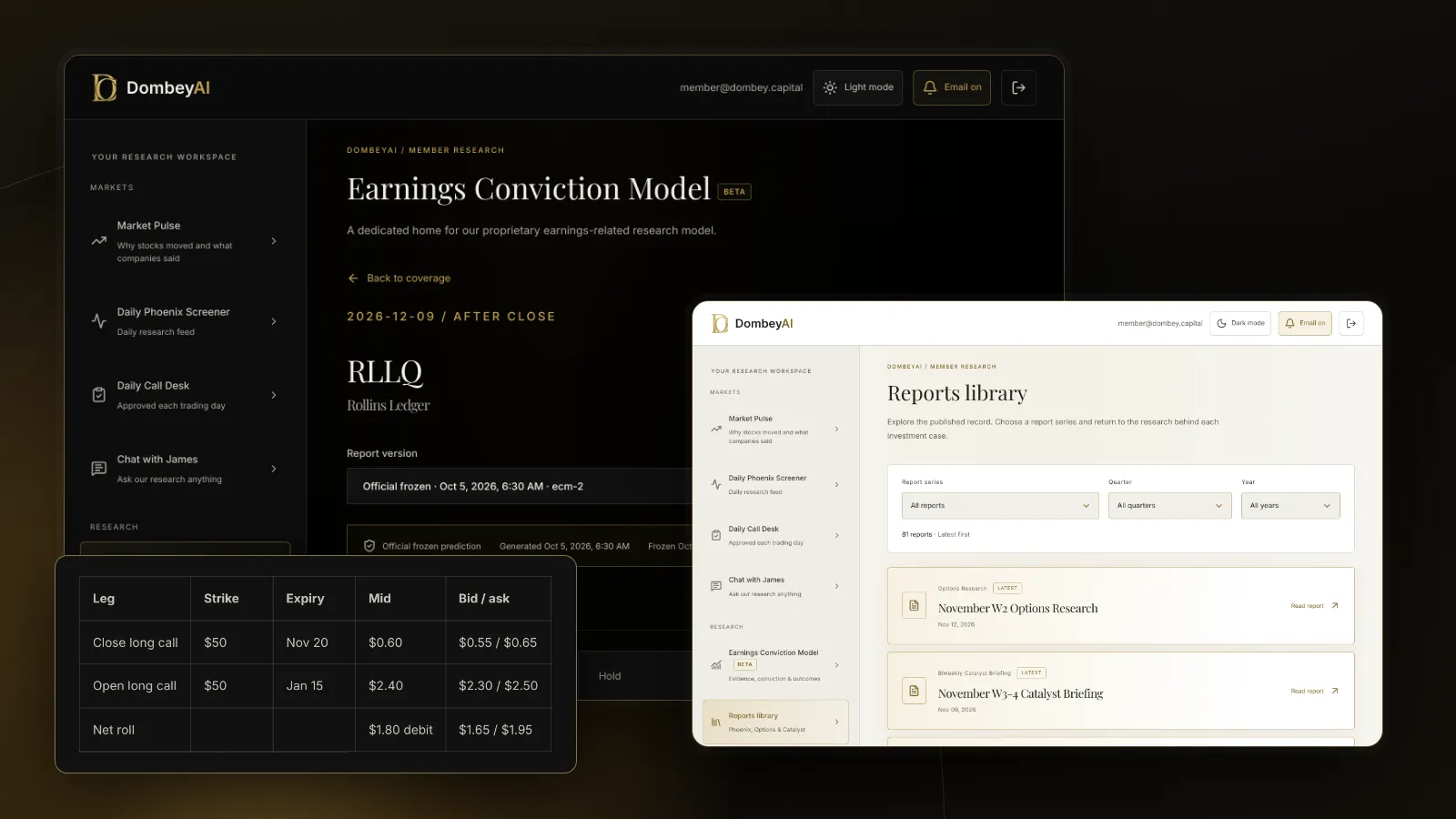
What a roll actually is
A roll has two legs that execute together:
- Close the existing contract. For a long option this means selling it; for a short option it means buying it back. Either way, the profit or loss on that contract is now realized.
- Open a replacement contract. Same underlying, same direction (long or short), new expiry, strike, or both.
Brokers usually let you enter both legs as a single calendar, vertical or diagonal spread order, so you are filled at one net price rather than taking two separate fills. That net price is the cost or proceeds of the roll.
The point that matters most: after the roll you hold a new position. It has its own break-even, its own time decay and its own risk. The fact that it grew out of an older trade gives it no special standing.
The three directions of a roll
| Roll | What changes | Typical net price | Common reason |
|---|---|---|---|
| Out | Later expiration, same strike | Credit for short options, debit for long options | Catalyst moved later, thesis intact |
| Up | Higher strike, same expiry | Depends on position | Stock rose; reset a short call or take profit on a long call |
| Down | Lower strike, same expiry | Depends on position | Stock fell; reset a short put or long put |
| Up and out | Higher strike and later expiry | Often near even for short calls | Short call tested by a rising stock |
| Down and out | Lower strike and later expiry | Often near even for short puts | Short put tested by a falling stock |
Rolling out adds time value. A later option on the same strike almost always costs more than a nearer one, so a short seller collects a credit and a long holder pays a debit. Changing the strike moves intrinsic value from one side to the other, which is why a roll up and out on a short call can often be done for a small credit or small debit.
How to price a roll
The net price of a roll is the new option's price minus the old option's price, with the signs set by your position. Four numbers decide whether it is worth doing:
- Net credit or debit. What the roll costs or pays today.
- New break-even. For a long call, the new strike plus the total premium paid across both contracts, if you treat the trade as one campaign. For a fair view, also check the new contract's break-even on its own.
- Time value bought or sold. Rolling out extends exposure. A long holder pays for more theta; a short seller takes on more of it, and more time for the stock to move against them.
- Implied volatility of each leg. If the new expiry spans an earnings report, a deal vote or a court date, its implied volatility will be higher. See the volatility term structure for how event months price differently from quiet ones.
Use the mid price of each leg to estimate a fair net price, then check the bid and ask. A roll that looks cheap at the mid can be expensive at the natural price if either leg is thinly traded. Our explainer on options liquidity shows how wide spreads distort what an option seems to cost.
In that example the question is not "how do I recover the $1.40". It is whether a two-month $50 call at $2.40 is a sensible way to express the strategic review thesis today. If it is, the roll is fine. If not, closing the position and taking the loss is the cleaner choice.
When rolling fits a catalyst position
Rolls are most defensible when the position was built around a dated event and the date moved. Common cases:
- A deal timeline slips. A merger awaiting regulatory approval gets a second request, or a closing date moves out a quarter. If you held options sized for the original date, rolling out keeps the exposure through the new date. Our guide to tracking a merger through approval covers where those dates come from.
- An earnings date changes. A company moves its report outside your expiry. Our piece on earnings date changes explains what a delay can signal, which is worth reading before paying for more time.
- A tender offer is extended. Extensions are common. Rolling a covered call or protective put into the new window keeps the hedge aligned.
- A short option is tested but the view holds. A covered call writer whose stock rose through the strike may roll up and out to keep the shares, if the higher strike and later date still match the intent.
Each case has the same structure: the event still matters, only the date or price level changed. Dated moves in individual stocks, and what drove them, are covered on Dombey's market pages. Matching expiry to event is covered in how to choose a strike and expiry for a catalyst.
Decision guide
- If the thesis is unchanged and only the date moved, roll out to the first expiry that comfortably covers the new date.
- If the thesis has weakened, close the position rather than rolling it.
- If the stock moved through a short strike and you no longer want the obligation at any price, close it instead of rolling up or down.
- If the new expiry spans an event you did not plan for, price that event separately before rolling into it.
- If the roll can only be done at a wide natural price, consider waiting for better quotes or closing outright.
- If you find yourself rolling the same position a third time, step back and treat it as a new decision.
Rolling short options
Short option sellers roll most often, because a short option has a clear failure point: the stock moves through the strike and assignment risk rises.
Rolling a short put down and out, for example, can turn an at-risk position into one with a lower strike and more time, often for a small credit. That credit is real income, but it comes with a cost. The seller now carries the obligation for longer, through more possible events, and with the stock already trending the wrong way. A string of small credits can end in a large loss if the stock keeps falling.
The same logic applies to covered calls. Rolling up and out to avoid having shares called away keeps the shares, but if the stock keeps rising each roll may need a debit, and the upside you hoped to keep can be smaller than it looks. Our piece on covered calls around catalysts covers the specific risks when an event sits inside the expiry.
Early assignment is also a risk. American-style equity options can be exercised at any time, and short calls are most at risk just before an ex-dividend date when the remaining time value is less than the dividend. Our explainer on what happens when options expire covers exercise, assignment and the expiration-day mechanics.
Where this goes wrong
Rolling is a useful tool, and it is also the most common way options traders turn small losses into large ones. The usual failure patterns:
- Rolling to avoid a realized loss. The loss on the closed contract is real. Rolling only moves new money into the same idea.
- Rolling into an event without pricing it. A later expiry that now covers earnings will have higher implied volatility. After the report, IV crush can take much of that value even if the stock moves.
- Ignoring the cumulative cost. Each debit roll raises the total spent. Track the campaign total alongside each leg so the full cost stays visible.
- Letting a short position grow. Rolling a short option for a credit while increasing the number of contracts raises the size of the bet at the point the market is already against it.
- Forgetting liquidity. Later expiries and far strikes are often thinner. A roll that can only be done at the natural price can cost more than the position is worth.
- Waiting too long. In the final days, gamma is high and quotes can move quickly. Pin risk near the strike at expiration adds uncertainty about assignment.
Common mistakes
- Treating the roll as one trade. It is two: a closed position with a result, and a new position with its own risk.
- Using the original entry price as the anchor. The market does not know what you paid. Judge the new position on today's prices.
- Rolling on a fixed schedule. Rolling every month regardless of the thesis turns a judgment into a habit.
- Not checking the event calendar. A new expiry can quietly span a report, a vote or a ruling.
- Missing the tax effect. In a taxable account, closing the first leg is a taxable event, and wash sale and straddle rules can apply.
The bottom line
A roll closes one option and opens another, usually in a single spread order. It realizes the result on the first contract and creates a new position that should stand on its own. Rolling fits best when a dated catalyst moved and the thesis is intact, and fits worst when it is used to avoid recognizing a loss. Price every roll as if it were a new trade, check the events the new expiry spans, and keep the campaign total in view.